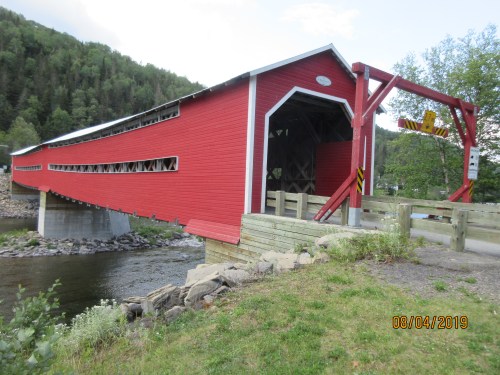
Dave walked along the west (left) side of the stream here in the wrong direction

He should have been walking this direction on the east side


Dave walked along the west (left) side of the stream here in the wrong direction

He should have been walking this direction on the east side

Filed under Uncategorized

Isle d’Orleans at High Tide
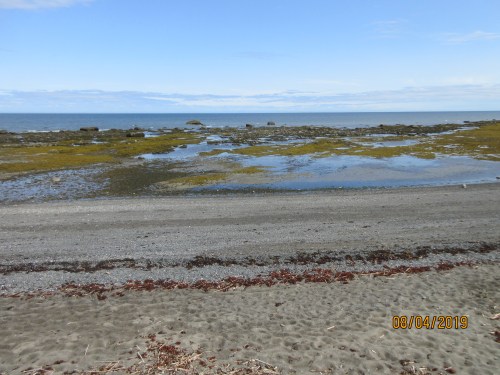
In the morning, Dave sat by the St Lawrence with Isle d’Orleans in the background and could also see Québec City in the distance. Then the water started to receed and he was surprised to see the tide going out this far from the Atlantic. Majestic.

The Charlevoix tourist region of Quebec extends from roughly Quebec City to past the Saguenay River along the north shore of the St Lawrence River. It includes rolling terrain, fjords, headlands and bays. Named after a Jesuit missionary, it is home to Canada’s first resort community – La Malbaie. It is teaming with art stores, music festivals, luxury inns and gourmet food. In winter there is some of the best skiing in Canada. We had heard a lot about the area and were looking forward to seeing it.
We took a leisurely drive to Baie-St-Paul after climbing to 740m and descending again. We went to the local laiterie (cheese factory store) for lunch enjoying some fresh baguette, paté and fresh cheeses, yum. Stopping at Gite des Petits Messanges, Nicole told us that it was already full for the night. We had a reservation for the following night.

We contented ourselves with walking down the streets of Baie-St-Paul lined with boutiques, art stores and restaurants. Très joli mais trop de gens pour nous. We drove down to the beach and luckily found a room in a lovely auberge. Great pizza dinner after wine and snacks with live music. Another superb day came to an end.


Baie-St-Paul
Next morning we enjoyed the buffet breakfast of exquisite cheeses, quiche, fruit, breads and charcuterie. Then we went to the nearby Baie-St-Paul beach for a few hours. This was not before Dave had a dip in the pool at the auberge next door and we walked a nice trail.


After a light lunch we did some shopping and headed for the Gite des Petits Messanges. Nicole was most friendly and gave us an upgraded room with a queen bed. She agreed the room had been prepaid for and said that she does not get paid by Expedia until we leave. Hence it was Expedia who had charged us the full amount for the room in advance, contrary to their online offer. They had blamed this pre-charge error on Nicole when I disputed it. Enough said.
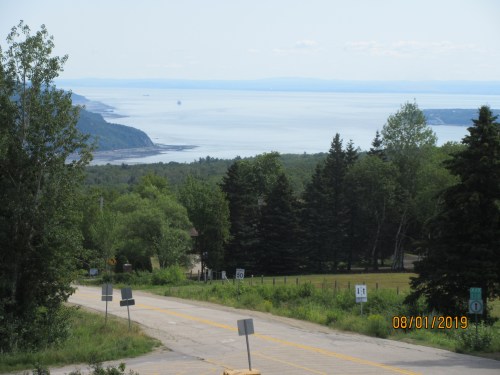
We slept reasonably well after a great dinner of salad and Italian poutine at the brasserie in town. Up and at it the next day we drove to the ferry crossing at St Simeon. Beautiful views of the St Lawrence. We waited about 2 hrs and caught the ferry to Riviere de Loup on the south shore. It is amazing how many cars they pack in. Then the fun began.

Leaving Charlevoix
When we arrived in Rimouski, pop. 50,000, every room in town was completely taken due to various festivals, construction workers holidays, etc. So we drove 20 km further to Sainte Luce and stopped at Julie’s Motel et Casse-Croute.
Julie was talking with 2 women as I entered but said she did have a room available. So we all drove in a convoy a bit further down the road to see a lovely restored house. We were 3rd in line as she showed the rooms to all of us. Meanwhile her cell phone was ringing constantly. Her standard question was “Combien de personnes etes-vous?” Then she would invite even more people to come and see the 4 rooms that she had available.

The first lady made her selection of the room that we wanted but then changed her mind as there was no private bathroom. The 2nd lady then chose the same room but Julie wanted a bit extra for her kids. She left. Finally we got to choose the nice sunny room. As we were finalizing the terms she kept saying in French to Marie and elbowing her, “Hey he speaks French eh.” about me. Then her cell phone would ring and “Combien de personnes etes-vous?”. We laughed so hard at this good natured lady multi-tasking with a friendly smile and a laugh.

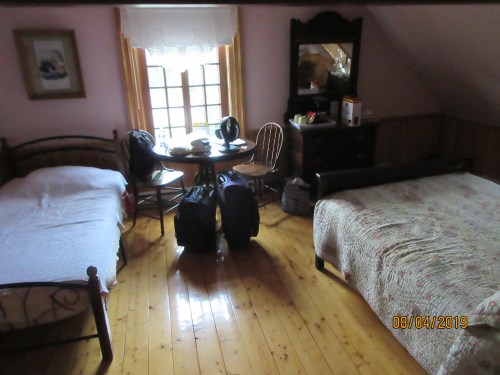
The prized sunny room we finally got
So we spent a delightful evening there including another great meal at a very crowded bistro by the beach nearby. Phew, another few great days here in Quebec!

Filed under Uncategorized

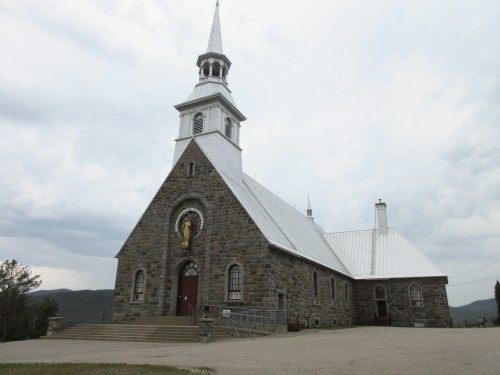
We did a little last minute shopping before we left Montreal and then drove to Trois-Rivières. “The country side is steeped with steeples”, Marie remarked. Everywhere we go in Quebec we see a steeple on the skyline, often more than one at a time. This is living evidence of the great religious hold the Catholic Church had on the people of Quebec. For the most part, these beautiful stone structures are still in good shape. Many though have already been closed, deconsecrated and turned into museums, concert halls or community centres.
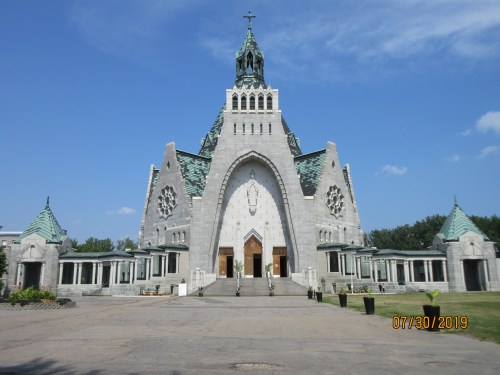
Our goal in visiting Trois-Rivières was to see Canada’s national shrine to the Virgin Mary, Notre Dame du Cap. It is administered by the Oblates of Mary Immaculate founded by St Eugene de Mazenod. As we drove into the eastern suburb, previously called Cap de la Madeleine, surprisingly there were no street signs directing us to the shrine. We passed a large boarded up church with gaping broken windows, not a good sign we thought. Finally we found Sanctuaire Notre Dame du Cap as it is called en francais. It consists of a large church, an historic stone chapel, outdoor Stations of the Cross, lovely gardens, pathways, an RV park and Oblate residences. They have thousands of pilgrims each year, ongoing youth rallies and special events year round.

Sanctuaire Notre Dame du Cap
We walked around the beautiful gardens and buildings and then met with Fr Bernard Menard, OMI for a little chat. He said there are at least a dozen Oblates working there. He is originally from Ottawa and had been very involved with Novalis and L’Arche in his long career. He told us about meeting Fr Jack Lau, OMI several years ago when Jack was considering coming to Canada from the U.S.. (It was Fr Jack who drew us to Galilee and Arnprior after we retired.) Then he blessed us. It was a special moment for us as Oblate lay Associates. Thank you again Fr. Bernard!

We then drove about an hour east looking for accommodation and suddenly saw a sign for Auberge du Manoir Dauth. The place initially looked deserted we thought but actually was quite busy. It was a magnificent, peaceful and comfortable place to stay which we thoroughly enjoyed. Hosts Bridgitte and Christian made us feel very welcome. They served us a great breakfast – gourmet porridge, crepes, fruit, eggs, bacon before warmly bidding us to come back. Wow! 5 star place, highly recommended.
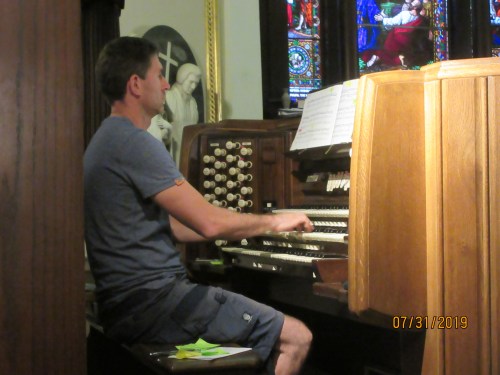
Next day we drove to Québec City and found a parking spot right near the Chateau Frontenac. We walked around taking photos of everything in the warm sunshine. We went to the Anglican Cathedral and heard a short organ concert. A little shopping and then lunch in the shade. We got out of town quickly and continued on our way to Ste Anne de Beaupré.

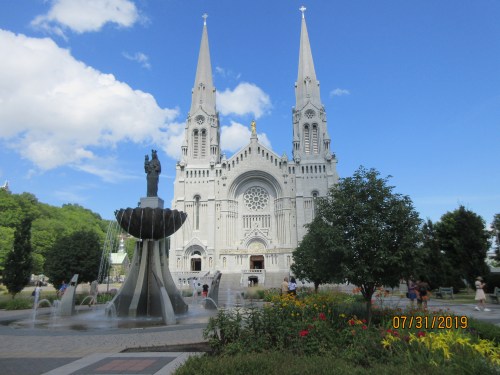
Ste Anne de Beaupré is the national shrine for Ste Anne, Mary’s mother and the patron saint of Québec. It is administered by the Redemptorists Religious Order founded by St Alphonsus Ligouri. We caught the English Mass in one of the most beautiful churches we have ever been in. This shrine is a real pilgrimage attraction and well maintained. Still it was not crowded. We relaxed a bit outside as we gazed at the impressive exterior of the church. We decided to stay nearby and found a nice little motel, though the room was tiny. We had a nice steak dinner after a most enjoyable day.

Sanctuaire Ste Anne de Beaupré
Sadly many of these shrines and churches may not last much longer. There is a shortage of young priests and religious to animate them. There is a shortage of young parishioners to support them. The next 10 years will see thousands of such properties shuttered across Canada. We are so lucky to experience them now in all their glory. We can’t imagine the sacrifices our ancestors and religious community members made to build and maintain them. Thanks be to God for giving us a glimpse of his great glory through our pilgrimage to these great national shrines.

Filed under Uncategorized

We slept well and then walked around Old Montreal for 5 hours in the heat. Notice I now have a neck strap for my sunglasses. We saw Montreal beach, the ferris wheel, Notre Dame de Bon Secour and Notre Dame Cathedral, which was the highlight. We had lunch at the highly recommended Olive et Gourmando bistro. Artisan breads, olive oil, salads and gourmet sandwiches. After a little shopping we went back for a rest.


Olive et Gourmando

Aesop Essential Oils
That evening we walked west along rue de la Gauchetiere through China town and then back to Old Montreal. We found it was a bit too far and got a little tired. We wanted to go to Auberge St Gabriel to have Brome Lake duckling a l’orange, but alas it was no longer on the menu. We settled for a casual outdoor restaurant a block off Place Jacques Cartier. The duck leg I had for dinner was great and Marie had a tasty duck salad. Not sure if it was from Brome Lake. Exhausted, we headed back to our Airbnb and fell into bed, very satisfied with a great Old Montreal experience.


Yum!
By the way if you are wondering where we stayed here is a link to the Airbnb. Host David was so gracious, accommodating and full of recommendations. He wanted to know why we had come and how he could help. Highly recommend this location on rue de l’Hotel de Ville for a great little get away. We hope to go back next year during Jazz Fest.
P.S. After we got home, our local No Frills store had Brome Lake duck on sale. Our friend Irene alerted us and is going to show us how to cook it – right here in Old Arnprior lol. Thanks Irene!
P.P.S. Another reason we were tired is we walked back and forth several blocks several times looking for Pierre Le Moyne d’Iberville’s family home which we never found. Sorry Marie! Since arriving home, Lime scooters have arrived in Montreal. Dave enjoyed these in Mexico and they are now starting up in Canada.
Filed under Uncategorized
This is the first of a series of postings on our recent Quebec-New Brunswick road trip.
For sometime now we have wanted to go back to Montreal and visit some old haunts. Well this was the year. We drove to Montreal stopping first at 6815 Sherbrooke Street W (near Cavendish) to see Dave’s grandmother’s apartment building. Nana as we called her, lived here from about 1954 to 84. Dave has fond memories of visiting her here as a child. I can still smell the clean soapy smell of her apartment and that particular musty smell of the lobby as you entered. To us Montreal was a big city then and now. I remember marvelling at the buses, the traffic and the excitement of it all. “Hatwatter” (with the accent on the last syllable) the bus drivers used to announce at Atwater Ave on our way downtown.

The balcony of the left was hers, very cool at the time.
The pedestrian tunnel under Sherbrooke to the park across the street is long gone. I remember loving at it as a kid – imagine walking under the roadway above? The big swings in the park that I so much enjoyed, have been replaced with a play structure and little kiddy swings. Trains still whistle by at one end like I recall. It is a peaceful fun place that I will always remember.

Next we drove to mom’s house on Beaconsfield Ave in NDG where she grew up and then to her church, Knox Kensington Presbyterian, a few blocks away. We then headed for Mount Royal Cemetery. Luckily I had brought the plot number and we found Papa and Nana Ward’s gravesite quickly.
Before we went to our AirB&B apt on rue Hotel de Ville, we toured St. Joseph’s Oratory. Dave forgot his sunglasses there right after the picture below was taken lol.

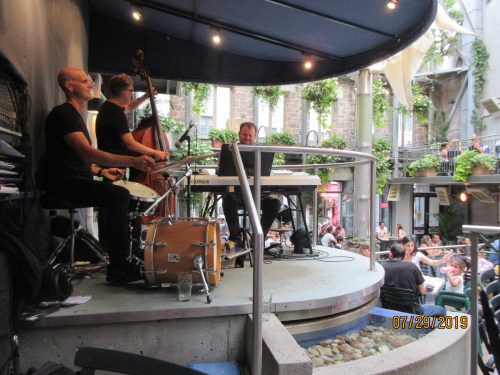
We were lucky and found found free parking on the street as host David greeted us warmly in front of the AirB&B. He was very helpful and recommended some good restaurants and sites to see. There was no A/C nor did the TV work. We had fans and as we were not there to watch TV, all was fine. That night we strolled to Old Montreal, just a few blocks away and had a great dinner of wine and nachos at Jardin Nelson, right beside the jazz trio – great!


Montreal is truly an exciting city to visit or live in. There is a cosmopolitan vibe you don’t find in many other places. This time I used my rusty French and people responded in French! The lack of French is not an impediment as nearly everyone speaks English, and many other languages too.


After a pit stop at Ben and Gerry’s in Place Jacques Cartier, we headed home for the night after a great day one!

Filed under Uncategorized
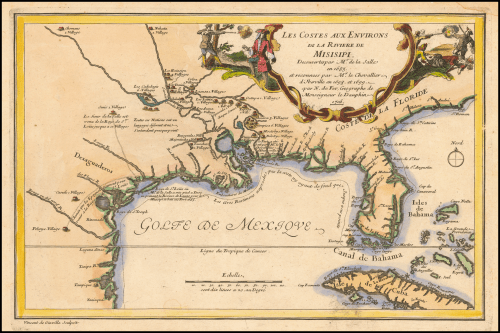
In the 1690’s, the policy of Louis IV became expansionist and aimed at hemming in the British east of the Appalachians. To secure this strategy, Pierre accepted a mission to Louisiana to find the mouth of the Mississippi River in the Gulf of Mexico and select a good site to block entry into the river by other nations. Accompanied by brother Jean-Baptiste Le Moyne de Bienville, in October 1698, he sailed with 4 vessels. After successfully locating the mouth of the Mississippi, he established a temporary fort on Biloxi Bay (Fort Maurepas, present day Ocean Springs, Miss.) and leaves a garrison of 81 including his brother Bienville in charge and returns to France.

Pierre Le Moyne d’Iberville was awarded the cross of the Order of St. Louis, the first Canadian born to receive it. In 1700 he returns to Louisiana and builds Fort Mississippi, 40 miles inland on the river. He argues for colonization of Louisiana to contain the rapid expansion of the English in the Carolinas. Adequate resources were not initially forthcoming. In a 3rd voyage, he establishes Fort Saint-Louis at Mobile (Alabama). He advocates policy to befriend the Indian tribes in the Mississippi basin by means of trade and religious missionaries in order to strengthen the French presence.

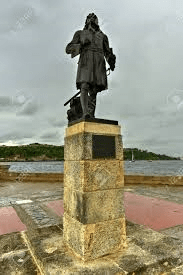
Statue of Pierre d’Iberville in Cuba
Iberville’s health is deteriorating due to malaria attacks and he writes his memoirs while back in France. In 1705 he is well enough to lead a squadron of 20 vessels to the Spice Islands of Martinique, Guadalupe and Nevis in the British West Indies. It was during this campaign of fear that accusations of fraud, illicit trade and manipulation of the King’s stores were aimed at the Pierre and his brother Serigny. In July 1706, Iberville suddenly dies while on a stopover in Havana, likely due to complications from yellow fever. He is buried in the Church of San Cristóbal (Havana Cathedral).
Pierre had married Marie-Thérèse Pollet in 1693 and had 5 children. They lived mostly in France. After Pierre’s death his great fortune was tied up in the aftermath of the “Nevis Affair”. An inquiry found him guilty of fraud and his estate was ordered to pay back 112,000 livres. Hi wife remarried and moved to Paris but this debt drained her inheritance.
I would like to finish with a quote from Bernard Pothier’s excellent on-line biography of Pierre that I have used for this mattersofthemoment series:
“However devoid of military or political consequence the career of Pierre Le Moyne d’Iberville may now appear, his achievements are nevertheless of lasting significance. Indeed Iberville’s exploits, like those of no other in New France, illustrate the physical and moral strength, the resourcefulness and adaptability that were required in some measure of the whole colonial society to survive and prosper in the exacting wilderness conditions of North America. The fierce patriotism, the bravery, even the savage cruelty, which characterized Iberville’s campaigns against the English, were to a lesser degree the qualities essential to all life and progress in early North America. In this context, Iberville is an important figure, and is beyond doubt the first truly Canadian hero.”
Postscript.
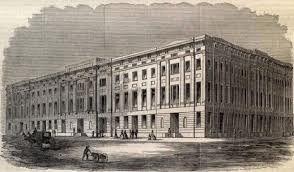
Bienville, Iberville’s younger brother was left to govern the slow growing Louisiana colony. In the spring of 1718, he founded New Orleans which becomes its capital. It was named after Philippe II, Duke of Orleans. In 1723, Governor Bienville moved into his new home in the French Quarter, in what is now the Custom House. Thus it is a Canadian born who is the founder of one of the most culturally unique cities in North America. If you google Iberville or Bienville, you will find dozens of towns, schools and communities which proudly bare these names today. This is living Canadian history folks. Thanks for reading.

Custom House, New Orleans
Filed under Uncategorized

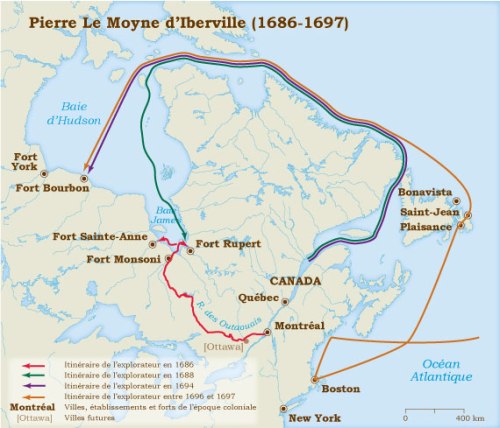
We left the Canadian adventurer Pierre Le Moyne d’Iberville in France getting ready for the 1692 season of war against the English in New France. It was not to be. The two ships he was given were required to escort a supply convoy to New France and arrived in Quebec too late to make the voyage to Hudson Bay before ice would set in. The same thing happened in 1693. Finally, in 1694, Pierre was appointed commander of an expedition force to remove the British from York Fort in Hudson’s Bay; his life long goal.
Setting sail from La Rochelle, the shrewd 36 year old agrees to pay the crew’s wages and cover their supplies. In exchange, the French crown provides the vessels and military supplies and grants Iberville a monopoly of trade in Hudson’s Bay until 1697. The directors of the Compagnie du Nord are outraged at these generous terms afforded Pierre. However, they had not contributed adequate resources leading to previous failure, feels Pierre. He agrees to share all booty and profits with his men.
Arriving at the mouth of the Hayes River on Sept 24, he lands a party to reconnoitre York Fort and begins preparation for a long winter siege. In October, he summons the English to surrender and surprisingly, they do. Though well supplied with men, heavy cannon, food, and trade goods, governor Thomas Walsh had neglected to lay in firewood, ignoring earlier warnings of an impending French attack. That winter, there was much hardship and scurvy takes the lives of many Englishmen, French sailors and Canadians too. In the late spring of 1695, York Fort, now renamed Fort Bourbon, is left in charge of the French and Iberville returns to France. During his campaign there, the Indians had brought 450 canoe loads of rich pelts to trade.
Iberville had finally captured the Hudson Bay Company’s most lucrative station and his own star shone more brightly than ever. He sets his sights on further adventure. In 1696 Iberville sets out from France with 3 vessels to attack English stations along the Atlantic coast from the New England – Acadia boundary north to St John’s Newfoundland. Iberville quickly routes 2 defensive frigates at the mouth of the St John River. He then besieged Fort William Henry, 200 miles west of St John with 25 regulars from Acadia and 240 Abenakis. The English fort capitulated as soon as the French set up their batteries on Aug 15.
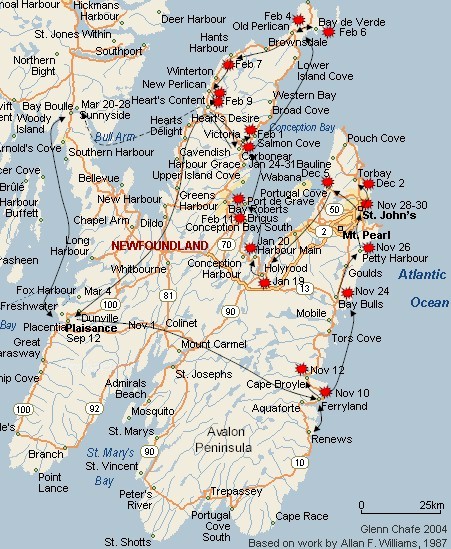
Iberville than sailed to Placentia (Plaisance), the French capital of Newfoundland, determined to route the English from the island. It is to be one of his most daring, ingenious and cruelest campaigns ever. Iberville marches his men across the Avalon Peninsula (this had never been done before by a military force) and proceeds to attack station after station, killing, looting and utterly destroying the fishing settlements of the English. There is an excellent detailed story of his campaign worth a read here. It is truly a gruesome result. 36 settlements are destroyed, 200 persons are killed, 700 are taken prisoner. Thousands of pounds of cod are taken and marketed by Iberville and others. It was not to be for long though as immediately following his departure, an English squadron and 2000 troops land in St John’s to induce the survivors to return and rebuild their settlements.

Le Pélican 2
Meanwhile, the English have reestablished themselves in Hudson’s Bay. Iberville joins a squadron from France heading there led by his brother Serigny. Iberville’s lead ship, the Pelican with 44 guns, becomes separated from the others in the fog. He is attacked by 3 English war ships – the Hampshire 56 guns, the Dering 36 guns and the Hudson’s Bay 32 guns. Iberville engages in a duel, carries out brilliant naval manoeuvres and sinks the Hampshire. The Hudson’s Bay is captured and sinks. Iberville’s vessel the Pelican is severely damaged and abandoned. His men regroup in a camp near York Fort and the next day the 3 remaining French vessels arrive. After 5 days of light skirmishing, York Fort is surrendered to the French for a second time. This had been Iberville’s swiftest and most brilliant campaign.
Iberville managed to have his monopoly at Fort Bourbon extended to 1699. Returning to France in 1697, the hero of Hudson Bay was about to be drawn into an entirely new theatre of adventure: Louisiana, which was henceforth to play an important role in France’s revised imperial designs. Conclusion of this riveting Canadian history will follow next time.
(Source material http://www.biographi.ca/)
Filed under Uncategorized


It was men like the Le Moyne brothers, especially Pierre d’Iberville, inspired by the endurance, techniques and cruelty of the Indians, who adopted similar guerilla warfare techniques by becoming even more ruthless in their lightning attacks on the English. This integration with Indian culture, fierceness and technique prolonged the survival of New France until 1760 against much superior English odds.
In 1689 the population of New France numbered 14,000. It’s territory consisted of Acadia on the Atlantic coast, Canada along the St Lawrence River and Great Lakes and Louisiana from the Great Lakes to the Gulf of Mexico along the Mississippi River. It controlled such a vast territory by allying itself with dozens of Indian tribes, by having a centralized military command structure and strategically placed defensive forts. English settlers number 154,000 (a 12 to 1 advantage) in North America in 1689. However, they are hemmed in by the French allied Indian tribes in multiple colonies along the East coast. They rely on local militia for protection and are unable to cooperate with each other efficiently. Their only major Indian allies are the Iroquois tribes of NY.
Back home in Europe, to contain Louis IV’s ambitions, England joins with the Dutch, Austria and eventually Spain and Savoy in the Nine Years War against France, known as King William’s War in North America. In August 1689, news of this having reached the English colonies first, 1500 Iroquois are emboldened to attack Lachine just outside Montreal. Many French settlers are killed (reports range from 25 to 250) and the settlement is burnt to the ground.
In retaliation, Governor Frontenac sends a force of 210 led by Pierre’s brother Jacques, with Pierre 2nd in command and another brother Francois de Bienville, to attack Corlaer (Schenectady) outside of Albany, NY in Feb 1690. They catch the town completely unawares, killing as many as 60 inhabitants, taking 25 prisoners and 50 horses back to Montreal after burning the settlement to the ground.
Pierre is rewarded with a Seigneury on Bai des Chaleurs in Gaspé but quickly disposes of the land. He is neither interested nor temperamentally suited to the life of a seigneur. Instead, that summer he returns to Hudson’s Bay with a small fleet of 3 ships, 30 guns and 80 men. The English traders at York Fort are ready for a fight and chase Iberville away with a ship of 36 guns. Pierre then attacks New Severn, an outpost, capturing it and thousands of rich pelts. He winters in James Bay before returning to Quebec and thence to France in late 1691, to prepare for the next campaign. The goal of the expulsion of the English from Hudson’s Bay was to elude him for several years to come.
(to be continued, with gratitude for source material from the Dictionary of Canadian Biography, http://www.biographi.ca/en/index.php )
Filed under Uncategorized

Pierre Le Moyne Le Sieur d’Iberville (Valliants sculptures, Ottawa)
Of all the heroes of the French Regime in Canada, this guy – Pierre Le Moyne le Sieur d’Iberville (1661-1706) is the most intriguing to me. Soldier, ship captain, explorer, trader, colonizer and adventurer – what a life he had!
The third son of Charles de Moyne, he was born in Ville-Marie (Montreal) in 1661. He eventually had two sisters and eleven brothers. His father Charles, arriving from Dieppe at the age of 15, started as an indentured servant to the Jesuit missionaries in Huronia. He moved to Ville-Marie in 1646, helping to fight off the Iroquois. He also served as a peaceful emissary to the many Indian tribes allied with the French. He eventually founds the Compagnie du Nord and becomes one of the wealthiest men in Montreal.
Pierre had an upbringing punctuated with boating on the St. Lawrence and regular church services. His military career begins in 1686 when he and two of his brothers join an expedition to route the English trader interlopers from Hudson’s Bay. You may recall the story of Radisson and Groseilliers. These two couriers du bois deserted to England after they are not allowed to keep their huge stock of high quality furs from the North because they had not been licensed for this trade. The English then agree to establish several trading posts in Hudson’s Bay in order to divert the lucrative fur trade away from New France.
After an exhausting voyage up the Ottawa River to Lake Temiskaming, the French reach James Bay and quickly route 3 English forts. D’Iberville distinguishes himself as the bravest of the brave with sword or onboard a ship. He is made governor of the three new French Forts and spends the winter of 1687 with 40 compatriots in Moose Fort in James Bay.

With the English fur trade now disrupted, D’Iberville and his men await fresh foodstuffs and supplies. When none are forthcoming by summer, he returns first to Quebec and then to France. He seeks to promote the advantages of a sea approach to the fur trade in Hudson’s Bay and to garner trade goods and support to lure more Indians away from Port Nelson, the English trading site still going strong.
In this he was successful. He takes command of the excellent escort vessel Le Soleil d’Afrique and sails her back to Quebec. Returning the James Bay, in September of 1688, two English vessels attempt to reestablish English control but are routed by D’Iberville. During the winter of 1688-89, there is much misery and bad faith on both sides and the 85 English held in limbo are no match for the fierce wilderness hardened French. 25 English die of scurvy and exposure after D’Iberville refuses their request to hunt for fresh game. His reputation as a swashbuckling privateer who gives no quarter is firmly established. His goal to expel the English from Hudson’s Bay will elude him for a few more years. Meanwhile he is recalled to Montreal for a new military campaign. His career is just starting as is the huge fortune that he will acquire.

(To be continued.)
Filed under Uncategorized

The Jesuits failed to convert the Huron to Christianity before destruction of the latter by the powerful Iroquois tribes. They did not see any good in the Huron culture or spirituality that needed saving. Instead they saw it as an obstacle to Christian conversion that must be undermined, if not destroyed. They failed to see that God was already at work in the Huron and that they too were God’s children. They accepted the failure of their mission as the will of God.
Nowadays, the missionary approach is much different. A missionary, e.g., of the Missionary Oblates of Mary Immaculate, still goes where the Church does not go. But first, they seek to walk with the people, get to know them, their problems and needs and only then, adapt the Gospel message to their culture, belief system and circumstance.
Pope John Paul II wrote in his 1990 encyclical Redemptis missio:
“The universality of salvation means that it is granted not only to those who explicitly believe in Christ and have entered the Church. Since salvation is offered to all, it must be made concretely available to all. But it is clear that today, as in the past, many people do not have an opportunity to come to know or accept the gospel revelation or to enter the Church. The social and cultural conditions in which they live do not permit this, and frequently they have been brought up in other religious traditions. For such people salvation in Christ is accessible by virtue of a grace which, while having a mysterious relationship to the Church, does not make them formally part of the Church but enlightens them in a way which is accommodated to their spiritual and material situation. This grace comes from Christ; it is the result of his Sacrifice and is communicated by the Holy Spirit. It enables each person to attain salvation through his or her free cooperation.”

So did the Jesuits accomplish anything good in Huronia? Yes, they were taking the gospel to the world which is what Christ told his apostles to do. For the greater glory of God, souls are to be saved from the fires of Hell through conversion to Christian beliefs. The cause of the Huron nation destruction was not the fault of the Jesuits, but of the warring Iroquois Confederacy who were bent on increasing commercial trade.
However Christ told his disciples (MT 10:14, MK 6:11, LK 9:5) that if any place does not welcome you or listen to you, leave that place and move on. Clearly the Jesuits did not move on in the face of obvious resistance. Instead, they sought to undermine the spiritual beliefs and practices of the Huron. Christ did not give instructions to his apostles like this. Indigenous people have human rights too.
It has been almost 30 years since George Erasmus, Chief of First Nations accused the Catholic Church of having destroyed native culture, language and traditions in Canada. As Co-chair of the 1991 Royal Commission on Aboriginal Peoples, he erupted in an an emotional tirade after a presentation by the Catholic agency, Development and Peace.
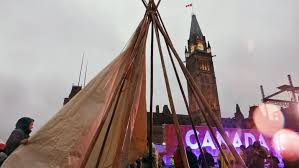
Since then we have seen many apologies from Catholic Bishops and Religious Congregations for this and other abuses that have taken place against indigenous peoples of Canada in the name of God and the Church.
Francis Jennings in The Founders of America, (1993) said that all such mission systems as the Jesuit in Huronia were intended and functioned in their various ways, to establish colonial domination over the Indians involved (p188). David Treuer in The Heartbeat of Wounded Knee (2018), says the Jesuits were not as bad as the Franciscans and Dominicans. Native American Trade Schools in the United States did a lot of good according to Treuer, an Ojibwe from Minnesota. In addition to teaching trades and language skills, natives from historically warring tribes got to know each other for the first time, realized they had common interests and decided to bury the axe.
Hence much good has come out of Jesuit and subsequent missionary work and joint Christian initiatives in Canada. Nevertheless we must not get complacent in our relationship with First Nations as the recent Truth and Reconciliation Commission and the Enquiry into Missing and Dead Indigenous Women reminds us. Many of us harbour misconceptions, misunderstandings and mistrust of our First Nations brothers and sisters, who after all, are the original peoples of Canada. Happy Canada Day!

Filed under Uncategorized
stories about English language and people in Asian communities in America and in Asia.
Blogging Faith, Life, Travel, Books and History
gehadsjourney.wordpress.com
Occasional Thoughts on Contemporary Christianities and Cultures
Follow the Journey ☩𓀙𓃦☉
A new commandment I give unto you, That ye love one another; as I have loved you ... John 13:34