Jesuits and the Huron Nation – Conclusion

As most know the story line I will paraphrase Proff. Eccles conclusion and also from Angus J. Macdougall, SJ’s excellent booklet on Brébeuf below.

Huron Wendat 2

Just as the fruits of the Jesuit mission to Huronia were bearing fruit, the menace of the Iroquois loomed larger again.  Recall that the Iroquois Confederacy, located in western NY and allied with the English colonists in Albany, sought to take over the Huron role of middlemen in the lucrative fur trade between western tribes and the colonial powers.
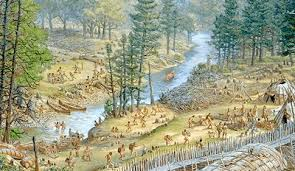
Huron-Wendat

In 1648 a 250 strong party of Huron paddled to Trois Rivieres and enroute, routed an attacking  Iroquois war party.  However while they were gone, an even stronger Iroquois war party attacked St Joseph mission and a neighbouring village in Huronia.  Of a total population of 3000, about 700 Huron were killed or captured, mostly women and children.  Fr. Antoine Daniel, SJ was killed too.

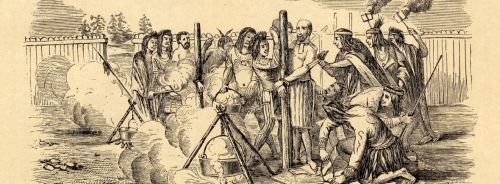
That winter was a cruel one.  Over 6000 persons took refuge in St. Marie as starvation stared them all in the face.  On March 15, 1649, a war party of some 1200 Iroquois attacked St-Ignace in complete surprise, breaching the palisade and over running the village.  After two unsuccessful attacks on nearby St-Louis, the same result occurred the next day.  Frs. Jean Brébeuf, SJ and Gabriel Lalemant, SJ who were visiting St. Louis at the time, baptised catachumens at the breach, urging the Huron to die bravely.  They themselves refusing to flee, were captured.  Both villages were burnt to the ground.

Huron Wendat 3Not far away at the fortified St.-Marie mission, the French and Huron prepared for a last stand.  300 brave Huron from La Conception sortied out and inflicted severe losses on the Iroquois before being overwhelmed by much superior numbers.  Fearing the arrival of other large Huron relief forces, the Iroquois then withdrew.  This was on March 19 which was the Feast of St. Joseph.  The French attributed their deliverance to his special protection.  St Joseph is the patron saint of Canada

Jesuits of Huronia

Frs. Brébeuf and Lalement were martyred after being gruesomely tortured.  (In 1930, they along with six of their fellow Jesuit missionaries were canonized by Pope Pius XI.)  In the weeks that followed, 15 additional Huron villages were abandoned out of fear of further Iroquois attacks.  Two months later the missionaries would burn and abandon St.-Marie, their pride and joy.  The final withdrawl of the Jesuits occurred in 1650 as the Huron nation had been destroyed.  This they sadly believed was clearly part of God’s grand design.  The Jesuits then moved further west and established a new mission on the southern shore of Lake Superior.

The Iroquois themselves having suffered severe losses, negotiated a peace treaty with the French in 1653.  The Jesuits were then allowed to establish themselves in the villages of the Five Nations.  While free to trade in both Montreal and Albany, the role of middleman eluded them, as the Ottawa Nation centered around Michilimackinac took over this role from the Huron.  Remnants of the Huron survived, dispersing to the west and south

And so ends the story of the Jesuit and Huron Nation.  You can see all this amazing history by visiting the Canadian Martyrs Shrine and the neighbouring St.-Marie Among the Huron restored village in Midland, Ontario.  Here are a few pics from our visit there a few years back.  Thank you Proff. Eccles and Fr. Macdougall, SJ for your painstaking research and analysis.

Brebeuf


1 Comment

Filed under Uncategorized

Jesuits and the Huron Nation – Part 2

Jesuit mission to HuronWe learned last time from W. J. Eccles in the The Canadian Frontier 1534-1760, that the Jesuits established themselves in missions in Huronia during the period 1632-39.  Their goal was to convert the Huron Nation, some 30,000 strong, to Christianity.

Prof Eccles continues: “The Indians found little that appealed to them in the Christian way of life.  Moreover, the attempts by the Jesuits to make them change many of their established customs did not sit well.  The Indians lived without laws and with very few restraints; each man or woman was free to live as he/she thought best, and crimes were punished by the victim or his kin, not by the collectivity.  The only restraint on action was the normal desire to be held in esteem by his/her community.

Women were the masters of their own bodies and from puberty until pregnancy they gave themselves to any male that pleased them.  To the Jesuits this was a carnal sin.  Some others of the French, the men sent by the fur trade companies to establish good trade relations, found the Indian moral standards very acceptable and took full advantage of the Indian girls lack of sexual inhibitions.  Thus when the Jesuits tried to persuade the Huron to lead chaste lives, they met a cool reception.  If chastity was such a good thing, why did all the French Christians not practice it, they asked.  To this the missionaries were hard pressed to find an answer.


Beaver WarsThe Jesuits found that before they could hope to enjoy and real success, they had to undermine the old beliefs of the Huron, and in so doing, they helped to destroy their culture.  One approach was to demonstrate that the Indians reliance on dreams to govern their future actions was inefficacious.  Once a few Huron had been converted and openly rejected the belief in dreams, and if they had as much luck in the hunt as the pagans, the latter began to doubt their old beliefs.
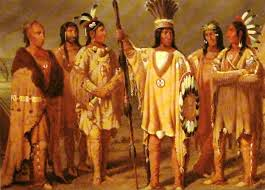

If the Huron were occasionally impressed by the efficacy of the Jesuit prayers, they were quick to blame them when something went amiss.  And amiss it did.  It appears about 15,000 Huron, many of them children, died in the 1630s when a European disease for which they had no resistance, attacked their villages.  The missionaries saw this as the work of Satan but were quick to take advantage.  Previously, they feared baptizing an Indian unless they were reasonably certain that henceforth, she/he would lead a Christian life.   The missionaries were now able to baptize the dying by the hundreds.  Because the Jesuits were blamed for the disease, they encountered more resistance than ever but took satisfaction that thousands had gone to heaven that otherwise would have been barred to them.

Beaver

No sooner had the plague run its course and began to abate, than another, and even worse disaster stuck the Huron.  The Iroquois anxious to gain more control of the fur trade, negotiated a commercial alliance and peace treaty with the Huron and French in 1645.  However they gained nothing by this accord and soon embarked on a war of extermination against the Huron.

In 1647 their sudden assaults forced the Huron to abandon some of their outlying villages and withdraw to the more populous villages near St. Marie for protection.  At or near St. Marie Mission were some 13 Huron villages.  During that year, 3,000 persons had been given shelter and food.  Converts numbered in the thousands and over 2,000 in all had been baptized; however a large number of the last had been moribund.  Attempts were made to renew the peace treaty and to arrange a military alliance with the Andastes, a fierce Iroquois Nation in the Susquehanna Valley (in NY and PA) hostile to the Five Nations Confederacy.  The Jesuits remained confident that the Iroquois assaults could be curbed and they started to see some success to their missionary efforts at last.”

Huron Indians


(To be concluded next time…)


Leave a comment

Filed under Uncategorized

Jesuits and the Huron Nation – Part 1

Canadian Frontier

We celebrate National Indigenous History Month in Canada during June: https://www.rcaanc-cirnac.gc.ca/eng/1466616436543/1534874922512

I thought I would share a few excerpts from a history book I am reading.  It concerns the first interactions of the Jesuits with the Huron Nation in New France during the first half of the 17th century.

Prof. Eccles writes:

“It was in the west in Huronia, a vast area bounded by Georgian Bay, Lakes Huron, Erie, Ontario, and Simcoe that the Jesuits concentrated their major effort to convert the natives to Christianity. The Huron, estimated to number some 30 to 35 thousand, had obtained a more advanced culture than the Algonkin nations.  Living in semi-permanent villages, they depended on agriculture for their main food supplies and traded their surplus of corn with the northern and western tribes for furs.  Between 1634 and 1639, the Jesuits established 3 missions here, the largest of which was called Ste. Marie… As many as 65 French resided there at one time, priests, lay brothers, servants, a surgeon, an apothecary, and a number of artisans…These tiny outposts separated from the settlements on the St. Lawrence by hundreds of miles of wilderness, formed a unique frontier, a frontier of the intellect.  There the products of the highly sophisticated Baroque civilization confronted the Stone Age.

Huronia map


…The Huron had a religion of their own which sufficed for their needs, and which they showed a great reluctance to abandon.  Theirs was a cruel world in which sudden death could come at any time.  In seeking to explain chance events and the phenomena of nature that affected their lives at every turn, they had developed a deep-rooted set of mystic beliefs.  For them, the natural world, inanimate objects as well as animals, were inhabited by spirits; some were benevolent, some malevolent, all had to be placated, appeased or at least acknowledged.  They believed that in their dreams they were in communication with the spirit world; thus, to dream of success in the hunt ensured it; to dream of disaster caused plans to be abandoned.  Some among them were able to induce conditions of hysteria in themselves, and in this way communicate with spirits.  These were the shamans, the wisemen, who healed the sick with simple remedies of magic, and gave advice on what action to take to cope with major problems.  They were the priests of the Huron culture. Others possessed supernatural powers but used them malevolently; these were the sorcerers, and they had to be appeased.

…One great difficulty in any attempt to understand the Huron religious beliefs was that their beliefs were passed from one generation to the next orally.  The Indians had developed a large body of myths and legends to account for the inexplicable in nature, and although some Jesuits sought to understand these beliefs, the language barrier and the desire to impose their own alien beliefs made real understanding virtually impossible.  Yet this primitive religion was intricately interwoven into the whole of Indian life and society.  The early Recollets and then the Jesuits discovered that the Indians appeared to believe in a supreme being and in an after life, hence in the immortality of the soul.  The problem than became whether these beliefs could be accepted in essence and amended in accord with Christian beliefs, or whether they had to be destroyed, eradicated, then replaced by a pure Christian creed.  Initially the Jesuits, appalled at the strange mores and practices of the Huron, sought to eradicate and impose.  As they came to understand these Indians better, they discovered how impossible such a task is so they came to accept much and seek to build on it.

…Fr. Paul Le Jeune writes in Vol. IV of the Jesuit Relations : Our lives depend upon a single thread; and if, wherever we are in the world, we are to expect death every hour and to be prepared for it.  Your cabin is only chaff that might be burned down at any moment, despite all your care to prevent accidents, the malice of the Savages gives special cause for almost perpetual fear; a malcontent may burn you down, or cleave your head open in some lonely spot.  And then you are responsible for the sterility or fecundity of the earth, under penalty of your life; you are the cause of droughts; if you cannot make rain, they speak of nothing less than making away with you.”

Huronia picture

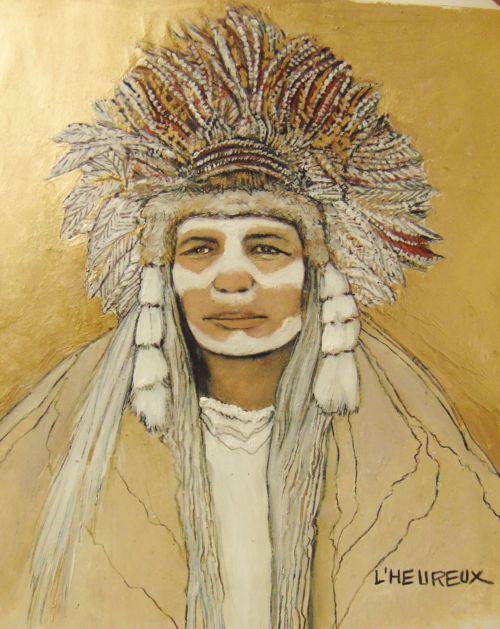
Huron Chief Nicolas Arendanki by Marianne S L’Heureux

Such was the nature of the first interactions between the Jesuit missionaries and the Huron in New France.  Proff. William J. Eccles has done a superb job in capturing this encounter.  William (1917-98) was a professor of history at the University of Toronto who wrote extensively on the French era in Canada.

To be continued.


Leave a comment

Filed under Uncategorized

The Five Iroquois Nations

This is a remarkable little book. It tells the very intimate story of the relationship between the Five Iroquois Nations of Western NY, the British and the French in 17th century colonial times. Written in 1727 and 1747 and often quoting first hand sources, makes it a very interesting  pre-confederation Canadian history read.

Covering the latter years of the Beaver Wars, 1663-1700, it starts and ends with interesting anecdotal facts:

–  the Iroquois or “longhouse people” were originally agricultural people raising corn, squash and beans, “the three sisters”.  Journeying north they were taught how to hunt and trap by the Algonquin peoples around Trois Riviere. On one of these early expeditions, the young Iroquois hunters faired very well outdoing their Algonquin hosts. In a fit of jealous rage the hosts murdered their visiting friends thus setting up a bitter war of retaliation that lasted almost 100 years.

– after peace was finally negotiated between the French and the Iroquois around 1700, there was an exchange of prisoners. Strangely enough most of the French and other native prisoners who were returned to Canada, freely chose to return to or remain with their Iroquois hosts for the rest of their days.

In between these bookends thousands of colonists, warring natives and indeed whole first nations were wiped out e.g., the Huron Nation in 1648, in an unrelenting series of attacks and brutal violence. The powerful Iroquois sought to become the middle men in the lucrative fur trade between the tribes near Lake Superior and the colonial powers in the east.  Although they greatly expanded their territory, they never quite succeeded as tribes further to the west took over once the Huron were gone..

The author spares no quarter in describing cannibalism and torture e.g., burning of prisoners alive that even the French succumbed to, to demoralize the other side. The British in Albany, always promising to come to the Iroquois aid in seeking to annihilate the French, never quite do setting the stage for the future abrogation of treaty rights that America became famous for. The Jesuits had a toe hold and counselled the Iroquois to break their relationship with the English in Albany. The Christian Mohawks in Caughnawaga near Montreal are called the “praying indians” and remained loyal to the French.

There are many detailed accounts of peace meetings between the Iroquois “sachems” or chiefs, the English and the French during which wampum belts and beaver pelts were laid down and gifted to signify honesty and commitment during negotiations. In the end. I was left with a sense of wonder and awe at the way the Five Nations conducted themselves with integrity throughout this violent period of our history.

I give it a 9 out of 10 rating and wished it were longer.


Leave a comment

Filed under Uncategorized

Honesdale, PA

IMG_20190601_155806_hdr

It almost rhymes

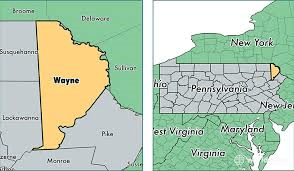
Wayne CountyWe headed to Wayne County in Pennsylvania in the heart of the Pocono Mountains on the weekend.  We stayed at the beautiful Himalayan Institute just outside of Honesdale, the county seat.  Marie was on a wellness retreat so I had some time.  I headed into Honesdale for a look around on a sunny afternoon.  Honesdale I learned, is famous as the Birthplace of American Railroading.

I was looking for a Catholic church so I could establish Mass times for Sunday morning.  I immediately found two RC churches just a few blocks apart.

That was easy I thought. So I stopped for a coffee at the Black Brass Coffee Roasting Co. just across the street.  I had no US cash and asked to pay by credit card for a small coffee.  She smiled and said there is a $5 minimum but … we have a “pay forward” going on so it’s free.  Wow, so I sit down and as I was enjoying the coffee I started to feel like I should buy something here.  I noticed a sign “Pre-ground decaf coffee $2 off”.  I asked for some.  As she hands me the bag she says oh, this is not pre-ground, would you like it ground?  I said no since we actually prefer to grind our own.  She gave it to me for the sale price anyway.  These small graces had me wondering what is going on here?

I continued my exploration of the town noticing the large number of church spires.  I found a park with a memorial to the Civil War dead.  I heard some live jazz wafting out the window of a bar.  I found a small river and spotted a cross on the back of a pick up truck.  As I slowly wondered back to the car I saw the sign about the first steam engine here.  All in all a very interesting visit to a pleasant town that no one hears much about.

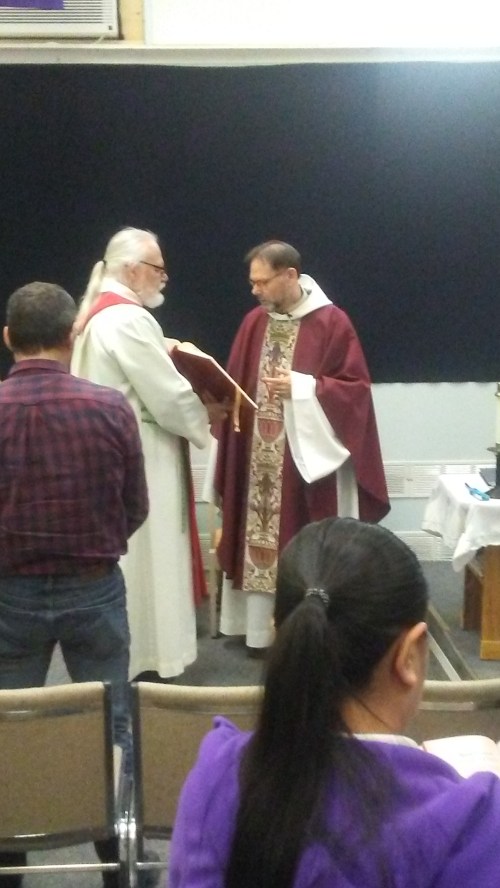
The next day I attended Mass at St John the Evangelist. The Priest was quite engaging and explained that we each are created as a new Christ and a priest, prophet and king thru our baptism as a Christian. Our lay priestly role is to live the Gospel and be a light that evangelizes others. He went on to explain that “ordained” priests have an additional role which is to call down the Holy Spirit to administer the sacraments such as Reconciliation and the Eucharist. This was very enlightening and timely given current debate in the American church about reform such as this piece in the Atlantic Monthly Abolishing the Priesthood.  I find this article somewhat unravels in its length and attack on Pope Francis.  It calls for the reclaiming of the Catholic Faith by lay people who have become exiled from the Church due to their disgust with clericalism and the abuse crisis.

Back at the Himalayan Institute we enjoyed our stay very much.  It was founded in the 1970s as a centre of Yoga Science and Holistic Health and offers retreats for yoga instructors and does humanitarian work.   Marie was on a retreat with Katherine Templeton.

Thank you Lord for this wonderful weekend of rich learning, continued graces, peace, tranquility, health and beauty.


Leave a comment

Filed under Uncategorized

When the rivers meet in Spring

IMG_3106

Madawaska River flowing to join the Ottawa River

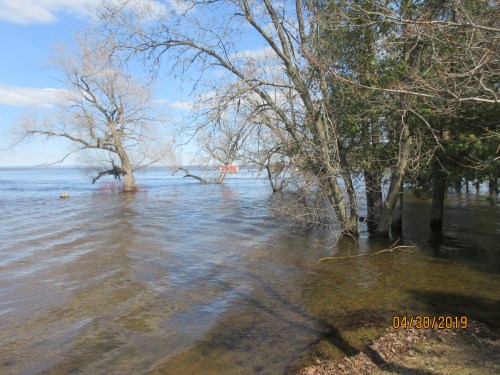
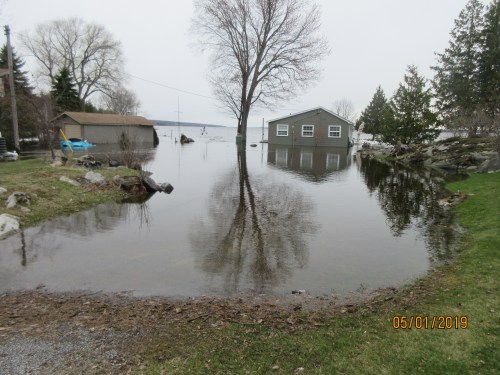
Arnprior has been our home since 2011.  We love the small town lifestyle because it is quiet and friendly and we can walk to almost everywhere in town.  There are many hiking trails and parks here, and the beautiful Galilee Centre for retreats and get togethers with friends and our Oblate community.   Arnprior has been in the news lately due to the record spring floods. Thought I would share a few photos from around town.

IMG_3100

Where these two rivers meet was flooded out

IMG_3113

Ottawa River at its first peak

IMG_3116

Sadly about a dozen houses where flooded

IMG_3112

Our house (right) on the Madawaska remained high and dry

The Ottawa has now subsided and things are getting back to normal as the massive cleanup proceeds.  People are searching for a reason why this happened (again) and what can be done to prevent it in future.  Certainly climate change is a plausible reason, but what is causing this change remains controversial.  I believe that we know implicitly that we are damaging the environment through our throw-away lifestyle and fossil fuel dependence and that we all must make changes to ensure our long term survival.

Arnprior has great recreational facilities e.g, hockey, swimming, library and lot’s of services for seniors.  On the short side for youth is a lack of local post secondary education facilities and not being able to find long term high paying employment opportunities.  Some complain that the shopping here is limited and statistics show there is a local shortage of nursing home beds.  We do have a great hospital and good medical care.  There are so many fundraisers it is hard to keep track.  There are many talented musicians, artists and trades people here and there are 4 local golf courses, a curling club, a bridge club, yoga studios, 10 churches, etc., etc.  It’s a great place to live, work, play and retire.

It is true that we are located on “unceded” Algonquin First Nation territory here (as is all Eastern Ontario).  However there is an agreement in principle with the Ontario Algonquin tribes to address this.  A treaty could be in place soon to address this historical shortcoming.  You can read more about this interesting development here.

IMG_3140

Samuel de Champlain canoed right by Arnprior in May 1613

IMG_3121

A morning dove is getting ready for summer in Arnprior

Cheers.  Have a great rest of Spring!


3 Comments

Filed under Uncategorized

A Cultural Extravaganza

HAPPY MOTHERS DAY TO ALL MOTHERS!

20190510_191503

Jorge Fajardo wows us with his tenor voice and expression

Last night we were treated to a cultural extravaganza chorale concert at St. Paul’s University chapel in Ottawa.  Thanks to Bro. Len Rego, OMI for making us aware of this free concert.

It was sponsored by UNAM Canada – the University National Autonoma de Mexico campus located in Gatineau, QC as well as St Paul’s and a few other organizations.  It was entitled Rencontre chorale: A une voix – One Voice choral festival.

20190510_192030

Coral Feminino Harmonia

The highlight for us was the all female choral group from the Tepic area of Mexico, just 2 hours down the road from Nuevo Vallarta.  They are one of only two all female choral groups in Mexico.  They are on their 2nd international tour.  To see a short video of them click here.

We were mesmerized by their pretty costumes, happy faces and the beautiful singing of traditional Mexican songs.  There were rolling R hoots and catcalls from the audience and loud shouts of Viva Mexico throughout.

Not to be outdone was the operatic like stage theatre of the Ensamble del Insituto Aleman Goethe from Mexico DF.  They sang and acted out with expressive faces while they chased each other around the floor bringing everyone to their feet at the end for a rousing cheer.

20190510_190539

Then there was the Coro UNAM Canada ensemble group led by Ana Cristina Ramirez who sang one of our favorite latin American songs – Solamente una vez.  It is written by the famous Mexican songwriter Agustin Lara whose full name is Ángel Agustín María Carlos Fausto Mariano Alfonso del Sagrado Corazón de Jesús Lara y Aguirre del Pino!   You have likely heard another of his songs called Granada which the Aleman Goethe group performed for us too.

20190510_185112

Coro UNAM Canada

Two other francophone groups from Gatineau sang in English.  At the end, the mass choir was fantastic.  We joined then in singing Beau Dommage’s delightful La complainte du phoque en Alaska (Complaint of a seal in Alaska) and, Leonard Cohen’s masterpiece Halleluyah, which brought tears to our eyes.  We can honestly say we have not had so much fun at a concert in a long time.  We thought we were back in Mexico with a dash of Quebec thrown in.

20190510_195743

Hallelujah

Au revoir – hasta la vista – bye for now.

Dave and Marie


Leave a comment

Filed under Uncategorized

Family Sojourn

IMG_20190417_171357

On our way home from Mexico we stopped in Winnipeg to see Kyle, Ashley and Elias and in Ottawa to see Michelle, Tim, Wyatt, Jackson, Nathan and Jordan.  It was a direct flight from PV to Winnipeg and the same from Winnipeg to Ottawa.  Too easy!

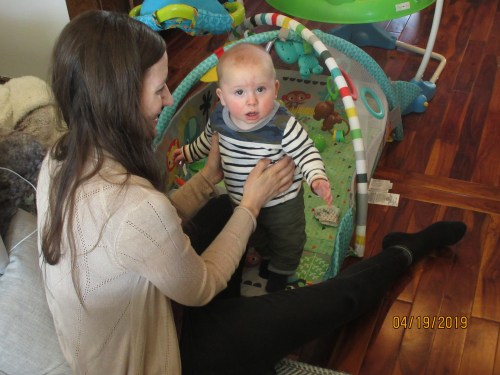
Elias, now 6 months old,  seemed very happy to see us.  He is very calm and accommodating letting us pick him up and hug him without a fuss.  He is eating some solid food now and growing quickly.  We think that he will be a tall guy like his Papa Dave.

IMG_3086IMG_3090

Kyle and Ashley live in Woolsley, a great area of town not far from Polo Park.  So we walked over there with Ashley and Elias on a warm and dry Winnipeg day.

IMG_3080

IMG_3081

On the way back we snapped a few pics in and around the beautiful Assiniboine River just a block or two from their home.

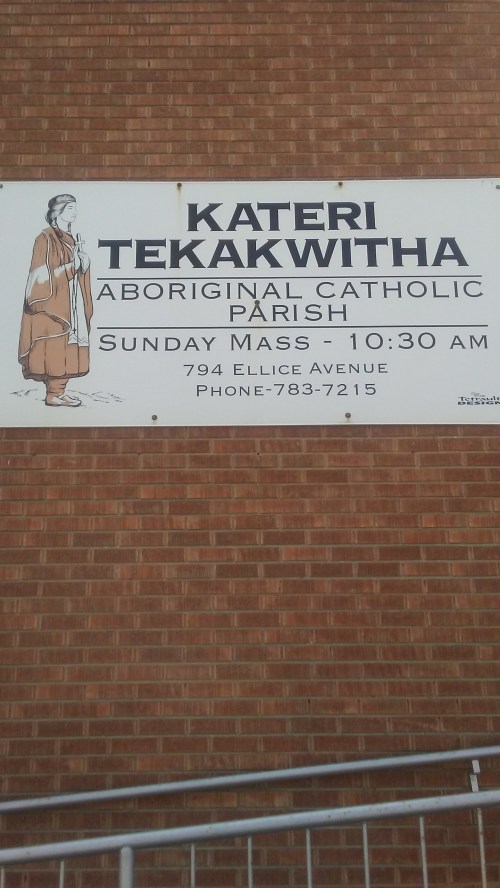
On Good Friday Marie and Dave walked to Kateri Tekawitha Parish to attend their cross veneration service.  We always try to visit this Oblate parish when we are in town.  It was great to see some old friends there.

20190419_162748

20190419_150438

Fr Francois Paradis, OMI and Pastor Fr Robert Laroche, OMI

20190419_162327

Parishioner Sister Eva Solomon who we had met on our 2018 Holy Land pilgrimage

The night before we all relaxed after going out for some great Italian food for Dave’s upcoming birthday.  Ashley surprised Dave with an absolutely delicious chocolate fudge cheesecake she made from scratch.  Boy was it good – all 3 pieces!  Thanks again Ashley!

IMG_3095

IMG_3096

It was soon time to head to Ottawa but not before a few more hugs with Elias.

IMG_3073

IMG_20190418_162610330

We flew to Ottawa without a problem and it was time to continue the family party on Easter Sunday.

IMG_2113

Wyatt and Jackson

IMG_2114

Nathan and Sarah

We finally made it home to Arnprior on Easter Sunday afternoon after these great family visits.  Of course the party continued when Dave had his official birthday celebration at home.  Thanks Marie!

IMG_20190423_183516


IMG_20190423_183557

We received a couple of georgeous follow-up photos of Elias and Ashley on their Easter family getaway.

afdd4ce9c5a4c2c3b5d2727aec57ec54.0

a6e234b631ebc4a100e136f0145f8242.0

It was a a very enjoyable end to our 2019 snow bird get away.  Thank you Kyle and Ashley and Michelle and Tim for your hospitality and warm welcome home.  Now if it would ever warm up here…

Dave


Leave a comment

Filed under Uncategorized

Mexico by the numbers

20190416_104837

This is not what you think it says, just like Mexico is not what you think it is…

Well we have completed our 2019 sojourn to Nuevo Vallarta and are looking forward to returning next winter. Our 8th floor condo looked out on the beach and pools and was like being on a cruise ship that never went anywhere. Best cabin we ever had.

20190416_131439
We have been blown away by the overall beauty of the place, particularly the weather and beach. It is the cleanest beach we have seen save perhaps for Florida panhandle barrier island‎ beaches.  The Mexican people are gentle and polite and seem very happy that we and thousands of others are here.
20190416_132002

Yes it seems to say Arnprior Hockey.  Bizarre!

Some challenges. Toll free phone numbers to Canada often do not work.‎ It is a different banking system here but hey so is the US. It is mostly a “credit card” free society and cash rules. The locals are always parading stuff unsolicited for you to buy (but quickly smile and leave when you decline).  The price of golf here is almost 2 x Arnprior prices but 30% cheaper than in FL. Great courses here I must add.  Dave misplaced his bank card and we got locked out of the condo one night, lol.
20190416_132115
Love the pedestrian society.  We have not driven a car in nearly 3 months, relying on our feet, busses and taxis. This is very healthy, refreshing and good for the environment given our “knee jerk” use of cars back home.  We had no trouble with the water or food.  Also lived comfortably without an automatic dishwasher!
20190413_173353
The entrepreneurial spirit of the Mexicans is to be admired. It seems everyone is operating a small business to rent or sell you something.  ‎For example the “collectivo” 10-12 passenger mini-busses that roar around to take you quickly everywhere are small businesses – the faster he goes, the more the driver makes lol!  Milk in a box that stores for months is a joy here.  Love those Lime scooters!
20190413_173413
The prices of food and restaurant meals here are cheaper than in Canada and way cheaper than in the US. The rental accommodation is world-class beach front and cheaper than Florida for the equivalent. There are more Canadians than Americans here and for many good reasons it seems.    We had many visits with friends from home plus enjoyed meeting a growing number of snowbird friends who winter here every year.  Jessica our property manager looked after us extremely well.  We even got to meet her mother, brother and son.
20190416_200700
So here goes our ratings for another swell trip:
Nights here: 78
Kms walked: 400+
Busses taken: 50+
Taxis taken: 20+
Yoga classes: 60+
Restaurant meals: 30+
Concerts (jazz, classical, live shows): 10
Stair flights walked up: 45 x 8 floors
Best night: Andales Bar in PV where we danced and sang “Who the xxx is Alice?)
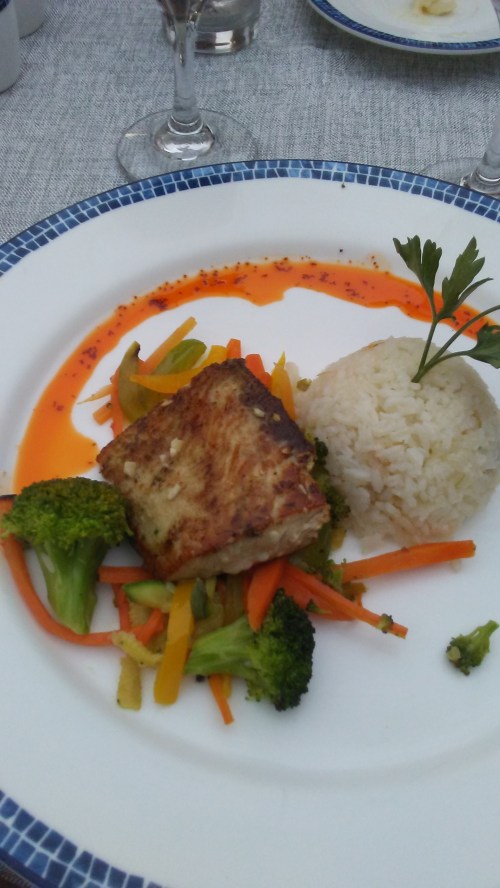
Best meal: tapas at Marival Residence Sky Bar in NV
Best Mexican meal: tacos al pastor at Ponchos in PV
Books read: (Marie 5, Dave 7)
Cloudless sunsets into the ocean: 50+
Laps swum in the pool: 300+
Swims in the ocean: 25
Days of rain: 1
Cloudy days: 6
Ave high/low: 28/17
Ratings:
Weather 10/10
Beach 10/10
Condo location 10/10
Condo 9.5/10 (another bdrm/bthrm would be handy)
Cleanliness of the hood: 10/10
‎People: 9.5/10
Food: 9.5/10
Transportation 10/10
Our rental agent Jessica 10/10
Church experience 10/10
Overall experience/value 9.75/10
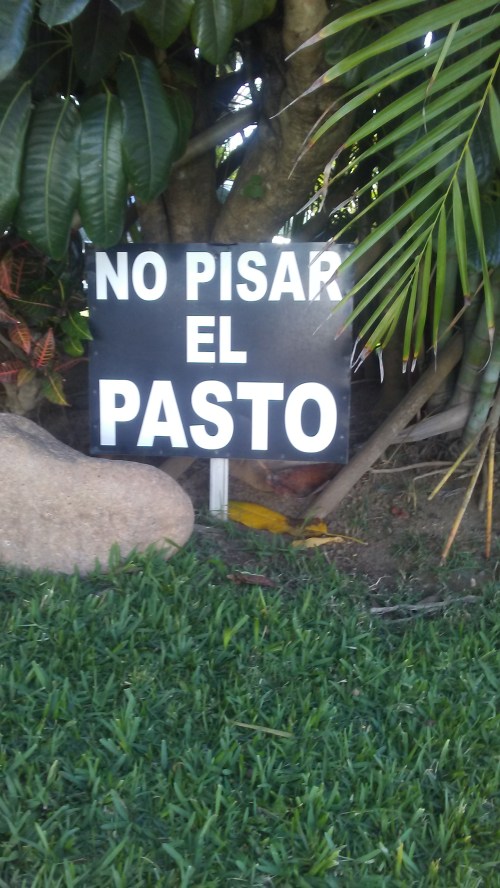
Hence as you can see, we are very satisfied and highly recommend Nuevo Vallarta.  But remember, don’t walk on the grass in Mexico – No pisar el pasto favour!  Mexico Si!
Saludos,
Dave and Marie
20190416_194648

Leave a comment

Filed under Uncategorized

Semana Santa

20190413_181241

“Abandonment is the supreme expression of love, this giving of oneself to the divine will, which is the total gift of our very selves. This heroic attitude formed from inexpressible trust in God’s Love, from perfect self-renunciation and from loving generosity, is the pinnacle of love.”
Venerable Concepcion Cabrera de Armida                                                              (Wife, mother and writer in Mexico)

We are still in NV and have been hearing about Semana Santa – Holy Week for sometime. Mexicans (there are some 20 million living in cities just a few hours away, flood to ‎PV and NV for 2 weeks of holiday, beach and family time.  Schools are closed for 2 weeks.  The wise we are told, get out-of-town before it is too late.

IMG_3069

Apparently there will be huge traffic jams, shortages of food, cash and gas. Church bells will compete with party revellers in one non stop loud and boisterous Mexican mash-up of the spiritual and the physical.  It is a really big religious week here!!!

At Palm Sunday Mass today with 700 Mexicans, we felt the Mexican spirit. Mexicans have not forgotten the mystery of life. Young and old flock to Church here not because they have to but because they want to. You can see respect, joy, calmness‎, love and kindness in their eyes. No one is in a hurry. The Mass lasts over 90 minutes and could go on forever.

On the way in we buy a woven palm frond. There is an entrance processional with people lining the aisles and the Priest sprinkles holy water on all as we wave our palms. The words Viva Christo Rei echo through the church and we bow and join in.

IMG_3070

There are no chocolate eggs or Easter Bunny in Mexico.  Instead people will crack cascarones over each other – colourful egg shells filled with confetti. There are large stations of the Cross processions out doors on Good Friday. The city is packed, the hills in the country side call out – Viva Christo Rei!

We all abandon our selves, bow and join in.

Welcome to Semana Santa everyone.

IMG_3005

2 Comments

Filed under Uncategorized