Day 5 – 6 – Germany

Day 5
Prague Secrets walking tour: Nov 17 1939 Nazis close universities and send student leaders to prison/death camp. Nov 17/ communists beat Prague students.‎ 1991 Velvet Revolution. Dvorak becomes 1st conductor Czech Orchestra. 19th century building :HQ, Jesuit Monastery after Dominicans left. huge building took 140 years to build. Agnostic country but Prague youth attend Mass here due skilled Priest. Oldest cobble stones 1160. Patron saint of lawyers who looked after the poor. St Francis of Xavier statue on Charles Bridge. If you want your love to last, couples place a lock on a romantic place. King is thrown over the bridge by Church. Maltese Knights Order mill and residence. 1968 invasion of Czech by Warsaw Pact countries to quell “liberalism”. Czechs feared the reunification of Germany in 1990. Now they revere Germany and fear Putin. Kind Charles IV monuments everywhere. St Nicolas Church in lesser town now a Baroque museum. Slovaks separate from the Czechs in 1993. “Pravda Vitezi” – Truth Prevails in coat of arms. Helena our tour guide does a great job. We have time for 1 more Urquel before hitting the road for Nuremberg.

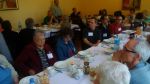
We arrive at the Avalon ‎Artistry II on the Main-Danube Canal. We walk on, receive a complimentary drink and are in our cabin within 15 min. Later we have a great dinner – perch. The wine flows, we feel great. In the morning we awake with the sun peeking under the shade. Our cabin is small but comfortable.

Day 6
Bamberg, the Rome of Germany, is built on 7 hills.Was not bombed during WWII. 50% of residents are enrolled Catholics. World Heritage site. River Falls steeply so 20 water wheel powered wood mills at one point. We walk up the narrow streets to the‎ Domberg Cathedral and Bishop’s Palace. We see St. Michael’s Monastery further up.

Leave a comment

Filed under Uncategorized

CEX Day 3 – 4 Prague

Day 3
We walk from our apartment to our hotel – it’s 5 blocks only. We are checked in and unpacked by 10h00. Dave heads for the pool.‎ Later, we head out for the Charles Bridge. We walk across the Vltava River on the Manesuv bridge and make our way to St. Nicolas church, a baroque beauty. We walk back across the Charles pedestrian bridge lined with statues of saints. The views are stunning. We find some wine and beer and retreat to our room. Walking on uneven cobblestones is tiring.

We connect with the cruise group and meet up with our friends Glenn and Betty Clarke. We have dinner at a nearby restaurant and retire early

Day 4
Guided tour. ‎Stalin Bust memorial being repaired. Prague Castle, residence of Prime Minister. 9th century, later Hapsburg palace. One of the biggest in the world, owned by Boston family. Cathedral of St. Vitus 1300, Hapsburg crypt. Painted glass window by Mucha. Hapsburgs lived here from 1508 to 1800. Maria Theresa, Austrian became queen. 16 children including Marie Antoinette. Hapsburg Catholics clash with Protestant majority setting off the 30 years war. Velvet revolution, Vaclav Havel brings Czech into NATO.

Puppet play ‎at old town astronomical clock, 1410. Revamping of mechanism over the years. Time is depicted in 3 different ways. Lower clock with saints. Jewish ghetto. 13th century Synagogue. $8K monthly rental apartment above Gucci store.

St James Church – wow!! Church of our Lady Before Tyn wow! I notice astronomer Tycho Brahe’s headstone in front of the altar. We walk through the Jewish quarter and site of the 1941 deportation to the nearby Terezin death camp. The streets are crowded with many nationalities speaking softly. Back at our hotel we run into friends Mike and Susan Issa from Ottawa who just happen to be in Prague right now. We walk a few blocks together and wish them a good trip.

In the evening we have a great Czech dinner (pork, duck) with the Clarke’s at the Kokolvone restaurant and lots of Urquel beer.‎ A great end to a great day!

Leave a comment

Filed under Uncategorized

Central European Experience Day 1-2 Prague

Day 1
We leave beautiful Poland today. At checkout we are handed a bag lunch for the road. The attendant thanks us again for coming to Poland. I respond that we are all Polish. We say our goodbyes to our fellow pilgrims.

We take a cab to our mini-bus which will take us to our train to Prague.‎ We have time to walk a bit and have a coffee. We arrive in Ostrava, Czech Republic. The language, the currency and the faces of the people change. Somehow we find the right train. On through yellow fields of canola, green forested hills and chocolate villages we go.

We arrive in Prague the “splendour of Europe”‎. Our apartment is above the Dubliner Prague pub. We are steps from the old town square. After exploring the cobblestone streets crowded with tourists we have beer and dinner in the pub. We meet a young man from the U.S. on tour filming a clown. We sleep 10 hrs!!

Day 2
We wander the pedestrian streets and find the Intercontinental Hotel where are river boat cruise starts from tomorrow. We walk along the river and marvel at the boats and architecture.‎ We have a goulash and dumpling lunch complete with apple strudel.

In the evening we go up in the clock tower in the square and take some photos. The view is awesome. There are many Asiatic tourists here in contrast with Poland where there were none. The churches here tend to be closed except for concerts and once a day masses. While we like the western culture here we wonder about the long-term.‎

The Urquel pilsener beer is ‎awesome too!

Leave a comment

Filed under Uncategorized

Day 12 – 13 Krakow

Day 12
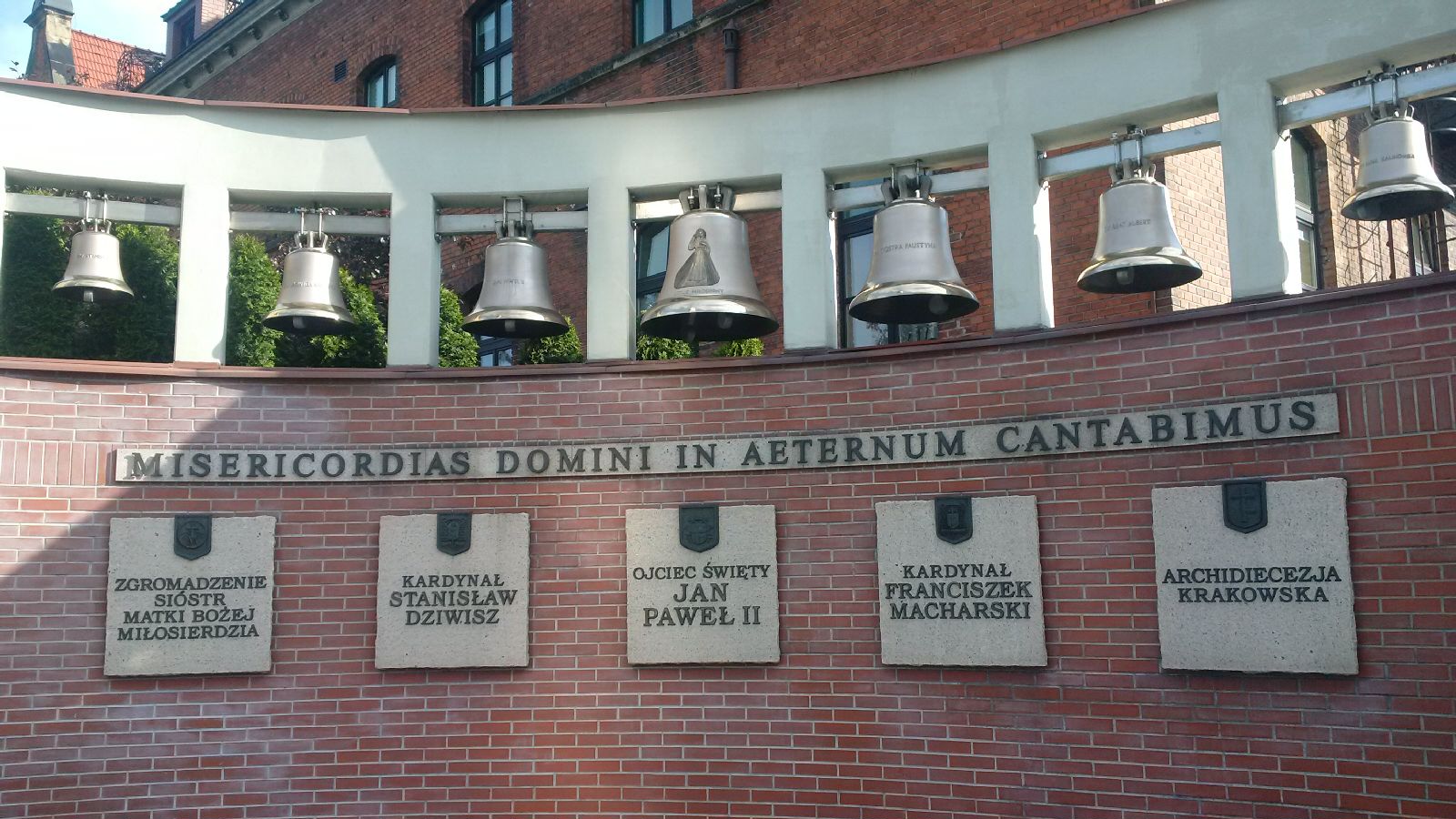
We visit Cardinal Dziwisz’s residence. He is Archbishop of Krakow and was Pope John Paul’s constant companion. He was present with JPII when the assassination attempt was made on his ‎life exactly 35 years ago today. Dave shakes his hand and says “jean projett”. He responds “jean projett” and looks at Dave’s Oblate cross. He explains the importance of Divine Mercy and thanks us all for coming to Krakow. On the way out he shakes Dave and Marie’s hands again and notices the Oblate cross. A kind humble man.

Across the street we enter a very old basilica church and Franciscan monastery. It was originally an Oriental Orthodox Church. Destroyed by invading Tartars, it was rebuilt. It is very narrow and high inside lit only by natural light from stained glass windows. We see the relics of the Foundress of the Poor Clares.‎ We light a candle for our prayer intentions. We see the pew the future JPII prayed in each day before he was Archbishop. It is at the very back of the church.

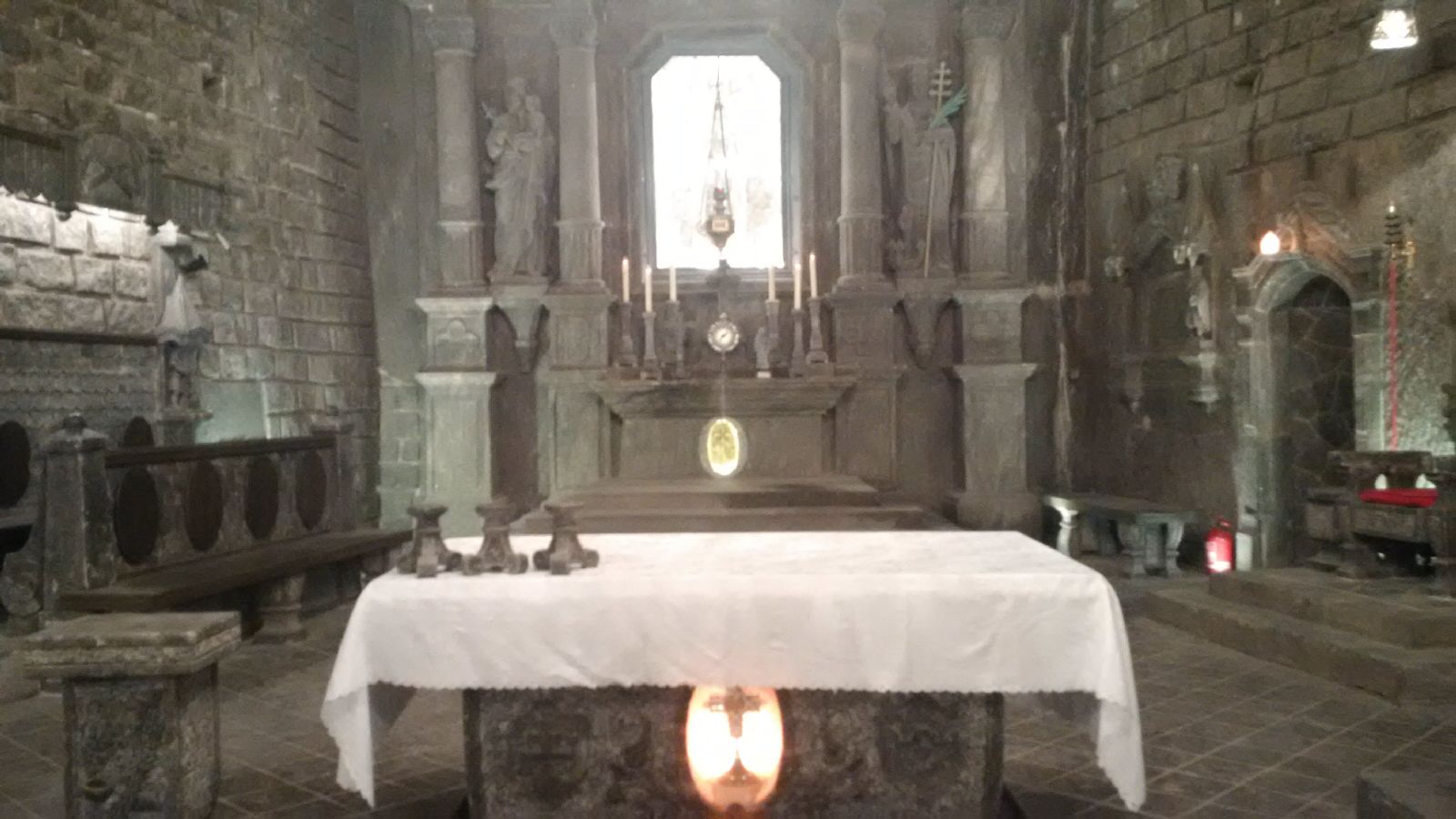
Wieliczka Salt Mine. 250 km of shafts and tunnels.‎ One of the oldest in the world still functioning. Generally a large cake of sandstone with blocks of salt. Wooden pillars support the shafts and chambers were needed.‎ Polish astronomer Copernicus statute placed here in 1979. Rock salt is 96% NaCl, 4% sandstone. Legend: Hungarian Princess thru her engagement ring down a deep hole and it turned into this salt mine. Horses were used to haul loads. We descend to 100 meters and pray the Chaplet in front of a stunning salt altar and Our Lady of the Salt in a huge chapel chamber. We pass thru a large chamber with Chopin music playing. We bottom out at 135 meters below the surface at the JPII Chapel. Mercifully, there is a lift so we don’t have to walk up 800 stairs!!

Fr. Tim ‎urges us to make our heavenly Mother Mary, our personal and effective Mother. The world needs Jesus.

Day 13

Day trip to Zakopane, the winter capital of Poland.‎ It lies at 1000 meters elevation in the Tetra mountains which is the highest range of the Carpathians, very close to the Slovakian border. We spend a few hours sightseeing and shopping.

We share our experiences of this retreat on the way home. At the travelers Mass, In honour of the Feast of Pentecost Sunday, we learn the history of the Catholic Charismatic Renewal movement, which started in the U.S. some 49 years ago from Fr. Albert.

This has been a wonderful sometimes humbling retreat for each of us – we have been exposed to aspects of the Faith and the Church that we were not aware of before.

Jesus, we trust in You!

1 Comment

Filed under Uncategorized

Day 10 – 11 Krakow

Day 11
A free day to explore Krakow, after Mass‎ in her chapel in front of St Faustina’s crypt. We have a great day exploring the old town. We pick up our trains tickets for Prague. In the evening, Fr John gives us a talk on the sacrament of reconciliation followed by a Q&A. We sleep well.

Day 12
Homily:
A sister of the Divine Mercy reads us a poem from St. Faustina’s diary – the incredible power of the Divine Mercy. Do not think that your sin is so great that God’s Mercy will not be given you. The Father hugs the Prodigal Son. Give God your sins every day and accept his forgiveness and mercy.‎ We need a close relationship with Jesus. We just have to want to come back to Jesus and he walks toward us. He shows us the Father.‎ Our answer to the Lord’s Mercy is “Jesus, I Trust in You!”. God then trusts us and gives us graces.‎ We are to show each other Mercy every day and everywhere. By deeds, by words and by prayer.

Auschwitz
June 1940. ‎Originally Polish army barracks converted to a “concentration camp” for Polish political prisoners. Then in 1942 becomes an extermination camp for Jews. 1.3 million sent here, 1.1 million died. Each prisoner was registered on a card. Men were separated from women and children, Women and children were told they were going to have a shower. They undressed and entered a big room with fake shower heads. ‎Then they were gassed with Cyclone B gas. Corpses were then incinerated. Gold teeth and any other jewelry was gathered. Artificial legs, glasses, prayer shawls, cooking pots were collected up. Ashes were removed by the ton and dumped in a river. Between Block 10 and 11 we see the death wall where political activists were tortured and shot. Tears overwhelm us. We pray a decade of the Rosary.

We move on to Auschwitz-Birkenau – a much larger camp with 300 wooden barracks. ‎We gaze at the triple spur line within the camp which is 1 km long. Deportees arrived here with no idea where they were or what was about to happen to them. 400 prisoners in each barrack, typhoid fever and other diseases were rampant. 1 sanitary barrack for each 5 dormitory barracks. Not much time to use was given. Many worked on farms and nearby factories 14 hr/day until they were too weak to stay alive. Of 200,000 Jewish children brought here, only 600 were found alive on liberation in Jan 1945. Prisoners were fed rotten vegetables, a tiny piece of bread. Sick, dying and dead were moved to the back of the camp where huge gas chambers and incinerators were their final fate. We are sickened. May this never happen again we all pray. Amen.

In the evening we celebrate a healing Mass. Although it was a troubling day, we know that good overcomes evil.  Mercy and love are stronger than death and sin. Be not afraid.

1 Comment

Filed under Uncategorized

Day 8-9 Krakow

Krakow is now our base.

‎Day outing to Wadowice the birthplace of St. John Paul II. It is in the lovely rolling hills of Lesser Poland.‎ We pass thru small villages with well-kept houses. We pass by little roadside monuments with crosses and flowers that dot Poland everywhere. People stop and pray here.

We find ourselves in the foothills of the Carpathian Mountains‎. Karol Wojtyla, the future JPII was an outdoors man who enjoyed hiking, skiing and camping here. We arrive in his home town. After Mass in Presentation Basilica, we tour his family home next door which is now a museum. I learn that JPII studied the theology of mystic St. John of the Cross. He learned what it means to be Man. His papal mission became to unite Man with the Church.

On the way back to Krakow, we stop at the Calvary (Kalvaria) Sanctuary. High on a hill this 400 year old site is one of the largest pilgrimage centres in Poland. It houses the Our Lady of Calvary image, a basilica and a monastery. There are also a complex of chapels, shrines, statues and bridges connected by paths. JPII came here many times as Archbishop of Krakow and as Pope.

Krakow, was the capital of Poland until 1609. Today 750k pop., 16 universities and colleges, 250k students!
St Mary’s Church, first parish in Krakow, 14th century

Wawel Cathedral:
St Stanislaw, first Bishop in Poland. Was beheaded in 1079 during Mass.‎ Relics entombed in crypt. President of Poland and his entourage died in a mysterious plane crash in Russia. The facts of this tragedy have not been made public yet.

In the castle we learn people used to sleep sitting up in the 15th century. It was dangerous to sleep flat as you might die overnight. There are numerous tapestries, woven with gold and silver threads that took years to make. They are sequenced to tell the biblical story e.g., Genesis. We are blown away by their beauty and magnificence! These tapestries were stolen by Catherine the Great. Later, Poland was able to buy them back. During the war the collection was stored in Canada for safekeeping.

Large painting of the sea battle of Lepanto. 17th century Baroque section filled with large paintings. The Polish monarchy was the 2nd richest in all Europe at its apex.

Prayer procession to the JPII Centre Shrine. Built 2008-10 as a monument from Poland to JPII.‎ The Church of Mary’s – all the Mary’s JPII visited around the world.

A fantastic homily from Fr. John which can be summarized as:

God created Man rational and ‎free. If you choose Jesus Christ, you choose eternal life. If you choose any other path, you choose eternal death.

Amen

Leave a comment

Filed under Uncategorized

People on the Bus

A summary of our pilgrim group makeup.

Fr. John Fletcher CC, is Chaplin at Wayne State U. In Michigan. From Buffalo, NY, he joined the Companions of the Cross at age 30. A very dynamic and skilled preacher who connects well with all.

Fr. Albert MacPherson lives at a Augustinian priory in Lawrence, Mass. From Cape Breton, he has spent some time at Madonna House in Combermere, ON. Specializes in healing mass ministry in many different places.

Fr. Tim Devine, CC is pastor at St. Maurice Parish in Ottawa. Almost totally blind, he is a very joyful, humorous and passionate Priest. He also is a talented song writer and musician who has won a Juno award for his gospel music. He hails from Waterloo, ON.

Stan Bielec, our tour organizer. Of Polish origin, his goal is to get the message of Divine Mercy out to the world. Quick to laugh, he is very adept at handling every type of group tour situation.

His wife, Maria. Full of joy and goodwill, helps share the load with Stan‎, She does real-time translation in each church we visit‎ and smiles continuously. She and Stan live in Ottawa.

41 others involved in all kinds of ministry. They live in:
– Newfoundland
– Michigan
– Australia
– Toronto, Simcoe, Kingston and Belleville areas
– Ottawa (from parishes all over the city)
(2 people from San Diego and 2 from the U.K. cancelled due health reasons.)

We are blessed to be part of this dynamic group. Note this is the 4th time Stan has escorted a Divine Mercy pilgrimage. There is another trip planned for the Fall of this year. (See JPII Centre website for further info.)

1 Comment

Filed under Uncategorized

Day 7 – Czestochowa (pronounced chestahova)

(We apologize in advance for the length of this and some other posts – there is so much to report on!)

HAPPY MOTHERS DAY TO ALL MOTHERS!

On leaving Plock, we cross the broad Vistula River. We wend our way through ‎small towns, yellow fields of canola and apple blossom lined roads. We soon find ourselves in Swinicach at St. Casimir’s Church where St. Faustina was baptized. Dave has time to find her parents’ grave site. There is half a dozen family members polishing the crypts of deceased family members. There are flowers on virtually every tomb and some have lighted candles.

We ‎move on to her house in Glocowiec where she was born in 1905. It is a small well maintained 3 room house the family of 8 lived in. Out back they have Stations of the Cross, a stone altar, a walking path and benches to meditate on. The green farm fields stretch out far beyond.

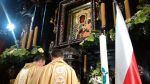
After a Polish lunch feast, we head for Czestochowa. The Black Madonna Icon – Mary Queen of Poland resides here. It is one of the most attended Marion shrines in the world – 4 to 5 million visitors each year. Stan says people will drive 500 km to pray one decade of the Rosary before Our Lady. Peter from Australia quips he would even stay for 5 decades.

After dinner we walk over to the Chapel and manage to squeeze into the front to get a good view. Ah, there she is with baby Jesus in all Her glory. You would not believe the number of people of all ages crowding in to pray the Rosary in front of the Black Madonna. We participate in Polish as best we can and then squeeze our way out.

In the morning we are given the honour of celebrating our Mass in the Chapel with Fr. John Fletcher, 99. Marie and I are seated in the front row not 20 feet from Our Lady. Pilgrims crawl continously round the perimeter of the chapel for special intentions. Fr. John says it is easy to be Catholic in Poland, but what are we personally going to do when we get home?

We tour a museum. We learn that the Black Madonna is a ‎634 year old painting from Byzantium. The story is told that Poles prayed so much to this icon of Mary and Jesus over the years, that the smoke and soot from candles blackened her image.

Much history of fighting over this and other icons occurred in Poland. Mary emerges as saving Poland through the window of Czestochowa. She is Queen of Poland. Many different “robes” have been created and used over the years to frame Mary and Jesus in the icon that we see today.

Mary is also seen as having saved John Paul II‎ by redirecting the bullets away from his heart and jamming the assassin’s gun. ‎Poland has 32000 priests and 30000 nuns out of 40 million population.

We are now off to Krakow for the week ahead.

Leave a comment

Filed under Uncategorized

Day 6 – Plock

We wake up an hour early having failed to adjust our watches for the time change. This gives us an opportunity to walk around a very modern looking medical university and do a few laps on an adjacent sports track.

On our way out of Bialystok, we stop at ‎St. Rocha church. Only 50 km from the Belarus border, Mary Queen of Poland faces the Soviet frontier, protecting the Poles.

‎At the Convent of the Sisters of Holy Mercy in Plock, we learn that St. Faustina worked in the kitchen here helping to bake bread. It was here in 1931 that this mystic had the first vision of the Divine Mercy image. The room she had this apparition in was in a building that the Communists destroyed during their 35 year tenure.

The Sisters are in the midst of restoring the facility originally built in 1896 including adding a new Chapel of the Divine Mercy.‎ They lack the money to set a fixed schedule but are confident the resources needed will come. They also want to minister to troubled youth who stay out all night drinking here.

After dinner, Mother Superior takes us on a walk around the town. There is a central square with outdoor cafes. The city hall faces and there are stalls for market day. They hold concerts and dances here. We continue and suddenly we find ourselves on a high bank overlooking the broad Vistula. It is almost sunset and groups of people gather to salute the sun. We pause for photos in an unbelievably beautiful place.

Tomorrow it’s off to Jasna Gora, home of the Black Madonna.

1 Comment

Filed under Uncategorized

Day 5 – Bialystok

Making our way back into Poland, we stopped in Sokulka at St. Anthony’s Church. Here is where Blessed M. Sopocko had two more Divine Images created. One has stayed here and the other is in Bialystok. 2 days before Fr Sopocko was beatified, during holy communion, a host fell on the floor. It was placed in water to dissolve. The next day when they looked at it, there was a red splotch in the centre of the undissolved host. When analyzed, it turned out to be type AB blood, the type of blood reported in other Eucharistic miracles. This is the blood of Christ.

At the Shrine of the Divine Mercy in Bialystok we venerated Blessed M. Sopocko’s remains as well as relics of St. Faustina and Pope John Paul II. Fr Sopocko died here in 1975 and was beatified in 2004. Dave read the first reading during Mass. A modern large church all white inside. Some rivalry between this much larger church and the Shrine of Divine Mercy (Chapel) in Vilnius is evident. A photo of a hologram of the Paraclete (Holy Spirit) here is attached.

One thing very evident in Polan‎d is the living strength of their Faith. Churches are full of people of all ages whenever we enter them. They have not lost their faith as have some other European countries like France. Perhaps because they have had to fight for it – they value it more.

Example. During the Communist regime, the image of the Black Madonna was actually arrested and put in jail – true story! Mary is the Queen of Poland and this was seen as a challenge to the Soviets. Poles responded by circulating the empty picture frame as an icon and proudly marched it through the streets of towns and cities in defiance of the Communists!

We had a great meat and potatoes lunch‎ again and a fab dinner somewhat similar. No complaints.

We have trouble sleeping as there is a boom boom party going on outside a few blocks away. We learn from Maria that alcoholism is a rampart problem among Polish youth.

1 Comment

Filed under Uncategorized