The Queenship of Mary Community

Scan0125
The other night Marie and I attended a Mass in honour of the Feast of the Queenship of Mary. The invitation came from the John Paul II Centre for Mercy on behalf of the Queenship of Mary Community.
It was our second encounter with these young and vibrant Roman Catholic Sisters. I decided to find our more about their story. And what a story it is! Rather than paraphrase, I post a link to it here:
 http://www.bccatholic.ca/canadian/3014-new-religious-order-founded-in-ottawa
Wow, a charism of praying for Priests. How beautiful is that?   While they are based in Metcalfe, ON at present, they dream of acquiring a property to establish a sanctuary and retreat house. How beautiful is that?
One of the gifts we received at the Mass was The Miraculous Medal also known as the medal of the Immaculate Conception.  The prayer on it says “O Mary conceived without sin, pray for us who have recourse to you.”  We noticed many young people at this celebration, particularly young women.  We heard to the most beautiful rendition of Ave Maria sung by one of the young nuns – it brought tears to our eyes.
Miraculous-Medal-gold-scarlet
While my base community is Oblate as an Associate in OMI Lacombe Canada Province, I always enjoy learning about other religious communities, their charisms and their foundation story.
We really enjoyed the Mass, saw some of our fellow Poland Divine Mercy pilgrims there and hopefully, will come in contact with this community again in the future.  Our prayers are with you.
SrPhilomena


1 Comment

Filed under Uncategorized

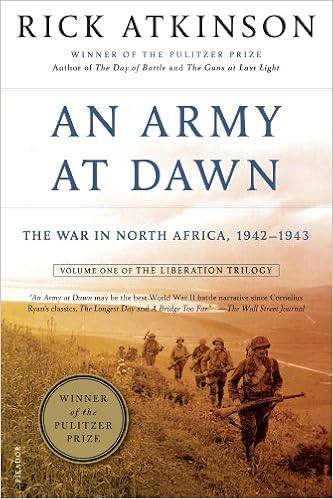
An Army at Dawn

An Oblate priest told me about this book and the series.  He said if you like history, you have to read this guy.  So I did, all 540 pages in 3 weeks flat – it was an inter-library loan with no renewal.

Basic story: The U.S. enters WWII after Pearl Harbour.  They are called upon by Churchill to help Britain drive Rommel and the Nazis from North Africa in late 1942.  (Reluctantly they agree as they would have preferred a more direct assault on the Continent as well as an allied focus on defeating the Japanese in the Pacific.)  Gen Ike Eisenhower is appointed Commander.  They land in Morocco and Algeria.  They suffer initial setbacks and humiliations in learning how to fight.  There is much rivalry and disdain between the American and British commanders. They proceed east to Tunisia where the bulk of the fighting takes place, finally annihilating the Afrika Corps, Panzer Divisions and Italian forces in May 1943 with the help of liberated French troops.  This is not before suffering some 100,000 Allied casualties (killed, wounded or missing)!

It was the coming of age of America’s might and world domination.  Part way through it became evident to everyone that the Allies are going to win the war due to the shear depth and strength of America’s industrial might.  It was a Quartermasters war and America was second to none in its ability to provide equipment, troops, food and transport.  Rick Atkinson is adept at explaining the horror of combat and the ugliness of war in exhaustive detail.  He won the Pulitzer Prize in history for this book in 2003.

There is some ugly portraying of Muslims as looters and traitors, Italians as lazy and inept, French as vacuous and pompous and the British as egotistical and simply awful.  There is grudging respect for Germans ability but real hate and a developed desire to kill, kill, kill Heinies.  I had some trouble understanding the maps detail but that was probably just me.  There were interesting references to U.S. Civil war heroes such as “unconditional surrender” Gen Ulysses S. Grant.

All in all a solid 8.5 out of 10, riveting.  Not sure whether I will read the 2 sequels yet, need a breather.


Leave a comment

Filed under Uncategorized

The Great Arnprior Water Riot of 2016

I am writing this in glee as the water advisory for Arnprior has been lifted in our area.  Let me back up and tell you the story.

Heading out the door on Aug 10 on foot to run an errand, the phone rings but I miss the call.  It is our elderly neighbour Rita, so I call her back thinking she has some emergency need.  Not at all, she informs me that the Town of Arnprior has just issued a water advisory – no drinking, washing or bathing in municipal provided water. No bathing!  I hang up and the phone rings again with Mike on the other side telling me the same thing.

I decide to drive out and pick up some drinking water just in case. Road traffic is unusually heavy for late morning.  At GT and Shopper’s they are sold out of H2O.  I drive up to Metro – they have dozens of cases still.  I pick up 4 and notice others stocking up.  Road traffic is even heavier on the way home.  I check local social media and the lines are abuzz with panic.  There are reports of angry men pushing aside women with baby carriages in their haste to grab drinking water in the stores.  People have unknowingly drank and showered after the warning was issued. What’s in the town water??  Go to the hospital if you feel sick!  All the restaurants are quickly closed. OMG!! The great Arnprior water riot is on.

We soon find out how much we take drinking water for granted.  Marie and I find ourselves accidentally washing our hands or brushing our teeth.  We post notes at each sink not to use the water and put bottles in each sink.  Go figure!  We can’t shower for several days!

Then it all changed. We find out that cases of drinking water are available for free at the central Nick Smith Centre.  Volunteers man the stations 24 hrs.  You can even call and they will deliver it.  Local businesses have donated the water for free.  Mayor David Reid is seen helping distribute free water.  Neighbours start picking up water for their families and shut in neighbours. People out-of-town offer access to their water well fed shower for free.  Random acts of such kindness multiply all over town.  The media does a great job of getting the news updates out to people. Everyone is concerned for their neighbours.

The tone on-line changes. My what a great town we live in with responsible leadership and caring neighbours.  We are so lucky to live here.  Local Canadian community at it’s best.  I pick up some water for Rita and call her back to inform her the advisory has just been lifted in our area.  She says neighbour Kevin just called her to let her know and that she had already picked up some water herself.

Apparently a wrong valve had been closed in the water distribution system in the course of some water main construction work.  Pressure quickly bled off for those houses and businesses connected downstream.  This meant groundwater or worse could potentially infiltrate into the town’s water distribution system.  Hence the Advisory was issued.  Authorities then had to sample at various points to verify water quality was still safe.  This took several days.  It appears that at least in our area of town, there never was a problem with water quality.

As some one on-line observed – now you know what is like to live with a boil water advisory as some of our indigenous communities have had to – for 11 years!  What a great lesson in hardship and hope.

DSCN0268


2 Comments

Filed under Uncategorized

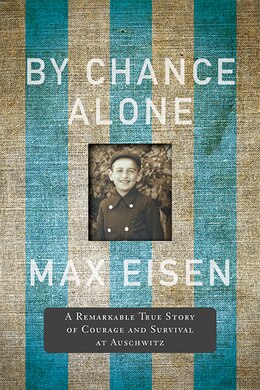
Max Eisen Book

Book By Chance Alone: A Remarkable True Story of Courage and Survival at Auschwitz by Max Eisen

This is a brand new first hand account of what is was like to spend time in Auschwitz-Birkenau Extermination Camp during WWII written by a Canadian.  Little Max, a 15-year-old Czech Jew was taken forcibly with his family to Auschwitz in March 1944.  His whole family perished there.  He survived as a slave labourer by chance after a Polish doctor took him in as a medical room assistant.  In 1948, he was fortunate to get a Displaced Person permit enabling him to emigrate to Canada.  He waited many years to tell his story.

A very grueling account of starvation, fear, pain, survival and hope. What I found particularly new and interesting here is the story of the forced march west of 10,000 prisoners from Auschwitz fleeing the advancing Russian forces and then, what happened to him personally after liberation.  Max describes an ongoing horror of sickness and hunger of being a DP (i.e. refugee).  He was imprisoned by the Communist regime in Prague, then wandered between Czechoslovakia, Hungary and Austria in poverty, trying to emigrate to Canada.  He finally finds safety and human warmth in Toronto.  He is married and has several kids and grand kids.  He helps educate about the Holocaust.

He tells his story in a matter of fact way after many years if being unable to talk at all about it.  Perhaps the most poignant lesson is when he describes what a former SS guard at Birkenau said in his war crimes trial at which Max testified…”Hitler told us that the Jews were a danger to our country.  I was just following orders and am not guilty of any offense.”  From this example, Max warns us to be extremely wary of the real dangers of totalitarianism – people will do all kinds of nasty things if they become brainwashed and are ordered to do them by a nasty leader.  A timeless lesson for today.

9 out of 10, a formidable read!


2 Comments

Filed under Uncategorized

78th Annual Pilgrimage to Shrine of St. Ann – Cormac, Ontario

DSCN0231

Pembroke Diocese Bishop Michael Mulhall reminds us of the need to detach from worldly goods in order to avoid loss of our personal freedom, at 78th annual pilgrimage to St. Ann.

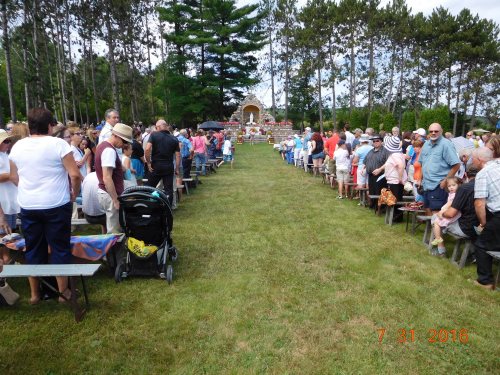
A crowd of 800 or more listened intently to Bishop Mulhall’s homily at the St. Ann Shrine Pilgrim Mass in Cormac, Ontario on July 31, 2016.  He reminded us that consumerism destroys our personal freedom because we want more and more.  While it is OK to have things in our life, we must detach from these things so that we remain conscious of God’s presence, love and great mercy in our lives.

We attended this event under brilliant sunshine.  In 1891, Fr. James McCormac who had a great devotion to St. Ann, had a church built in this small Opeongo Hills settlement about 150 km NW of Ottawa.  The original church burnt down in 1916 and a new cement block one was erected by Fr. J. N. George within 6 months with the help of 55 families.  The beautifully decorated church house a statue above the altar as well as a relic of St. Ann.

DSCN0222

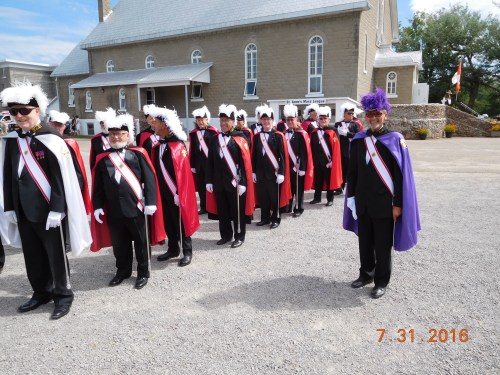
Commander Yvon Ouellette leads the KofC 4th Degree Honour Guard with the Church of St. Ann in the background.

DSCN0226

St. Ann (or St. Anne), the mother of the Virgin Mary, and hence Jesus Grandmother, is not mentioned in the Bible.  She is mentioned in the apocryphal Gospel of James written about 145 AD. She has been venerated since c. 550 AD.  She is the patroness of unmarried women, housewives, women in labour, grandmothers and the Mi’kmaq people of Canada.  A major shrine is at St. Anne de Beaupré, Quebec.

In 1938, Bishop C. L. Nelligan approved of a Shrine of St. Ann in Cormac which is centrally located in the Pembroke Diocese.  On her Feast Day July 26, 1938, the first Pilgrimage was hosted which subseuqntly fostered a deep devotion to St. Ann by local people.  A Polish lady in her late 60s from Barry’s Bay told me this year that she has attended every year since childhood.  “It was mandatory in those days” she said.  “There were 9 or more pilgrim buses parked in the field then” vs. the 3 we saw this year.

Fr. Howard Chabot, a retired Pembroke Diocese priest, was the Pilgrimage Leader this year.  He led 3 nights of reflection which lead up to the Shrine and Healing Masses on Sunday.  Fr.Ken Obrien from St. James the Less Parish in Eganville, our host, thanked all volunteers as well as attending pilgrims.  As well as the Masses, there is Adoration in the church, opportunity for Reconciliation, sale of religious articles and good food available. This year 54 adventurous pilgrims hiked the Opeongo Line from Renfrew to Cormac, as a special Year of Mercy Pilgrimage, a distance of some 60 km.  Well done folks!

We will surely attend again next year, God willing.

DSCN0224

DSCN0239

DSCN0241


Leave a comment

Filed under Uncategorized

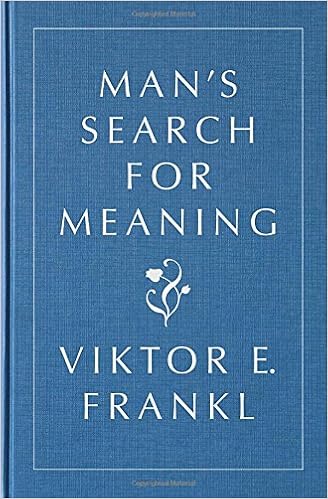
Auschwitz – Primo Levi and Victor Frankl Books

Pope Francis will visit the Auschwitz Extermination Camp this Friday.  I am delving into what went on there.  Here are a couple of books of interest on this subject.  Note, neither book is morbid but well worth the read.
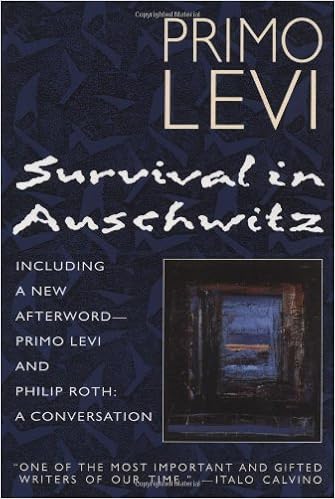
I read Primo Levi’s book first that tells his personal story of surviving for over a year in Buna-Morowitz Concentration Camp in Poland (Auschwitz 3).  He is an Italian Jew chemist who survives by being chosen to work in the laboratory from which he could steal food and fuel for barter.  The most harrowing part is perhaps the last chapter dealing with how several hundred sick prisoners survive a week in January after the departure of the SS and before liberation by the Russians.  This is after 10,000 “healthy” prisoners are marched off to the west by the Nazis, never to be heard from again according to the author.

There is not a lot of mention of the gas chambers nor of God in this book.  Nevertheless it is a classic for the way it describes what happens to man when all comfort, hope, compassion – humanity in short – is removed from one’s life.  For example, those who kept asking questions or tormenting themselves about their condition, tended not to survive.  Those who deadened themselves to all feeling, obeyed and guarded their light, tended to survive.

A few quotes:

“A country is considered more civilized the more the wisdom and efficiency of its laws hinder a weak man from becoming too weak or a powerful one too powerful.”
“We believe that the only conclusion is that in the face of driving necessity and physical disabilities, many social habits (e.g., not to steal from others or show compassion) and instincts  (e.g., to help others) are reduced to silence.”
“We would like to consider that the Lager (camp) was preeminently a giant biological and social experiment.”
“After 5 months in the Lager, we were old Haftlinge (prisoners): our wisdom lay in not trying to understand, not imagining the future, not tormenting ourselves when it would all be over; not asking ourselves or others any questions.”
Arbeit Macht Frei – Work Makes Freedom (the sign over the gate at Auschwitz 1).
I liked the sprinkling of German and French words used in the text. e.g., Jawohl, Komandant! (Aye, sir) and Musselman (Muslim) for someone who had given up. Tour de force or masterpiece does not do this book justice.  A 20th century work of art comes closer.  Highly recommended read for people of all ages!  I really liked it, 9 out of 10.
The 2nd book by Frankl – Man’s Search for Meaning is different.  Victor Frankl, an Austrian neurologist and psychiatrist also survived Auschwitz.  He was able to survive partly because as a doctor, he was given higher value work and somewhat protected by the camp medical staff.  He is the founder of “logotherapy”, a form of existential psychotherapy.  The latter half of the book explains this therapy in detail.
His basic thesis is that we should ask not what life means as there is no definitive answer to this. Rather, it is in the fulfilling of what life presents us with that each finds the unique meaning of life for us.  He cites the example that every so often, a prisoner would refuse to get out of bed in the morning.  No matter how firmly beaten, they would lie there in their own excrement.  They had simply stopped living i.e., refused to fulfill what life was presenting them with.  Predictably, they would die within 2 days.
This book is somewhat “clinical” and Frankl sets out to prove that his logotherapy is right based on his premise that man’s main quest is for meaning in life.  I did not quite finish the book as I am more interested in what happened at Auschwitz rather than the psychological explanation.  A few quotes:

“There was little sexual perversion.  Even in his dreams, the prisoner did not concern himself with sex.  Perhaps in part due to the general preoccupation with getting enough food.”

“The depth and vigour of religious belief often surprised and moved a new arrival.”
“Then I grasped the meaning of the greatest secret: that the salvation of man is through love and in love.”
I would rate this book a 7 out of 10.  Depends on what you are looking for I guess.

Leave a comment

Filed under Uncategorized

Playing Rivermead

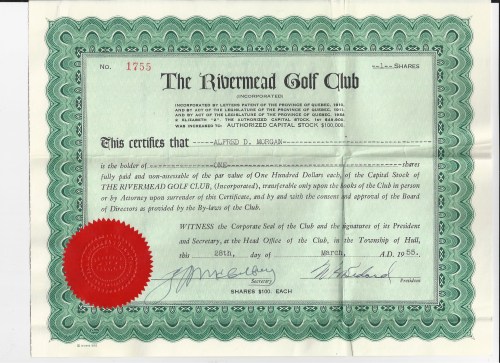
In 1955 my Dad received the following letter.

Scan0123

He had joined the Rivermead Golf Club in Aylmer, (now Gatineau) Quebec.  A life long golf nut, I am not sure where he played in the intervening years after the McKellar Park course that he grew up beside, closed in 1952.  I am now the proud owner of his membership share.

Scan0124

Yesterday I made the pilgrimage to play the Rivermead course with 3 friends for old time’s sake.

My Dad was a member for 10 years until his untimely death from cancer in 1965.  He played Rivermead 3 times a week.  I was his caddy several times and have fond memories of those days and the club at that time.  There were no electric carts in those days.  Everyone would walk, some carrying their golf bag and some using a pull cart.  I remember arriving with Dad and someone would pull his clubs out of the storage shed and shine them up.  There were dozens of employees serving others in this way.  It was a privileged life style.  We would then head out on the course walking.  There was a lot of banter among the group.  The one phrase I remember when someone sank a long put was “Lafayette, we are here!”

After the game I would be given a coke and a snackbar to enjoy outside while the men had a beer.  I also remember big pitchers of shandy – beer and ginger beer that my Dad let me try on a hot day.  It was the best of times.  All winter long Dad would read books on golf and strengthen his grip with rubber dog bones.  Periodically, he would exclaim, “I’ve found the secret!” (to improve his game for next year’s playing.)  I think he shot in the low to mid 80s – not bad for a weekend golfer.

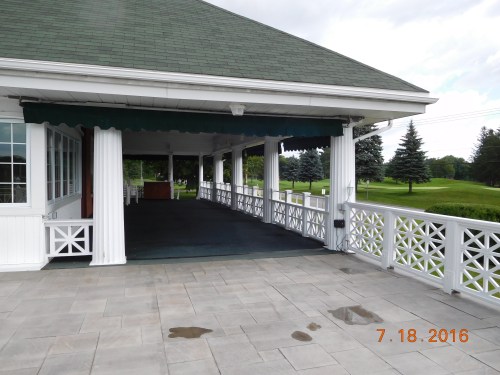
So yesterday in the blistering heat, here we are at the club, teeing off on this iconic golf course founded in 1910.  Of course I flubbed my tee shot – I was just too flooded with memories.  The course (unfortunately for me) was totally redesigned in the 1980s, so all the holes and layout have changed from what I remember.

The course is in immaculate green condition with baby skin fairways and extremely fast greens.  In the heat and wind it played long.  I found a bit of my game on the back 9 but failed to break 100.  It was a great day with a great bunch of guys.  Thanks Dad for the memories and thanks Steve, Larry and Tony for sharing this memorable day with me.

DSCN0174

DSCN0175

DSCN0176

DSCN0177


1 Comment

Filed under Uncategorized

Catholic and Ecumenical

`

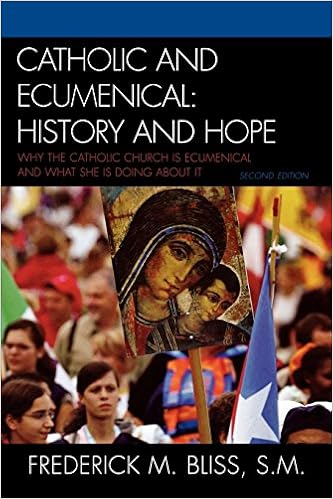
This is an interesting book on the relatively recent awakened ecumenical consciousness of the Roman Catholic Church.  The author traces in detail the history of schisms and the protestant reformation before going on the explain what dialogues are now firmly underway between the Church and various other Christian churches.  The guiding vision of “koinonia” he explains, is about building relationships with God, one another and the world rather than insisting on “a return to” or seeking only to reestablish the primacy of the Pope over all Christians.  It was the Vatican II Council that set this new tone and direction with such documents as Unitatis Redintegratio (Decree of Ecumenism) (http://www.vatican.va/archive/hist_councils/ii_vatican_council/documents/vat-ii_decree_19641121_unitatis-redintegratio_en.html ) The theologian Yves Congar is quoted many times and given much credit for this awakening.

While there is considerable hope for reunification between the Roman Catholic and Orthodox faiths, contemporary barriers to additional progress are many.  The nature of ecclesial communion remains a big stumbling block.  Catholicity requires communion i.e., union of all the local churches and with the church of Rome.  Congregationist and other non-episcopal churches have only loose bounds to each other by their very nature.  Ministry including recognizing the orders of other Christian communities, the role of women, marriage of clergy as well as the effective functioning of the papacy in a world community of churches, requires much much more investigation.  Finally, the presence of neoconservative movements is without doubt, antiecumenical and can impede progress.

The aim of intereligious dialogue is different.  The Church holds dearly that there is only one redeemer of people, Jesus Christ.  But the Church professes in Nostra Aetate (Relation of the Church to Non-Christain Religions) ( http://www.vatican.va/archive/hist_councils/ii_vatican_council/documents/vat-ii_decl_19651028_nostra-aetate_en.html ) that God has a means of extending salvation to members of other faiths by means we may not fully comprehend.  A second conciliar teaching is that the right to religious freedom has its very foundation in the very dignity of the human person.  It is acknowledged that these non-Christian religion do immense good in this world.  Consequently the Church rejects nothing that is true and holy in them.

The author falls short of mentioning what can and is taking place between the Church and members of Traditional Religions (native African and other indigenous peoples religions).

I found this book informative but was disappointed that there is no call to action for lay people.  There is little or no mention of the appropriate role of the laity in ecumenism and interfaith dialogue.  Such dialogues are going on between committees of church authorities and theologians behind closed doors.  While progress is being made, it is not something we hear about on Sunday morning.  We are increasingly aware of such organizations as the World Council of Churches and the annual prayer service for Christian unity.   However at the local level, we are often not sure of ourselves and may look to our clerics for direction.  Perhaps there is need for a sequel on how lay people can take more control and get involved in the ecumenical movement.  This could help us ward off the troubling trend we see around us that “a stranger is an enemy”.  It also might help families deal better with mixed marriages, multiple religious traditions and neigbours in our increasingly pluralistic world.


(ISBN 1-58051-056-6 , 1999)


Leave a comment

Filed under Uncategorized

A Confederate Soldier’s Prayer

As I was reading this prayer this morning I was thinking it was written by a Saint or someone like Henri Nouwen.  To my surprise, it was composed by an unnamed Confederate soldier, presumably during the U.S. Civil War 1861-65.

As America seems to be at war with itself again, it is a great prayer I thought worth sharing for its humbleness and hope.

Scan0122

From Magnificat Year of Mercy Companion 2016


Leave a comment

Filed under Uncategorized

Kicking Ottawa’s ***

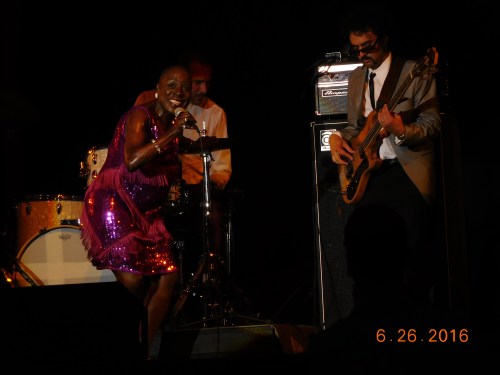
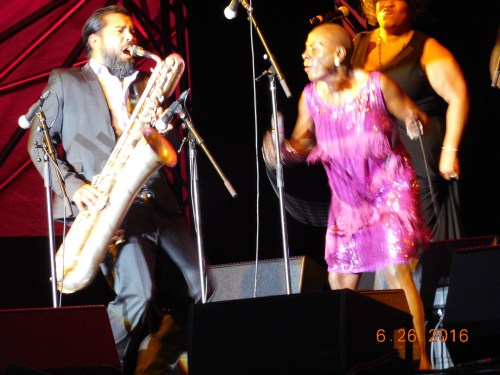
Last night at Jazzfest, Sharon Jones, a 60 year old cancer patient from SC, sang her brand of retro ‎funk/R&B into Ottawa history.  One of her band mates announced at the end of the show “Ottawa you just got your butt kicked by a 60 year old cancer patient.”
For 90 minutes she kept 6000 pairs of eyes and ears riveted on her expressive face, shimmering purple dress‎ and bald head. Recovering from recent chemo therapy, she sang one song aptly named ‘get up and get out’ which she explained is directed at her cancer.
She admitted when she gets a mike in her hand and an audience in front of her,‎ she goes crazy.  Not knowing if she was going to drop dead from exhaustion, we held our breath and our seats until right near the end.
Ex gospel singer and prison guard‎, she hit the big time at age 40 and has not looked back since. The 8 piece Dab-Kings were as tight as a drum and they too looked a little amazed at Sharon’s energetic antics. Dedicated to getting America up and dancing again, they knew their place and did not overshadow.  Two accompanying female singers added to the night’s experience which was already very hot.
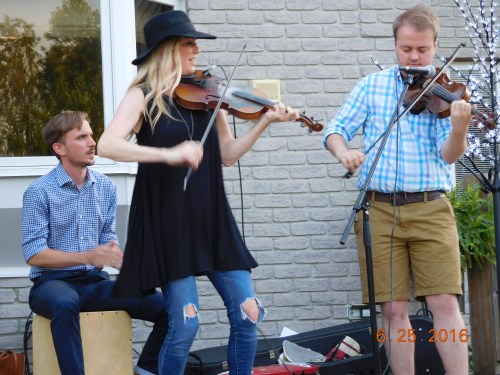
On Saturday night we had our butts kicked as well by a virtuoso ‎Cape Breton fiddler named Anna Ludlow. With her 2 piece ensemble, she fiddled her way into our hearts at a great private concert. Wow, she sings and composes too. Tall and engaging, she also teaches the fiddle and demonstrated the subtle differences between Cape Breton and Ottawa Valley styles.  Again we sat glued to our chairs except for a daring few.
So give us another chance Anna and Sharon.  Once our butts heal from this drubbing, we will dance at once the next time, promise!!!‎
DSCN0097
DSCN0100
DSCN0102
DSCN0101
DSCN0105
DSCN0090
DSCN0089
DSCN0092
DSCN0091
DSCN0096

1 Comment

Filed under Uncategorized