From Year of Mercy to Life of Mercy


Pope Francis yesterday called on all Christians to reject the trappings of “power or glory,” and to embrace a life that’s “free, faithful, poor in means but rich in love.”  Such a lifestyle, the pontiff suggested, would be the real legacy of his Year of Mercy.

Pope Francis closes the Holy Door at St. Peter’s Basilica signifying the end of the extraordinary Jubilee Year of Mercy

From his earlier talks and writings on mercy:

Lord Jesus, mercy is the ultimate and supreme act by which God comes to meet us.  Mercy, as regards external works, is the greatest of all virtues. It is proper to God to have mercy.  Through mercy God’s omnipotence is manifested to the greatest degree. The very salvation that God offers us is itself the work of his mercy.

God’s mercy is great, forgiving us by caressing us.  The steadfast love of God never ceases; his mercies never come to an end.  They are new every morning.

Divine Savior, your invitation to mercy is intended to draw  us into a deeper imitation of God our Father: “Be merciful, as your Father is merciful” (cf. Lk 6:36).  Your gaze, O Jesus makes us feel an interior wonder, and makes us hear your beckon: Follow me.

Mercy is the bridge that connects God and the human being , opening our hearts to a hope of being loved forever, despite our sinfulness.  Mercy brings us peace!

To become merciful, we mist first acknowledge that we have done many things wrong: we are sinners!  I need to know how to say: Lord, I am ashamed of what I have done in life.  With this attitude of repentance I will be more capable of being merciful, because I will feel God’s mercy upon me.

To become merciful, I need an openness to expanding my heart.  Shame and repentance expand a small , selfish heart, since they give grace for God to forgive us.   A big heart does not get entangled in other people’s lives.  It does not condemn, but forgives and forgets.

The way of mercy is the way of life.  A Christian must necessarily be merciful , because this is the center of the Gospel.  Mercy overcomes every wall, every barrier, and leads us always to seek the face of the other – of the person.  And it is mercy that changes one’s heart and one’s life – that can regenerate a person and allow that person to integrate into society in a new way.

True mercy takes the person into one’s care, listens to the other attentively, approaches the situation with respect and truth, and accompanies that person on the journey of reconciliation.  Love can never be just an abstraction.  Mercy means first treating others wounds.  And mercy means neither generosity nor rigidity.  Whenever we have an opportunity to perform a work of mercy, we should rejoice as if a fountain has been let loose so that a fire might be extinguished.

And you, our Lady, through your grace, your intercession, and your example, deliver us from all evil and untie the knots that prevent us from being united with God, so that we, free from sin and error, may find him in all things, may have our hearts placed in him, and may serve him always in our brothers and sisters.

Amen.


(source Magnificat Year of Mercy Companion)



Leave a comment

Filed under Uncategorized

America at War with Itself

Written by ultra-liberal American/Canadian Henry Giroux just prior to the election this year, it is a diatribe on the societal fault lines that Donald Trump has exploited to gain political power.  He cites the following trends as evidence of a disturbing turn to authoritarianism in the U.S:

  • state sanctioned violence against afro-Americans (racial profiling, police shootings, high incarceration rates)
  • state tolerated lead poisoning of 6000 children in Flint, MI due to corrosive water
  • gun lobby which resulted in 2,525 children and teens dying of gunfire in 2014
  • corruption of the U.S. media who are more interested in building advertisers revenue than doing in-depth analytical reporting
  • blaming of immigrant Muslims for terrorism and Hispanics for stealing jobs
  • increasing militarization of U.S. foreign policy instead of dialogue

Donald Trump is a demagogue authoritarian who has and will say anything to gain power.   He does not ask the electorate for a sacrifice and is unconstrained by ideology.  He is interested only in power for power’s sake and the effect that he has on people.  Very scary and dangerous indeed.

Giroux’s hope is that broad based youthful social groups such as Black Lives Matter and the Occupy Movement will lead a broad social revolution in the U.S. that will address the root causes that are leading to the fracturing of their society along ethnic, social, religious and economic lines.

And now we see the Not My President protests beginning.  Let us hope that this movement will remain peaceful and lead to real social, economic and ethnic relations progress and change in the U.S.   I and many others have our doubts and fears.

Image result for not my president

A timely read, 4 out of 5 stars.


Leave a comment

Filed under Uncategorized

Stop the Kinder Morgan Pipeline Expansion Now


From 1974-78, I was a process engineer working at the now defunct Imperial Oil Ioco refinery on Burrard Inlet near Vancouver, B.C..  In the photo below, you can see how beautiful the setting was.

Image result for ioco refinery

It was an opportunity to put my university training into practice. In those days, Ioco received light Alberta crude oil via the Trans Mountain pipeline and turned it into refined petroleum products such as gasoline, diesel, propane, bunker oil and asphalts.

As a “contact” engineer my job was to interact with the refinery operators, monitor, report on and optimize the operations.  I was initially assigned the pollution control units of the plant that do the cleanup and then to the crude unit that did the major distillation splitting of the crude oil as it entered the plant – about 40,000 barrels a day then.

I remember peering into red-hot furnaces where the pipes containing crude oil would be glowing red, climbing towers to inspect gauges and equipment, and urging the operators to open the valve a little more to increase production.  We wore a little fabric H2S indicator that if it turned brown, meant you were being poisoned and to get out right away!  It was the best of times and the worst of times.

Image result for Ioco refiner closure

Well, Ioco refinery closed in 1995 and was converted to a products terminal.  It now receives refined petroleum products from Alberta via the Kinder Morgan (former Trans Mountain) pipeline and ships them out by barge, tanker, truck and rail, all over B.C.

Image result for kinder morgan pipeline


The Kinder Morgan company also sends unrefined heavy (oil sands) crude oil to Vancouver now for trans-shipment to foreign refiners via tanker.  They propose to expand the capacity from 300,000 barrels to about 900,000 barrels/day by twinning the line.  This is causing much consternation among indigenous and local communities along the route.  They are concerned about:

  • increased risk and environmental impact of pipeline break and spill
  • increased risk of shoreline leak at the Burnaby tanker terminal
  • increased risk of tanker leak in the Burrard Inlet, Vancouver harbour and up and down the lower Mainland coast

I tend to sympathize.  Oil sands crude is very thick and although mixed with a dilluent, would tend to make a spill extremely hard to cleanup as it would be very sticky, heavy and coating.  Going from 2 outgoing tanker loads/week to 6 or more certainly does increase the risk of an accidental spill that could damage nature and wildlife for many years to come.  Finally, the motive of Kinder Morgan is to make profits for its shareholders.  Is this a valid reason to increase the risk of such devastation to people’s livelihoods, communities and to nature?

Image result for kinder morgan burnaby tanker terminal

I say no, despite my nostaligic fondness for the industry, that pipeline and the engineers who build and maintain it.  Stop the pipeline expansion now!  And consider making your next car purchase a hybrid or electric one to reduce fossil fuel demand and reduce carbon emissions!

Express your opinion on this important decision to Prime Minister Trudeau by signing the petition to stop this pipeline expansion now.

Dave


1 Comment

Filed under Uncategorized

Wilno

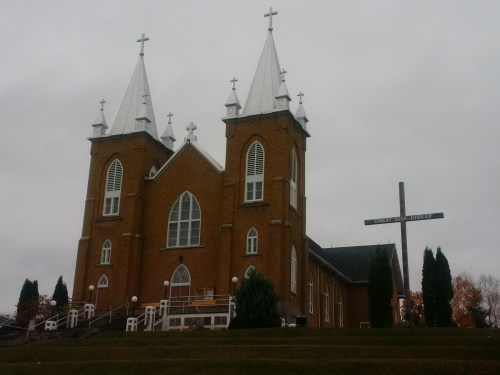
Wilno (Polish for Vilnius) is the first and oldest Polish community in Canada.  Located between Barry’s Bay and Eganville in Ontario, it was first settled in 1848 by families from the Prussian area of Poland.  It has fascinating cultural history such as the tradition of  building crosses at cross roads.  Our pastor in Arnprior, Fr. John Burchat is directly descended from these immigrant families.

Last Saturday Marie and I went on a pilgrimage to Wilno with our Divine Mercy friends.  The occasion was the Feast of Saint John Paul II.  The day retreat was led by Fr. Dan Dubroy, Ottawa Archdiocese and assisted by St. Mary’s pastor Fr. Jan Wadolowski, OMI and St. Casimir Associate Pastor Fr. John Bosco Gali, OMI, located in nearby Round Lake.  Frs. Jan and John are from the Assumption (Polish) Province of the Oblates of Mary Immaculate.

img_20161022_102641

img_20161022_102739

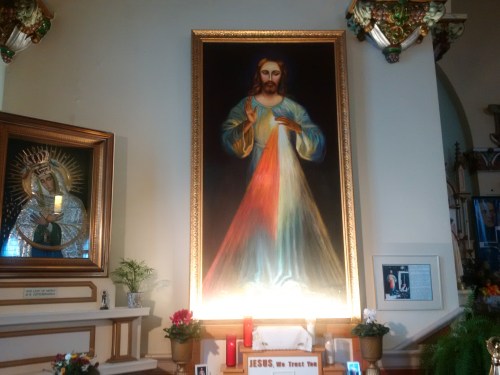
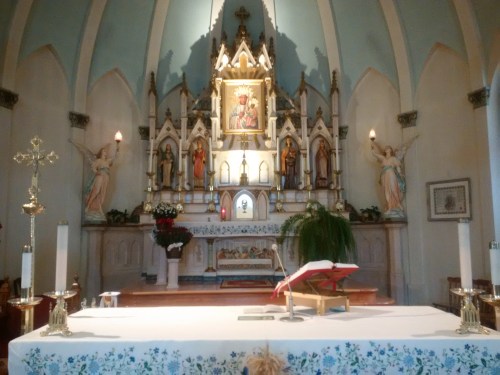
We were truly amazed at the size and beauty of St Mary’s Church, high on the hill overlooking the gorgeous fall colours of the Ottawa valley.  It hosts a number of special icons.  In particular:

  • a specially commissioned Divine Mercy painting from Vilnius, Lithuania
  • Our Lady of Sorrows from the Vilnius Gates of Dawn Chapel (visible at left below)
  • Our Lady of Czestochova above the altar

img_20161022_102134


img_20161022_100919

img_20161022_100927

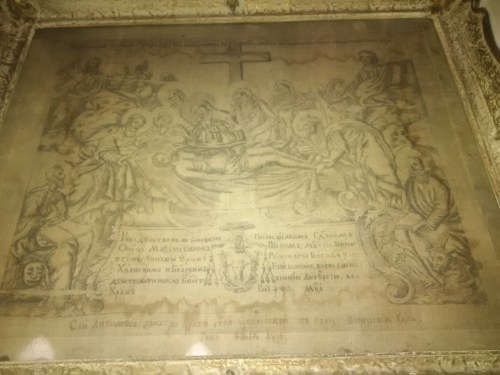
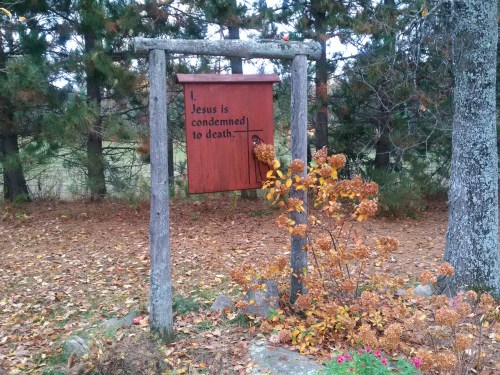
Because we had visited Saintes-Maries-de-la-Mer in Provence where as the legend goes, the Three Marys landed in exile, I was particularly intrigued by an etching depicting the Three Marys mourning the death of Christ.  Presumably these were Mary Magdalene, Mary Salome and Mary of Clopas.

img_20161022_103751

img_20161022_104020

We had a very full and holy day filled with prayer, reconciliation, Eucharist, adoration, veneration and stations of the cross.  At lunch I chatted with Fr. Jan and Fr. John who were delighted to meet an Oblate Associate from Lacombe Province.

img_20161022_151742

img_20161022_154546

We tried to get a group picture outside but it was too windy and cold.  We chanted “JP2, we love you!” to stay warm.

img_20161022_160240

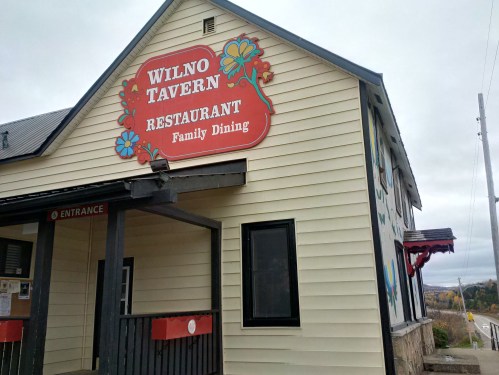
On the way home we stopped at the famous Wilno Tavern to pick up some delicious cabbage rolls and pirogues for dinner.  A wonderful spiritually meaningful day’s outing in this Jubilee Year of Mercy.

img_20161022_161403_hdr

img_20161022_102445


2 Comments

Filed under Uncategorized

Ta-Nehisi Coates

Coates delivering the keynote speech at the University of Virginia's 2015 Community Martin Luther King, Jr. Celebration

Between the World and Me.jpeg


Is an award winning author who writes for the Atlantic about cultural, social and political issues affecting African-Americans.  I picked up his latest book Between the World and Me from the library.  It won the 2015 National Book Award for non-fiction.

The book is in the form of a letter to his son about U.S. history, endemic racism and the ongoing fear this invokes in black people.  He explains to his son that as an African-American male, he is in constant fear of having his “body broken” by the police.  Even if it is a misunderstanding, an error or an “over-reaction”; a black man in the U.S. today (and since day 1 of the Republic), can be beat up, shot, clubbed, kicked and locked up to die at any moment, by police.

This came as a real shocker to me. There is real terror everyday for black Americans that I as a white person cannot see, feel or appreciate. The streets are a very dangerous place.  African-Americans live in fear of their life everyday.  The gangster rap, bravado and crime we see are just a mask for real gut wrenching fear.  They have no perceived control over their bodies which can be broken at will at any time.

I was disappointed when Ta-Nehisi said “I will not retreat into religiosity” and “I live a Godless life.”  It’s as if he has no soul and his body is the only thing – which of course he does not freely have in American society.  They can never take away your soul Ta-Nehisi.  Perhaps you know this at a deep level – your wonderful prose certainly betrays to me the existence of your beautiful soul.

A little girl’s recent plea for peace, justice and en end to violence in Charlotte, NC breaks my heart:

http://www.independent.co.uk/news/world/americas/zianna-oliphant-charlotte-police-city-council-meeting-keith-scott-death-jennifer-roberts-kerr-putney-a7335156.html

A very gut-wrenching, touching book easy to read in a couple of days.  10 out of 10.

However, not all succumb to “the spirit of fear”.  Witness this reflection by Cardinal Robert Sarah*:

sarah31

“A Godless society, which considers my spiritual questions a dead letter, masks the emptiness of its materialism by killing time so as better to forget eternity.  The farther material things extend their influence, the more man takes pleasure in sophisticated, narcissistic, and perverse amusements; the more man forgets God, the more he observes himself.  In looking at himself, he sees the deformations and the ugliness that his debauchery has encrusted on his face.  Then, to delude himself that he still shines with the original splendor of a creature of God, he puts on his make-up.  But the hidden evil is like the glowing coal beneath the ashes.

Without God, man builds his hell on earth.  Amusements and pleasures can become a true scourge for the soul when it sinks into pornography, drugs, violence, and all sorts of perversions.

There is great sadness in claiming to want to indulge in limitless pleasures, whereas the most beautiful joy is to remain simply with God, allowing him to clothe us in light and purity….

The man who ignores God and turns his own instincts into godlike standards for all things is headed for destruction.  Today we are confronted with one of the last stages of the civilization of diversion.  The alternative is simple: if mankind reforms itself, it will live, but if its headlong flight persists, civilization will become a hell.”

*Interpreting the Present Time from God or Nothing, A Conversation on Faith  (Ignatius Press, 2015).


Leave a comment

Filed under Uncategorized

Four Last Things: Death, Judgment, HEAVEN and HELL

Ladder of Divine Ascent icon, St. Catherine’s Monastery, Sinai, Egypt

Heaven is the state of existence we as believers wish to enter into in after our bodily life and death.  Also known as eternal paradise, it is the culmination of our divinization, the ultimate end and fulfillment of the deepest human longings, the state of supreme, definitive happiness (CCC 1024).

And there will be no more night; they need no light of lamp or sun, for the Lord God will be their light, and they will reign forever and ever. (Rev 22:5)


Illustration of Hell from the Hortus delicarium by Herrad of Landsberg

Hell is eternal fiery punishment for refusing to love God and the consequence of dying in mortal sin without repenting and accepting God’s merciful love.  It is a place or state of torment where we remain separated from Him for ever by our own free choice (CCC 1033).

Depart from me, you who are cursed, into the eternal fire prepared for the devil and his angels. For I was hungry and you gave me nothing to eat, I was thirsty and you gave me nothing to drink, I was a stranger and you did not invite me in, I needed clothes and you did not clothe me, I was sick and in prison and you did not look after me. …whatever you did not do for one of the least of these, you did not do for me. (Mat 25:41-43)

This Catholic Plan of Salvation sums up the LAST FOUR THINGS very nicely.  Start at ‘Begin Here’ at the bottom left and follow the arrows (rather than the numbers).

Image result for Roman Catholic plan of salvation

May God’s peace and eternal salvation be with you.

Image result for face of God in Heaven


Leave a comment

Filed under Uncategorized

Four Last Things: Death, JUDGMENT, Heaven and Hell

Image result for st michael weighing souls

Detail of St. Michael weighing of souls from a frescoe in a church in Burgos, Spain

Continuing our discussion of the last four things we believe in the RC Church, we come to Judgment.  However we must first talk a bit about sin and the sacrament of confession.

Sins are evaluated according to their gravity.  The Church teaches that there are 2 kinds of sin: mortal sin and venial sin.  For a sin to be mortal, three conditions are necessary: it’s a grave matter; it is committed with full knowledge and it is committed with full consent (CCC1857*).  A grave matter is specified by the Ten Commandments and there is a relative gravity among sins: murder is graver than theft, violence against parents is graver than against a stranger (CCC1858).

Mortal sin destroys charity in the heart of a person and turns them away from God – there is a rupture.  One commits venial sin when in a less serious matter, one does not observe the standard prescribed by the moral law or disobeys the moral law in a grave matter without full knowledge or complete consent (CCC1862).  Venial sins are every day faults that only weaken charity and impede a soul’s progress in the exercise of virtues.  If repeated they can however lead to mortal sin (CCC1863).

All mortal sins must be recounted to a priest in the sacrament of confession (or reconciliation) after a diligent self-examination of conscience (CCC 1456).    Confession of venial sin while not strictly necessary, is recommended (CCC1458).  Adults must confess their sins to a priest at least once per year (CCC1457).  Mortal sins can only be forgiven while we are alive and not after death.  Unconfessed venial sins can be forgiven after death.
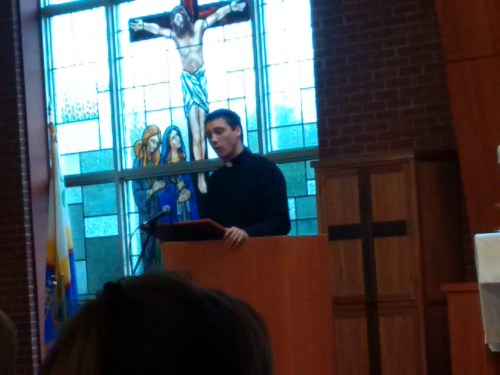
While we are living, all confessed sins are given absolution by the priest (who becomes Jesus) i.e., are forgiven provided that you are truly sorry and will honestly try not to sin again (CCC1449).  Penance (temporal punishment) is assigned as a necessary purifying step to restore us back to a state of God’s grace.

Image result for sin

We can now proceed to discuss judgment of which there are two phases:

  1. The Particular Judgment (CCC 1021-22)
  2. The Last Judgment (CCC1038-41)

When we die, our soul leaves our body and proceeds to the Particular Judgment.  Death puts an end to the time open for each of us to accept or reject divine grace manifested in each of us receives our eternal retribution in our immortal soul: either entrance into heaven – through a purification or immediately – or, immediate and everlasting damnation.

Those who die in God’s grace and friendship (i.e., free of all temporal punishment) are already perfectly purified and live forever in Christ thereafter (their body and soul are reunited and go to heaven immediately).  Those who are not yet perfectly purified from the “residue of sin” (Fr. Wade’s words) are assured eternal salvation but first must undergo purification in Purgatory which is also called The Final Purification) (CCC1030).  Those who die with unconfessed mortal sin proceed immediately to Hell.

Image of a fiery purgatory by Annobale Carraci

This doctrine of Purgatory was formulated at the Councils of Florence and Trent.  The two scripture quotes supporting this period of cleansing are:

 If it is burned up, the builder will suffer loss but yet will be saved—even though only as one escaping through the flames. (1 Cor 3:15)

These have come so that the proven genuineness of your faith—of greater worth than gold, which perishes even though refined by fire—may result in praise, glory and honor when Jesus Christ is revealed. (1 Pet 1:7)
Once in Purgatory there is indeed suffering (a purifying flame) and you are not permitted to see God’s face. The length of time there is proportionate to the number and seriousness of the sins you committed. The living can shorten the stay of a soul in purgatory by having Masses said for them, by praying for them and by doing good works for them.  When one leaves Purgatory their body and soul are reunited and immediately go to heaven.
At the Last Judgment, upon the second coming of Christ, all the dead will be resurrected and along with those still living, will proceed to judgment. Our body and soul will be reunited at this time.  Those who have done good works (sheep) and those who have done evil (goats) will be separated by Christ.  The sheep will enter into eternal life and the goats into eternal punishment.   There is much scriptural reference of this e.g. Mat 7:13-23.  This last judgment seems entirely based on help given or refused “to one of the least of my brethren.”  However, their was one sin that can never be forgiven according to Jesus and that is blaspheming the Holy Spirit.
Last Judgement (Michelangelo).jpg

Michelangelo’s The Last Judgment

Your comments on and questions on the above are solicited and always welcome.
*CCC# refers to the referenced paragraph in the Catechism of the Catholic Church, Canadian Conference of Catholic Bishops, c. 1994.

Leave a comment

Filed under Uncategorized

Four Last Things: DEATH, Judgment, Heaven and Hell

Image result for christian death


Death was the subject of Fr. Wade Menezes, CPM, first conference in Ottawa Sept 30 – Oct 1/16.  Not the most enlivening subject but it is essential that we understand and prepare for it.  Having gone through RCIA 23 years ago, I have forgotten the details of what the Church teaches on this subject.  Hence I needed a refresher.  Fr. Wade’s teachings were drawn directly from the Catechism of the Catholic Church (CCC) and sprinkled with frequent scripture references:

For the wages of sin is death, but the free gift of God is eternal life in Christ Jesus our Lord.  (Romans 6:23)

And everyone who lives and believes in me shall never die. (John 11:26)

The last enemy to be destroyed is death.  (1 Cor 15:26)

  • death is the end of our earthly life (CCC 1007)
  • God the Creator had intended man not to die
  • death entered the world as a consequence of sin (CCC 1008)
  • Jesus accepted death willingly as an act of submission to the Father
  • death is transformed into a blessing by Jesus Christ (CCC 1009)
  • through our Baptism, we have “died with Christ” sacramentally in order to live a new life (CCC 1010)
  • physical death completes this “dying with Christ” so that we can live with Him again
  • death is the end of our earthly pilgrimage (CCC 1013).
  • God offers us his grace and mercy right up to the moment of our death, so that we may work out our earthly life in keeping with the divine plan and to decide our ultimate destiny
  • our goal is to die a happy death in a state of God’s grace
  • we should prepare ourselves for the hour of death (CCC 1014)
  • “From a sudden and unforeseen death, deliver us, O Lord.”(Litany of the Saints)
  • ” Mother of God, pray for us at the hour of our death” (Hail Mary prayer)

To die in a “state of grace” means at the moment of death to be free of unabsolved sin and ideally of any “temporal punishment” associated with absolved mortal or venial sin.  At the moment of death, our soul is separated from our body (temporarily).  More on the subject of JUDGEMENT to follow.  St. Joseph is the patron saint of a happy death, something I did not know:

Image result for st joseph happy death

Fr. Wade went on to explain that the taking of morphine or other pain killers for comfort purposes when the body is in the process of shutting down for death, is completely acceptable.  However, requesting assisted suicide i.e. premature to the body shutting down for death, goes against natural law and hence is not permitted.

Epilogue

Since beginning to draft this post, thousands of people have died suddenly and unexpectedly.  I am thinking of the 900+ who were killed in Haiti in the recent hurricane, people who were killed in Aleppo, Syria and elsewhere as a result of war and people killed in accidents, one right near our Arnprior home.  Were they prepared?  It underlines for me the need to prepare spiritually for death as outlined above, which can and often does come unexpected.

Finally, I attended a funeral for a middle aged man who apparently committed suicide.  It was a somber one but one also filled with hope.  The pastor said that the family members should not dwell on the feeling that they could have done more to prevent this tragedy.  We cannot save those we love – only Jesus can.   Furthermore, Jesus turned to this man at the moment of his death and said “Peace be with you, I give you my peace.”

Amen.


Leave a comment

Filed under Uncategorized

Surprising Spititual Connections


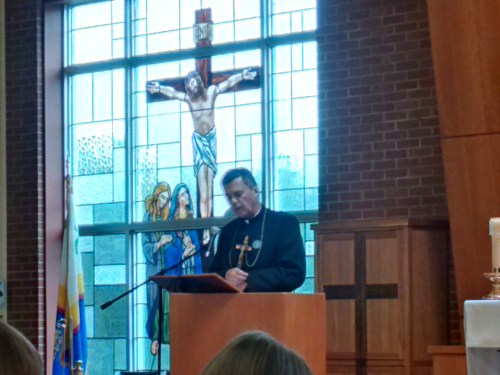
Marie and I had the great pleasure of attending a weekend conference sponsored by the Motherhood of Priests Apostolate in Ottawa at which Fr. Wade Menezes, CPM preached. You may have seem Fr. Wade on EWTN – he is a frequent visitor and conducts his own programs there from time to time.  A very dynamic and forceful young preacher, we learned a lot about the Four Last Things: Death, Judgement, Heaven and Hell, which I will post on separately.

Noticing his large cross looked much like my small Oblate Cross, I was intrigued.  Then he said that their order, was originally called the Missionaries of France and had been founded by Fr. Jean-Baptiste Rauzan in Lyons in 1808.  So, after checking, it turns out Fr. Rauzan knew Fr. Eugene de Mazenod and invited him in 1815 on more than one occasion to join the fledgling  MoF community.  Perplexed as to what to do,  (St.) Eugene was inspired by the Lord to instead found his own mission society in 1816, which eventually was named the Oblates of Mary Immaculate.  This was to meet the needs of Aix-en-Provence area parishes for missions preaching.  Hence, by his example, Fr. Rauzan must have influenced St. Eugene to take this initiative in response to the call by Pope Pius VII to form mission societies to help restore the French church to health.

The Missionaries of France were suppressed briefly around 1830 in response to political turmoil in France which outlawed religious societies.  Fr. Rauzan spent the time in Rome drafting up a constitution and rules and in 1834 received papal approval for his order, renamed the Fathers of Mercy and consecrated to the Immaculate Conception.  In 1839, they began sending missionaries to the U.S. to help attract fallen away Catholics back to the Church.  Now based in the U.S., the Fathers of Mercy home is in Auburn, KY.  Their  mission remains to preach missions to parishes at the request of the local pastor.  And what a great job they do!  I was delighted, as an Oblate Associate in Lacombe Province Canada, to discover and revel in the founding spiritual connection between Fr. Wade’s order and the Oblates some 200 years ago.

For more info on the Fathers of Mercy, you can go to: http://fathersofmercy.com/

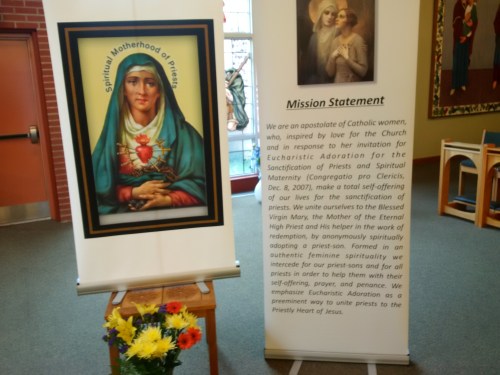
The Motherhood of Priests Apostolate is a growing women’s ministry formed in Ottawa whose mission is to pray for the sanctification of Catholic priests.  They have as many as 200 members.  It is a beautiful ministry and we were glad to be part of their annual conference which was open to the public.  You can find more info about them at:  http://www.spiritualmotherhoodofpriests.ca/

Here are a few photos from this event held at Holy Redeemer Church in Kanata, ON.

img_20161001_112446_hdr

Fr. Wade makes a point

img_20161001_111533

Motherhood of Priests Mission Statement

img_20161001_090953

Music ministry from St Morris Parish was great

img_20161001_094721

Fr. Mathew Chojna, Associate Pastor Holy Redeemer

https://i0.wp.com/www.eugenedemazenod.net/wp-content/uploads/2016/09/Chapitre.jpg


Leave a comment

Filed under Uncategorized

Percherons, Clydesdales and Belgians

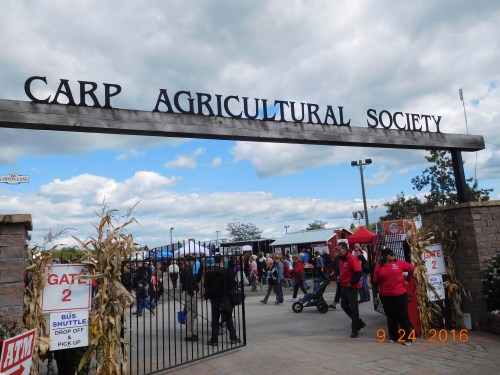
We attended the 153’d annual Carp Agricultural Fair on the weekend with some friends. We fell in love with the draft horses!

dscn0423

A draft horse is a large horse bread for work. There are several breeds all known for there strength, patience and good temperament.  Used less for farm work these days, they are used for driving carriages, for breeding and for horse show purposes.

There were a quite a number of draft horse competitions.  We saw the 6 hitch horse show competition.  There were 22 entries for a total of 132 horses who came from Quebec, New York and Ontario.  It was an absolutely beautiful show.

dscn0436

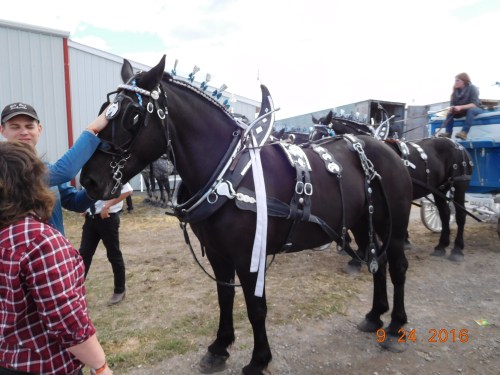
We saw 3 breeds in action: Percherons with their strong war like appearance:

dscn0439


Clydesdales with their beautiful pom pommed ankles:

dscn0441

… and palomino-like good looks:

dscn0443

The Belgians took first place this year – such majesty, calmness and affection.

dscn0437

dscn0446

But my favorite remain the percherons – these dark horses break your heart for their gentle obedience, vast strength, fierce pride and showmanship.


DSCN0427.JPG

There is lot’s more to see at the Carp Fair.

dscn0428

Dog jumping contest

dscn0429

Huge harvester

An assortment of “hit and miss” gasoline motor powered pumps and grinders from long ago.

We also saw Tracey Brown of the former award-winning Family Brown country music group, sing.  We will be sure to bring Wyatt and Jackson our two grandsons next year.  They will love it too!

2 Comments

Filed under Uncategorized