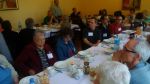
People on the Bus

A summary of our pilgrim group makeup.

Fr. John Fletcher CC, is Chaplin at Wayne State U. In Michigan. From Buffalo, NY, he joined the Companions of the Cross at age 30. A very dynamic and skilled preacher who connects well with all.

Fr. Albert MacPherson lives at a Augustinian priory in Lawrence, Mass. From Cape Breton, he has spent some time at Madonna House in Combermere, ON. Specializes in healing mass ministry in many different places.

Fr. Tim Devine, CC is pastor at St. Maurice Parish in Ottawa. Almost totally blind, he is a very joyful, humorous and passionate Priest. He also is a talented song writer and musician who has won a Juno award for his gospel music. He hails from Waterloo, ON.

Stan Bielec, our tour organizer. Of Polish origin, his goal is to get the message of Divine Mercy out to the world. Quick to laugh, he is very adept at handling every type of group tour situation.

His wife, Maria. Full of joy and goodwill, helps share the load with Stan‎, She does real-time translation in each church we visit‎ and smiles continuously. She and Stan live in Ottawa.

41 others involved in all kinds of ministry. They live in:
– Newfoundland
– Michigan
– Australia
– Toronto, Simcoe, Kingston and Belleville areas
– Ottawa (from parishes all over the city)
(2 people from San Diego and 2 from the U.K. cancelled due health reasons.)

We are blessed to be part of this dynamic group. Note this is the 4th time Stan has escorted a Divine Mercy pilgrimage. There is another trip planned for the Fall of this year. (See JPII Centre website for further info.)

1 Comment

Filed under Uncategorized

Day 7 – Czestochowa (pronounced chestahova)

(We apologize in advance for the length of this and some other posts – there is so much to report on!)

HAPPY MOTHERS DAY TO ALL MOTHERS!

On leaving Plock, we cross the broad Vistula River. We wend our way through ‎small towns, yellow fields of canola and apple blossom lined roads. We soon find ourselves in Swinicach at St. Casimir’s Church where St. Faustina was baptized. Dave has time to find her parents’ grave site. There is half a dozen family members polishing the crypts of deceased family members. There are flowers on virtually every tomb and some have lighted candles.

We ‎move on to her house in Glocowiec where she was born in 1905. It is a small well maintained 3 room house the family of 8 lived in. Out back they have Stations of the Cross, a stone altar, a walking path and benches to meditate on. The green farm fields stretch out far beyond.

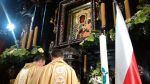
After a Polish lunch feast, we head for Czestochowa. The Black Madonna Icon – Mary Queen of Poland resides here. It is one of the most attended Marion shrines in the world – 4 to 5 million visitors each year. Stan says people will drive 500 km to pray one decade of the Rosary before Our Lady. Peter from Australia quips he would even stay for 5 decades.

After dinner we walk over to the Chapel and manage to squeeze into the front to get a good view. Ah, there she is with baby Jesus in all Her glory. You would not believe the number of people of all ages crowding in to pray the Rosary in front of the Black Madonna. We participate in Polish as best we can and then squeeze our way out.

In the morning we are given the honour of celebrating our Mass in the Chapel with Fr. John Fletcher, 99. Marie and I are seated in the front row not 20 feet from Our Lady. Pilgrims crawl continously round the perimeter of the chapel for special intentions. Fr. John says it is easy to be Catholic in Poland, but what are we personally going to do when we get home?

We tour a museum. We learn that the Black Madonna is a ‎634 year old painting from Byzantium. The story is told that Poles prayed so much to this icon of Mary and Jesus over the years, that the smoke and soot from candles blackened her image.

Much history of fighting over this and other icons occurred in Poland. Mary emerges as saving Poland through the window of Czestochowa. She is Queen of Poland. Many different “robes” have been created and used over the years to frame Mary and Jesus in the icon that we see today.

Mary is also seen as having saved John Paul II‎ by redirecting the bullets away from his heart and jamming the assassin’s gun. ‎Poland has 32000 priests and 30000 nuns out of 40 million population.

We are now off to Krakow for the week ahead.

Leave a comment

Filed under Uncategorized

Day 6 – Plock

We wake up an hour early having failed to adjust our watches for the time change. This gives us an opportunity to walk around a very modern looking medical university and do a few laps on an adjacent sports track.

On our way out of Bialystok, we stop at ‎St. Rocha church. Only 50 km from the Belarus border, Mary Queen of Poland faces the Soviet frontier, protecting the Poles.

‎At the Convent of the Sisters of Holy Mercy in Plock, we learn that St. Faustina worked in the kitchen here helping to bake bread. It was here in 1931 that this mystic had the first vision of the Divine Mercy image. The room she had this apparition in was in a building that the Communists destroyed during their 35 year tenure.

The Sisters are in the midst of restoring the facility originally built in 1896 including adding a new Chapel of the Divine Mercy.‎ They lack the money to set a fixed schedule but are confident the resources needed will come. They also want to minister to troubled youth who stay out all night drinking here.

After dinner, Mother Superior takes us on a walk around the town. There is a central square with outdoor cafes. The city hall faces and there are stalls for market day. They hold concerts and dances here. We continue and suddenly we find ourselves on a high bank overlooking the broad Vistula. It is almost sunset and groups of people gather to salute the sun. We pause for photos in an unbelievably beautiful place.

Tomorrow it’s off to Jasna Gora, home of the Black Madonna.

1 Comment

Filed under Uncategorized

Day 5 – Bialystok

Making our way back into Poland, we stopped in Sokulka at St. Anthony’s Church. Here is where Blessed M. Sopocko had two more Divine Images created. One has stayed here and the other is in Bialystok. 2 days before Fr Sopocko was beatified, during holy communion, a host fell on the floor. It was placed in water to dissolve. The next day when they looked at it, there was a red splotch in the centre of the undissolved host. When analyzed, it turned out to be type AB blood, the type of blood reported in other Eucharistic miracles. This is the blood of Christ.

At the Shrine of the Divine Mercy in Bialystok we venerated Blessed M. Sopocko’s remains as well as relics of St. Faustina and Pope John Paul II. Fr Sopocko died here in 1975 and was beatified in 2004. Dave read the first reading during Mass. A modern large church all white inside. Some rivalry between this much larger church and the Shrine of Divine Mercy (Chapel) in Vilnius is evident. A photo of a hologram of the Paraclete (Holy Spirit) here is attached.

One thing very evident in Polan‎d is the living strength of their Faith. Churches are full of people of all ages whenever we enter them. They have not lost their faith as have some other European countries like France. Perhaps because they have had to fight for it – they value it more.

Example. During the Communist regime, the image of the Black Madonna was actually arrested and put in jail – true story! Mary is the Queen of Poland and this was seen as a challenge to the Soviets. Poles responded by circulating the empty picture frame as an icon and proudly marched it through the streets of towns and cities in defiance of the Communists!

We had a great meat and potatoes lunch‎ again and a fab dinner somewhat similar. No complaints.

We have trouble sleeping as there is a boom boom party going on outside a few blocks away. We learn from Maria that alcoholism is a rampart problem among Polish youth.

1 Comment

Filed under Uncategorized

Day 4 – Vilnius

We visit the house where Blessed Fr. Michel Sopocko lived. He was St. Faustina’s confessor and championed her Divine Mercy message after her death. A young nun from Alberta excitedly explains the history and importance of the Divine Mercy. We are touched by Marie Theresa’s passion – she is one year away from her final vows. Next door is a hospice the Sisters operate which is supported by Canada and other countries.

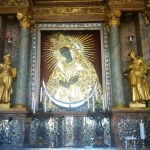
We walk through the Gate of Dawn‎ and up to a chapel. There is the most gorgeous icon of our Lady, Queen of Lithuania (and Poland). We celebrate Mass. Dave inadvertently stands in the spot John Paul II did when he visited here.

We walked to the nearby Russian Orthodox church and witnessed a celebration. Their Patriarch, priests and all the congregation marched out around the church with icons, incense and holy water. The church inside was truly magnificent. They believe icons are a real window into the presence of God – not just symbolic.

In the afternoon, we visit the house that St. Faustina lived in. We look into the little room she shared with another sister and see her original furniture.‎ It was at this house that she received the Chaplet of Divine Mercy in 1935. We pray the Chaplet together. It is very moving.

We pay a short visit to the Church of St. Peter and Paul, a fine example of baroque design with hundreds of sculpted angels and saints on its interior white walls.

Then on to the Cathedral of Vilnius. In the square out front is the “miracle” stone. This commemorates the 2 million Estonians, Latvians and Lithuanians who joined hands in a 200 km long human chain‎ in solidarity against the Soviets in 1989. Inside, we see St. Casimir’s crypt and light more candles for special intentions.

Another long prayerful day comes to an end.

1 Comment

Filed under Uncategorized

Day 3 – On the Road to Vilnius

We have a long day ahead – an 8 hr. bus trip to Vilnius, Lithuania. The time flies as we chat, nap, sing a bit and watch some beautiful farmland and forests go by.

Lithuania (pop. 3 million) is one of the three small Baltic countries. St. Faustina’s order maintained a number of houses here. It was here where she had many visions of Jesus. The first image of the Divine Mercy was commissioned here.

Lithuania has a long history of being overrun by outsiders but is proudly independent today.  They went on the Euro last year and are suffering the consequences – rising prices, fixed wages. Vilnius (pop. 500,000) the capital is a classy city, well maintained, modern with a huge old town and 60 churches. The patron saint of Lithuania is St. Casimir.

We checked into the Polish Guest House‎ into a large room. After a delicious dinner we head for the old town. First stop is a convent with a Franciscan well with spring water that heals.

We then visit the Shrine of Divine Mercy, a chapel where the original image of Divine Mercy is venerated. This was the only painted image that St. Faustina saw in her short life. ‎Open 24/7, visitors drop in at any time of the day or night to pray and light a candle. We noticed a lot of youth present.

Special intentions were offered at our Mass and candles were lit. Back in our room‎ about 10 PM we reminisce about the long day and drop off to sleep quickly.


Leave a comment

Filed under Uncategorized

Day 2 – Warsaw

After a good night’s sleep we were on the bus into Warsaw. The first thing the tour guide said is that Warsaw is an ugly city. We had a laugh because it is sort of true. Some old crumbling buildings, untrimmed grass‎ in the medians, sort of grey and dingy. But then the sun came out and our opinion changed quickly.

First stop was at the church where Blessed Fr. Jerzy Popieluszko preached and where his museum is. Fr. Jerzy ‎was very outspoken against the communist regime. In 1984 he was kidnapped by the security service, badly beaten, tied up and dumped n the Vistula River. His funeral was a huge religious-patriotic manifestation. His cause for canonization started immediately.

We then visited Warsaw Cathedral in the old town after walking through the Holy Doors. The crypt of Cardinal Wysnski, Prelate of Poland is there. We learned that he delicately managed the relationship with the Communists. He was arrested, released and lived to see John Paul II become Pope. They were close friends.

We were told about the Warsaw uprising and drove by the monuments‎ and cemeteries. Interestingly only 5% of current Warsaw families have relatives that were living here during WWII. A long and dark history.

Our last stop was the convent that took in little Helen Kowalska (St. Faustina) in 1925. She had knocked on the doors of several convents before the Sisters of Our Lady of Mercy accepted her. We had Mass said in the Chapel where she had attended. We joined in with the nuns to sing Jezu Ufam Tobie – Jesus, I Trust in You. We toured the wonderful St. Faustina museum that they were so proud to show us.

Back at the residence in Niepokalanow we paused for dinner. Then it was over to the cathedral for a short session on Mary Immaculate by Fr. John Fletcher, CC. Finally Fr. Tim Devine, CC‎ led us outside for a candle lit rosary walk.

After the busy day, Dave had a Mr. Bean moment when he thought he lost his BlackBerry. All ended well after a very rich day. We went to bed as a large group of youth were singing to drums in the courtyard.

Poland is still a very visibly religious society. Their Faith and solidarity has gotten them through many wars and much oppression. We are privileged to be seeing it with our Polish friends and guides. The deserts here are very good too!

1 Comment

Filed under Uncategorized

Day 1 Niepokalanow

DSCN0582Well we made it safely to Poland. We met up with the group in Warsaw and headed to the small town of Niepokalanow on the outskirts, in our tour bus. The name of this town means Immaculate in Polish.

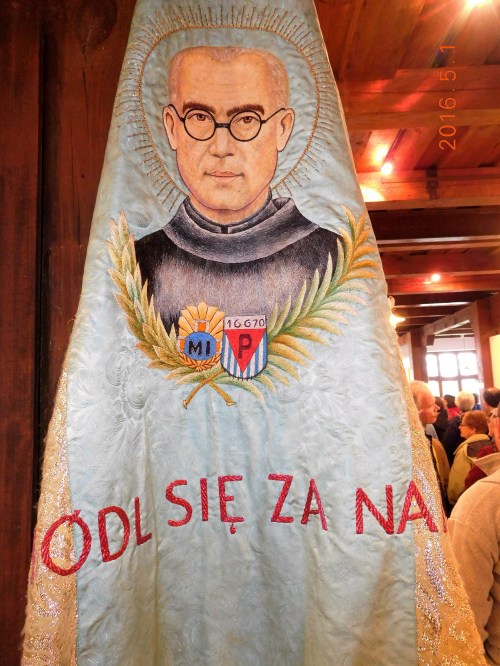
Niepokalanow has a large Franciscan seminary where St. Maximilian Kolbe was a Superior. St. Maximilian was a priest, a publisher of a Catholic magazine/newspaper, the founder of the Order of Knights of Mary, a missionary to Japan and a martyr.

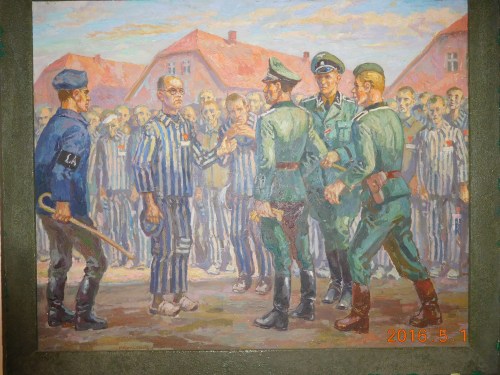
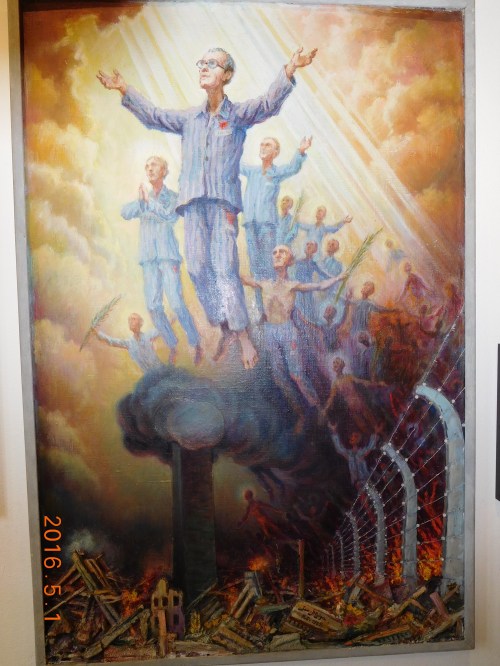
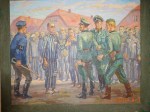
He was arrested by the Nazis and sent to the Auschwitz concentration camp. One day a prisoner escaped. The Germans decided they would kill 10 prisoners in retaliation.‎ One of the selected men to die cried out “My wife and children!” Hearing this Fr. Maximilian said “Take me instead.”

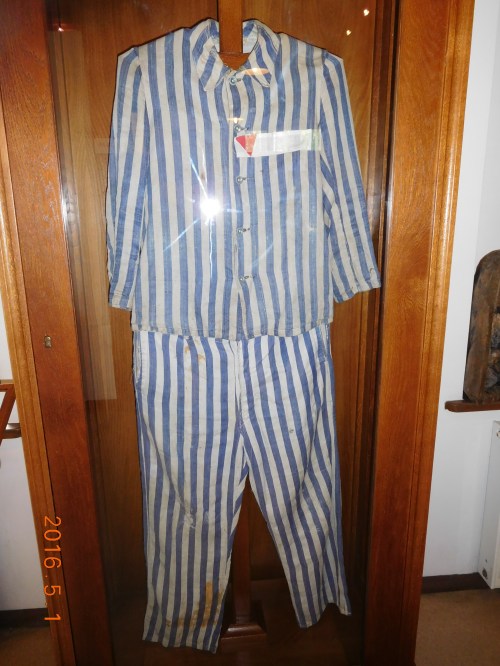
Maximilian was duly executed by injection of carbolic acid. He was canonized in the 1980s as a martyr. We had Mass in the Chapel where he and his fellow Brothers prayed and said Mass in. We visited his museum here containing many artifacts including the uniform he wore at Auschwitz.

It was a great start. Now off the sleep.

DSCN0586

DSCN0583

DSCN0584

DSCN0587


2 Comments

Filed under Uncategorized

Divine Mercy Pilgrimage

images
Marie and I are on a Divine Mercy pilgrimage to Poland. It is organized by the John Paul II Centre for Divine Mercy in Ottawa: http://jp2centre.com
We are among a group of 50 pilgrims including 3 priests from the Companions of the Cross congregation.
What is the Divine Mercy (devotion)?  A devotion first of all, is a practice of piety not part of the official liturgy of the Roman Catholic Church but part of the spiritual practice of Catholics.  An example is the Devotion to the Sacred Heart of Jesus.
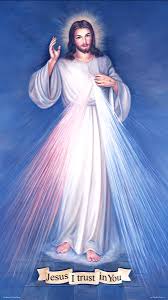
The Divine Mercy message is that Jesus Christ’s gift of mercy to each of us is his most important gift. In a series of visits, he conveyed the importance of his mercy to Sister and mystic Faustina Kowalska (now Saint) in Poland during the 1930’s. He asked her to inform the world.  She faithfully documented these visions and messages in her extensive diary.
Jesus also asked St. Faustina to:
– have his image painted with the blue and white rays emanating from his heart with the inscription “Jesus I trust in You”
– pray and teach others the Divine Mercy Chaplet using the Rosary
– have the first Sunday after Easter declared Divine Mercy Sunday in the Church
 In 2000 Pope John Paul II canonized‎ Sr. Faustina and declared Divine Mercy Sunday on the first Sunday after Easter, just as Jesus had requested.  Poland is the spark for all this.  We are very excited to be going there to see the places where Saint Faustina lived, prayed and experienced Christ’s presence and to visit her shrine in Krakow.  We also will be visiting the Marion shrine of our Lady of Czestochowa (The Black Madonna) and the John Paul II Sanctuary shrine in Krakow.
 We always enjoy your comments.

5 Comments

Filed under Uncategorized

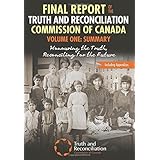
Truth and Reconciliation

Product Details

I borrowed this book from the library and did not finish it all.  I wanted to know a little more about the aboriginal situation in Canada.  It is very detailed, well written it seems by lawyers for lawyers and, very convincing.

The elevator speech.  For 100 years or more, the government of Canada had an assimilation policy or law (Indian Act) that impelled native children to be sent to boarding school where they were forced to learn English/French, be evangelized with Christianity, to eat western foods or wear clothes they were unaccustomed to nor allowed to leave and go home when they wanted to.  In addition there is detailed proof of physical, sexual and psychological abuse of these children.  Countless thousands died of disease and were unceremoniously buried in unknown grave sites all across the country.

This “Malthusian” solution did not work and that is why we now have the many social, economic, cultural, legal, health, racial and spiritual tradition problems that we hear about everyday in aboriginal communities, cities and towns across Canada.  Most non-aboriginal Canadians have inadequate knowledge of this history and consequently tend to blame the victim for the situation.

In 94 Calls to Action, the TRC calls for continued apologies, education, funding, respect and support for aboriginal culture, language, spiritual traditions, justice as well as adoption of the U.N Declaration on the Rights of Indigenous Peoples as a legal framework for reconciliation.

The Catholic Church (60%) along with the United, Anglican and Presbyterian churches operated the bulk of these residential schools where all this took place.  Hence they are directly involved in the financial settlements, reconciliation, apologies and rebuilding of relationships and trust for a brighter future for our aboriginal populations.

Regarding the Catholic Church involvement, the Canadian Conference of Bishops (CCCB) and the Canadian Religious Conference (CRC) as well as individual religious communities e.g., Missionary Oblates of Mary Immaculate have issued formal written apologies as well as contributed millions of dollars and work in-kind as part of the Settlement Agreement.  However one of the outstanding problems is that no one speaks for the Catholic Church in Canada as do the national leaders of the other mainline Christian churches involved.

This is why the TRC calls for the Pope to make a formal apology for the residential school sins in Canada as was done for the abuse of children in Ireland some years back.  As well the Vatican’s repudiation of the Doctrine of Discovery and terra nullius (no one’s land policy) policy which were used by sovereign countries to claim ownership of aboriginal territories upon discovery, is seen as weak.  They claim this theology was repudiated years ago by Papal Bull so the fact that countries continued to use it as justification of colonial actions is not their responsibility (I think).

I am left staggered by the mess we got ourselves into and the complete about-face it now requires to alleviate the wrongdoing.  Meanwhile we are bombarded with nightly news e.g. suicide crises and crime that reinforces the casual viewer’s view that the first nations people are their own worst enemies.

One thing I am not clear on: A clear vision of what success looks like to the aboriginal populations e.g., a return to native ways of life, justice and spirituality, respect, understating and appreciation of their many contributions to Canada, opportunity to choose integration or cultural freedom with health, education and financial support?  All of these?

In the moment, I am thankful for this increased understanding of Canada’s history and how we are trying to change and make amends for the wrongs we committed to our aboriginal friends.


1 Comment

Filed under Uncategorized