Day 4 – Vilnius

We visit the house where Blessed Fr. Michel Sopocko lived. He was St. Faustina’s confessor and championed her Divine Mercy message after her death. A young nun from Alberta excitedly explains the history and importance of the Divine Mercy. We are touched by Marie Theresa’s passion – she is one year away from her final vows. Next door is a hospice the Sisters operate which is supported by Canada and other countries.

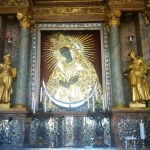
We walk through the Gate of Dawn‎ and up to a chapel. There is the most gorgeous icon of our Lady, Queen of Lithuania (and Poland). We celebrate Mass. Dave inadvertently stands in the spot John Paul II did when he visited here.

We walked to the nearby Russian Orthodox church and witnessed a celebration. Their Patriarch, priests and all the congregation marched out around the church with icons, incense and holy water. The church inside was truly magnificent. They believe icons are a real window into the presence of God – not just symbolic.

In the afternoon, we visit the house that St. Faustina lived in. We look into the little room she shared with another sister and see her original furniture.‎ It was at this house that she received the Chaplet of Divine Mercy in 1935. We pray the Chaplet together. It is very moving.

We pay a short visit to the Church of St. Peter and Paul, a fine example of baroque design with hundreds of sculpted angels and saints on its interior white walls.

Then on to the Cathedral of Vilnius. In the square out front is the “miracle” stone. This commemorates the 2 million Estonians, Latvians and Lithuanians who joined hands in a 200 km long human chain‎ in solidarity against the Soviets in 1989. Inside, we see St. Casimir’s crypt and light more candles for special intentions.

Another long prayerful day comes to an end.

1 Comment

Filed under Uncategorized

Day 3 – On the Road to Vilnius

We have a long day ahead – an 8 hr. bus trip to Vilnius, Lithuania. The time flies as we chat, nap, sing a bit and watch some beautiful farmland and forests go by.

Lithuania (pop. 3 million) is one of the three small Baltic countries. St. Faustina’s order maintained a number of houses here. It was here where she had many visions of Jesus. The first image of the Divine Mercy was commissioned here.

Lithuania has a long history of being overrun by outsiders but is proudly independent today.  They went on the Euro last year and are suffering the consequences – rising prices, fixed wages. Vilnius (pop. 500,000) the capital is a classy city, well maintained, modern with a huge old town and 60 churches. The patron saint of Lithuania is St. Casimir.

We checked into the Polish Guest House‎ into a large room. After a delicious dinner we head for the old town. First stop is a convent with a Franciscan well with spring water that heals.

We then visit the Shrine of Divine Mercy, a chapel where the original image of Divine Mercy is venerated. This was the only painted image that St. Faustina saw in her short life. ‎Open 24/7, visitors drop in at any time of the day or night to pray and light a candle. We noticed a lot of youth present.

Special intentions were offered at our Mass and candles were lit. Back in our room‎ about 10 PM we reminisce about the long day and drop off to sleep quickly.


Leave a comment

Filed under Uncategorized

Day 2 – Warsaw

After a good night’s sleep we were on the bus into Warsaw. The first thing the tour guide said is that Warsaw is an ugly city. We had a laugh because it is sort of true. Some old crumbling buildings, untrimmed grass‎ in the medians, sort of grey and dingy. But then the sun came out and our opinion changed quickly.

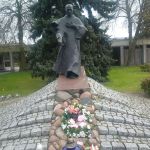
First stop was at the church where Blessed Fr. Jerzy Popieluszko preached and where his museum is. Fr. Jerzy ‎was very outspoken against the communist regime. In 1984 he was kidnapped by the security service, badly beaten, tied up and dumped n the Vistula River. His funeral was a huge religious-patriotic manifestation. His cause for canonization started immediately.

We then visited Warsaw Cathedral in the old town after walking through the Holy Doors. The crypt of Cardinal Wysnski, Prelate of Poland is there. We learned that he delicately managed the relationship with the Communists. He was arrested, released and lived to see John Paul II become Pope. They were close friends.

We were told about the Warsaw uprising and drove by the monuments‎ and cemeteries. Interestingly only 5% of current Warsaw families have relatives that were living here during WWII. A long and dark history.

Our last stop was the convent that took in little Helen Kowalska (St. Faustina) in 1925. She had knocked on the doors of several convents before the Sisters of Our Lady of Mercy accepted her. We had Mass said in the Chapel where she had attended. We joined in with the nuns to sing Jezu Ufam Tobie – Jesus, I Trust in You. We toured the wonderful St. Faustina museum that they were so proud to show us.

Back at the residence in Niepokalanow we paused for dinner. Then it was over to the cathedral for a short session on Mary Immaculate by Fr. John Fletcher, CC. Finally Fr. Tim Devine, CC‎ led us outside for a candle lit rosary walk.

After the busy day, Dave had a Mr. Bean moment when he thought he lost his BlackBerry. All ended well after a very rich day. We went to bed as a large group of youth were singing to drums in the courtyard.

Poland is still a very visibly religious society. Their Faith and solidarity has gotten them through many wars and much oppression. We are privileged to be seeing it with our Polish friends and guides. The deserts here are very good too!

1 Comment

Filed under Uncategorized

Day 1 Niepokalanow

DSCN0582Well we made it safely to Poland. We met up with the group in Warsaw and headed to the small town of Niepokalanow on the outskirts, in our tour bus. The name of this town means Immaculate in Polish.

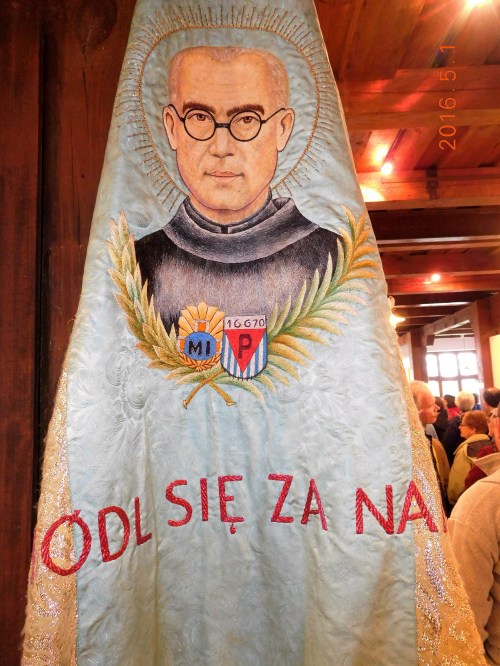
Niepokalanow has a large Franciscan seminary where St. Maximilian Kolbe was a Superior. St. Maximilian was a priest, a publisher of a Catholic magazine/newspaper, the founder of the Order of Knights of Mary, a missionary to Japan and a martyr.

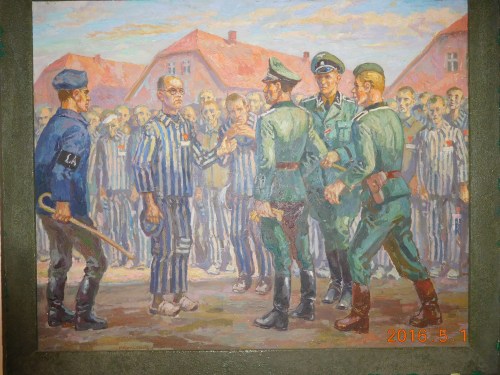
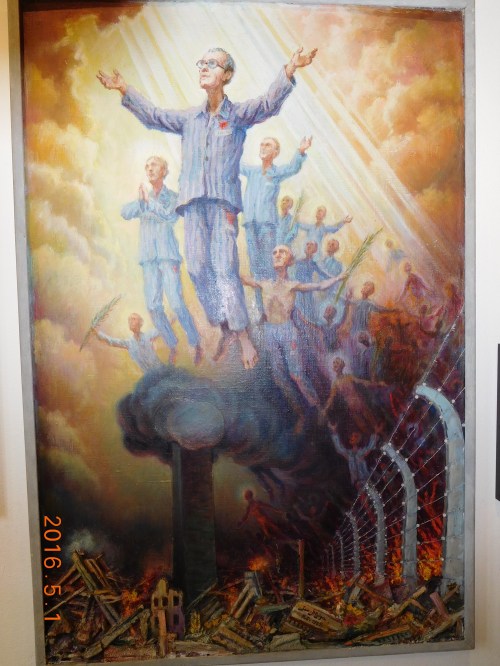
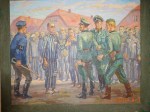
He was arrested by the Nazis and sent to the Auschwitz concentration camp. One day a prisoner escaped. The Germans decided they would kill 10 prisoners in retaliation.‎ One of the selected men to die cried out “My wife and children!” Hearing this Fr. Maximilian said “Take me instead.”

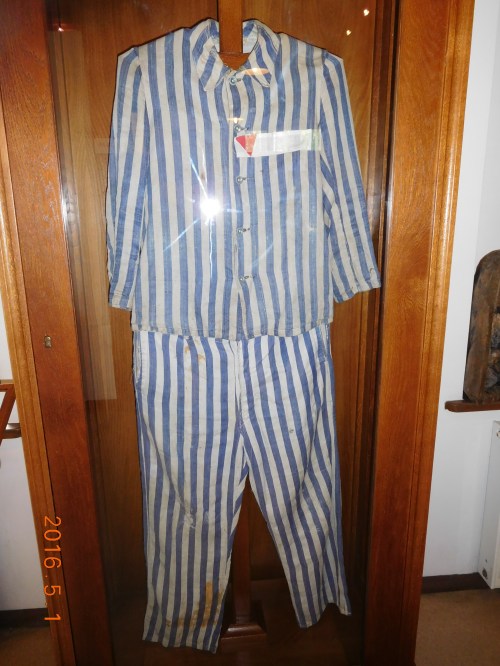
Maximilian was duly executed by injection of carbolic acid. He was canonized in the 1980s as a martyr. We had Mass in the Chapel where he and his fellow Brothers prayed and said Mass in. We visited his museum here containing many artifacts including the uniform he wore at Auschwitz.

It was a great start. Now off the sleep.

DSCN0586

DSCN0583

DSCN0584

DSCN0587


2 Comments

Filed under Uncategorized

Divine Mercy Pilgrimage

images
Marie and I are on a Divine Mercy pilgrimage to Poland. It is organized by the John Paul II Centre for Divine Mercy in Ottawa: http://jp2centre.com
We are among a group of 50 pilgrims including 3 priests from the Companions of the Cross congregation.
What is the Divine Mercy (devotion)?  A devotion first of all, is a practice of piety not part of the official liturgy of the Roman Catholic Church but part of the spiritual practice of Catholics.  An example is the Devotion to the Sacred Heart of Jesus.
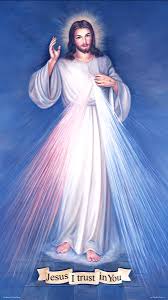
The Divine Mercy message is that Jesus Christ’s gift of mercy to each of us is his most important gift. In a series of visits, he conveyed the importance of his mercy to Sister and mystic Faustina Kowalska (now Saint) in Poland during the 1930’s. He asked her to inform the world.  She faithfully documented these visions and messages in her extensive diary.
Jesus also asked St. Faustina to:
– have his image painted with the blue and white rays emanating from his heart with the inscription “Jesus I trust in You”
– pray and teach others the Divine Mercy Chaplet using the Rosary
– have the first Sunday after Easter declared Divine Mercy Sunday in the Church
 In 2000 Pope John Paul II canonized‎ Sr. Faustina and declared Divine Mercy Sunday on the first Sunday after Easter, just as Jesus had requested.  Poland is the spark for all this.  We are very excited to be going there to see the places where Saint Faustina lived, prayed and experienced Christ’s presence and to visit her shrine in Krakow.  We also will be visiting the Marion shrine of our Lady of Czestochowa (The Black Madonna) and the John Paul II Sanctuary shrine in Krakow.
 We always enjoy your comments.

5 Comments

Filed under Uncategorized

Truth and Reconciliation

Product Details

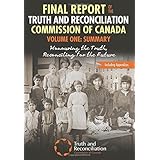
I borrowed this book from the library and did not finish it all.  I wanted to know a little more about the aboriginal situation in Canada.  It is very detailed, well written it seems by lawyers for lawyers and, very convincing.

The elevator speech.  For 100 years or more, the government of Canada had an assimilation policy or law (Indian Act) that impelled native children to be sent to boarding school where they were forced to learn English/French, be evangelized with Christianity, to eat western foods or wear clothes they were unaccustomed to nor allowed to leave and go home when they wanted to.  In addition there is detailed proof of physical, sexual and psychological abuse of these children.  Countless thousands died of disease and were unceremoniously buried in unknown grave sites all across the country.

This “Malthusian” solution did not work and that is why we now have the many social, economic, cultural, legal, health, racial and spiritual tradition problems that we hear about everyday in aboriginal communities, cities and towns across Canada.  Most non-aboriginal Canadians have inadequate knowledge of this history and consequently tend to blame the victim for the situation.

In 94 Calls to Action, the TRC calls for continued apologies, education, funding, respect and support for aboriginal culture, language, spiritual traditions, justice as well as adoption of the U.N Declaration on the Rights of Indigenous Peoples as a legal framework for reconciliation.

The Catholic Church (60%) along with the United, Anglican and Presbyterian churches operated the bulk of these residential schools where all this took place.  Hence they are directly involved in the financial settlements, reconciliation, apologies and rebuilding of relationships and trust for a brighter future for our aboriginal populations.

Regarding the Catholic Church involvement, the Canadian Conference of Bishops (CCCB) and the Canadian Religious Conference (CRC) as well as individual religious communities e.g., Missionary Oblates of Mary Immaculate have issued formal written apologies as well as contributed millions of dollars and work in-kind as part of the Settlement Agreement.  However one of the outstanding problems is that no one speaks for the Catholic Church in Canada as do the national leaders of the other mainline Christian churches involved.

This is why the TRC calls for the Pope to make a formal apology for the residential school sins in Canada as was done for the abuse of children in Ireland some years back.  As well the Vatican’s repudiation of the Doctrine of Discovery and terra nullius (no one’s land policy) policy which were used by sovereign countries to claim ownership of aboriginal territories upon discovery, is seen as weak.  They claim this theology was repudiated years ago by Papal Bull so the fact that countries continued to use it as justification of colonial actions is not their responsibility (I think).

I am left staggered by the mess we got ourselves into and the complete about-face it now requires to alleviate the wrongdoing.  Meanwhile we are bombarded with nightly news e.g. suicide crises and crime that reinforces the casual viewer’s view that the first nations people are their own worst enemies.

One thing I am not clear on: A clear vision of what success looks like to the aboriginal populations e.g., a return to native ways of life, justice and spirituality, respect, understating and appreciation of their many contributions to Canada, opportunity to choose integration or cultural freedom with health, education and financial support?  All of these?

In the moment, I am thankful for this increased understanding of Canada’s history and how we are trying to change and make amends for the wrongs we committed to our aboriginal friends.



1 Comment

Filed under Uncategorized

Saying goodbye to Florida

It has been a great winter stay down here full of sunny days, friends, healthy food, peace and downright fun.  We head for home with mixed emotion- happy to be soon seeing our loved ones and friends – sad that it is all over for another year.  We have secured a rental for next year so are already thinking about coming back God willing.

In the last week so so we took a few pics to say goodbye for now.  Thanks for following our story.

DSCN0517[1]

Bye Fort Myers Beach Pier

DSCN0520[1]

Bye really fresh fruit

DSCN0522[1]

Bye yummy vegetables

DSCN0518[1]

Bye yoga in the park

DSCN0524[1]

Bye pool

DSCN0525[1]

Bye Resurrection of Our Lord Church

DSCN0529[1]

Bye shells

DSCN0530[1]

Bye lush vegetation

DSCN0531[1]

Bye walks on the beach

DSCN0533[1]

Bye seagulls

DSCN0548[1]

Bye gray squirrels

DSCN0535[1]

Bye Sanibel

DSCN0564[1]

Bye pelicans

DSCN0555[1]

Bye March breakers on Fort Myers Beach


DSCN0560[1]

Bye Fort Myers Beach Doc Ford’s

DSCN0553[1]

Bye Florida sunshine

Leave a comment

Filed under Uncategorized

Estero Cousins and Ball Game

One of the things we like to do in FL each year is meet up with Dave’s cousins who stay in Estero each winter.  Estero is about a 30 min. drive south from where we are so we often meet in the middle to catch up and share Florida tall tales.

This year was no different.  We met Cheryl and Larry at Lakes Park one Friday morning and went to the green market they have there.  We love picking up some fresh vegetables, fruit and an artisan bread.  Then we go for a walk around the park and stop for a picnic lunch.

DSCN0245[1]

Summer tomatoes

DSCN0251[1]

Having fun at Lakes Park

DSCN0315[1]

Our grandsons would love this

DSCN0319[1]

With Larry and Cheryl in Lakes Park

IMG_0483 (2)

From centre clockwise Larry, Lynn Carson, Cheryl, son Jim, daughter-in-law Lynn at the Grandeeza Country Club for dinner March 2016 (cousin Brian Carson missing)


A new activity this year was to go to a baseball spring training game.  The Boston Red Sox play at Jet Blue Park and the Minnesota Twins at Hammond Field.  John Jarrell kindly gave us some tickets to a Minnesota – Pittsburgh Pirates game.  The seats were excellent and we really enjoyed the afternoon.  Pittsburgh won 2-0 in a closely fought game.  On our activity list to do again next year with the Jarrells.

DSCN0502[1]

DSCN0506[1]

The Pittsburgh bench

DSCN0504[1]

At the game

DSCN0507[1]

DSCN0514[1]

Pittsburgh beat the home team

2 Comments

Filed under Uncategorized

Uncle Tom’s Cabin

Title: Uncle Tom's Cabin (Barnes & Noble Classics Series), Author: Harriet Beecher Stowe

I wanted to read this book because of Lincoln’s purported greeting to author Harriet Beecher Stowe in 1862 when they met:  “So you’re the little woman who wrote the book that started this great war.”

It tell’s the story of Uncle Tom a slave who went from good master to bad.  Tom a devout Christian, is killed by the bad master at the end because he “refuses to let anything separate him from the love of Christ.”  Tom is ordered by Legree to flog 2 fellow slaves and he refuses as it is morally wrong.  Tom is ordered to divulge to Legree where 2 escapee slaves are hiding but again refuses to for the same reason.  In a fit of rage Legree strikes him down and Tom eventually dies of his wounds – a happy man I might add.

Morally uplifting this story was written in 1852 to expose the practices of slavery to American society and promote abolition of slavery.  It set off a publishing revolution that sold millions of copies, propelled slavery to the dinner conversation across America and led to the creation of “Tom” plays and movies that still reverberate today.

Now seen as somewhat racist in its approach due to stereotyping and over the top by others, it was the story of it’s times that polarized Americans and no doubt stoked the fires that led to the American Civil War 1862-65.  There is even an extraordinary endpiece by Stowe that explains why she wrote the story, the moral wrongness of slavery where she includes the North as being guilty too for abetting and enabling the continuation of the problem.

There is some good news.  Tom by his stoic and prayerful witness leads several others to find the Lord and change their thinking and actions.  One slave family makes it safely to Canada and we find them embarking for Liberia in search of their new life.  Slavery was abolished in the U.S. in 1865.

Some points learned.  A slave’s life was not so bad if they had a good master who treated them with respect and care.  However, should the master fall into financial difficulty or die, the owned slaves would be sold on the market.  Families were separated, a bad master could be your new owner and you could be abused, raped and beaten at whim.   A black person could not testify in any court at least in the South.  Hence the master could act as a total despot when no other whites were around as there would be no other witness with legal standing.  Finally the Fugitive Slave Act applied penalties to any one in a “free state” who was found helping a slave to escape the South.

I liked this book more than I thought I would.  4 out of 5 stars.


Leave a comment

Filed under Uncategorized

City of Palms

McGregor Blvd

McGregor Blvd in Fort Myers

Fort Myers truly is the city of palms.  From the Royal palm lined McGregor Blvd above, to the numerous palm varieties in everyone’s yard to the palm sheaves given out on Palm Sunday at church.  Here are some typical varieties of palm trees in our immediate neighbourhood.

The Royal palm can grow to 80 feet in height.  Smooth gray-white trunk topped with a green crownshaft and a long luxurious frond.  They are sought after in landscaping of houses on large properties and lining roadways and walkways.

DSCN0482[1]

Royal palm

The Coconut palm can grow to 50 feet tall and produces coconuts at random times after 6 to 8 years.  The coconuts take a year to ripen.

DSCN0480[1]

Coco palm

The very common Queen palm is fast growing attaining 40 feet.  Inexpensive, they are very popular and produce orange fruit which drops and can be messy.

DSCN0476[1]

The Queen palm

The Latania comes in a red and blue variety and has gorgeous fan shaped fronds that grow to 8 feet across.

DSCN0477[1]

A beautiful Latania

The Canary Island Date palm is sometimes also called the Pineapple palm.  The crusty thick leaf scar pattern and huge crown of stiff leaves are reminiscent of a pineapple.

DSCN0479[1]

Canary Island Date palm

The Washingtonia  palm is also known as the Mexican fan palm have very beautiful trunks and rich fan like plumage.  They are a favorite with builders and can grow to 100 feet tall.

DSCN0481[1]

A stand of Washingtonia

The Foxtail palm is known for its smooth gray trunk, bright green crownshaft and big tufted fronds that each resemble a foxtail.

DSCN0484[1]

Two Foxtail palms with a curved trunk Queen to the left

On Palm Sunday I was curious to see what would happen.  The ushers brought out several bundles of palm leaves wrapped in clear plastic.  They gave them out as we exited the church.  It is safe to say that they were not too worried about running out – they could have grabbed more growing not 20 feet from the door.  The City of Palms – no more appropriate place to be on Palm Sunday.

Leave a comment

Filed under Uncategorized