
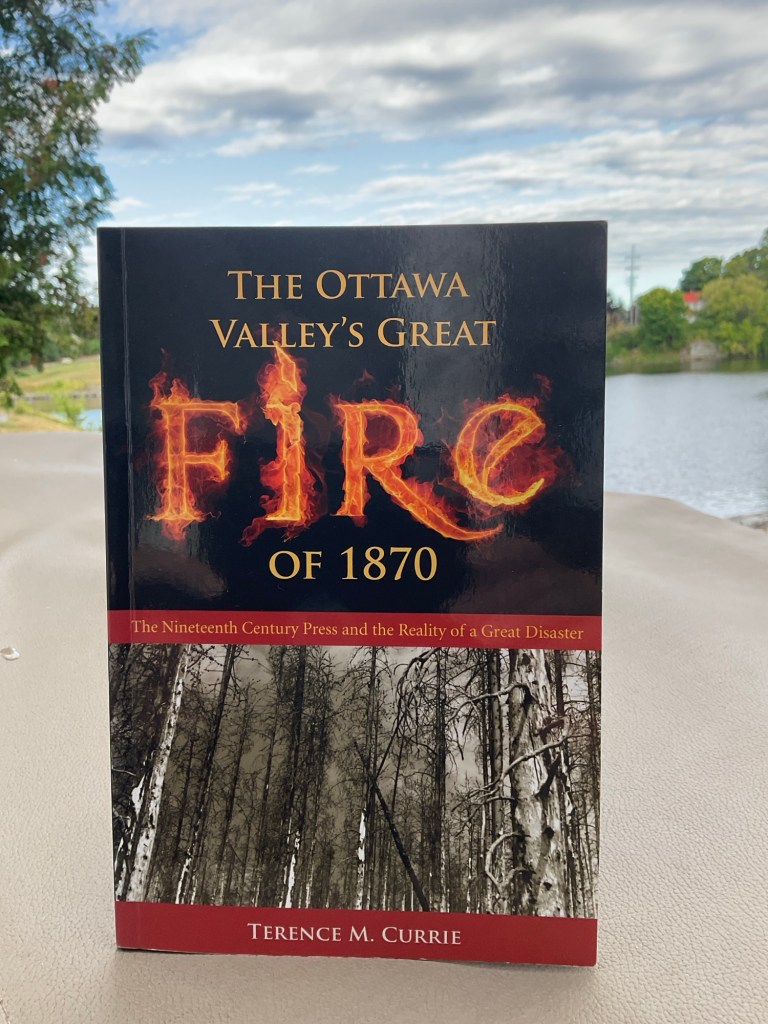
Almonte HS teacher, historian and friend Terry Currie wrote and self-published this book in 2009. At the time it was the first comprehensively researched complete story of this cataclysmic event.
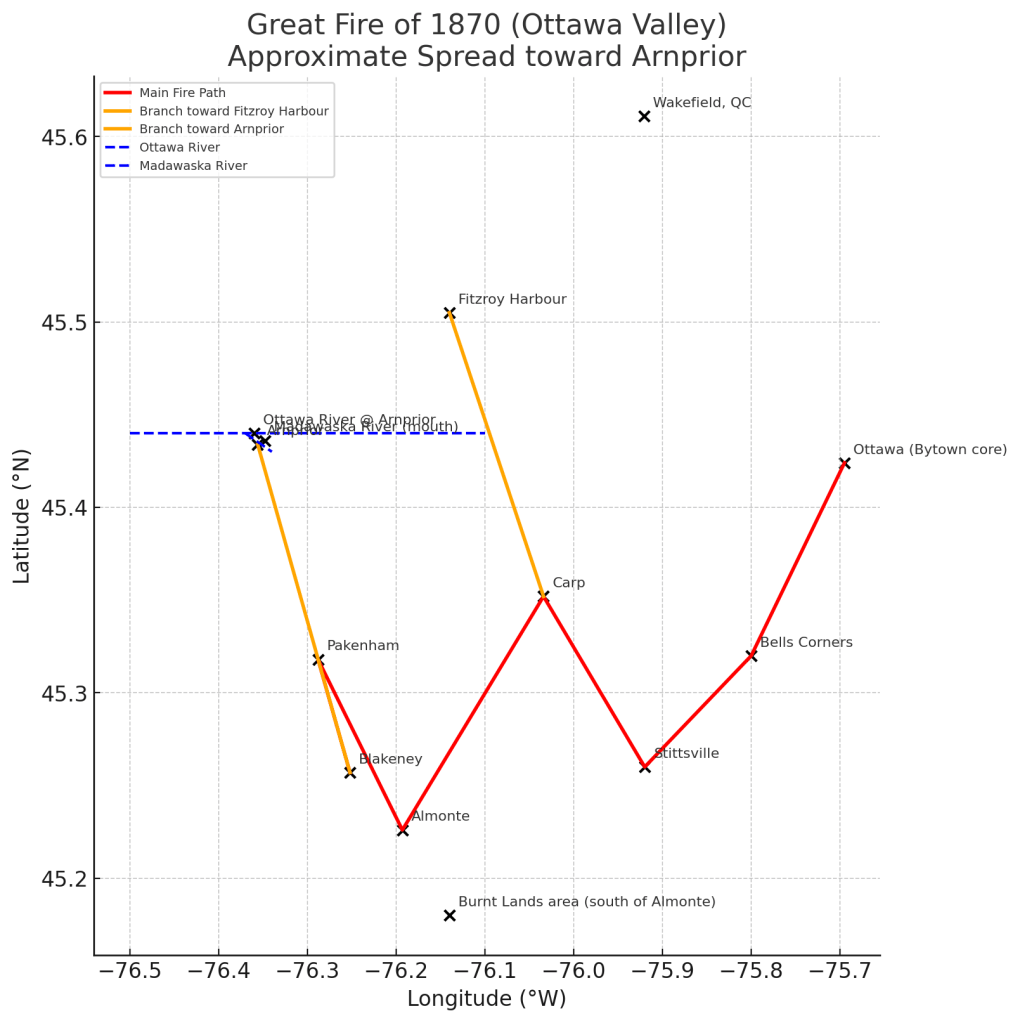
On August 17, 1870, locals woke up to yet another hot day. Since there had been no rain since April, Carleton County was a tinder box. That day, a work gang was clearing brush near Blakeney in the process of extending the rail line right-of-way from Almonte to Pakenham and beyond.
They would pile up the dry brush and burn it off. Suddenly a strong southerly wind caught the flames and blew them north across the line into the woods. The fire was immediately out of control heading north and NW towards Carp and Pakenham.
No one in the path knew what was happening until they were nearly engulfed in flames. As Terry explains in detail, the Press were very limited in their ability to find out what was going on and inform everyone. People and animals fled but there was nowhere to go. Farm families would put a ladder down their wide diameter well and climb down to escape. Those who ran back to the farmhouse to retrieve some heirlooms often died.
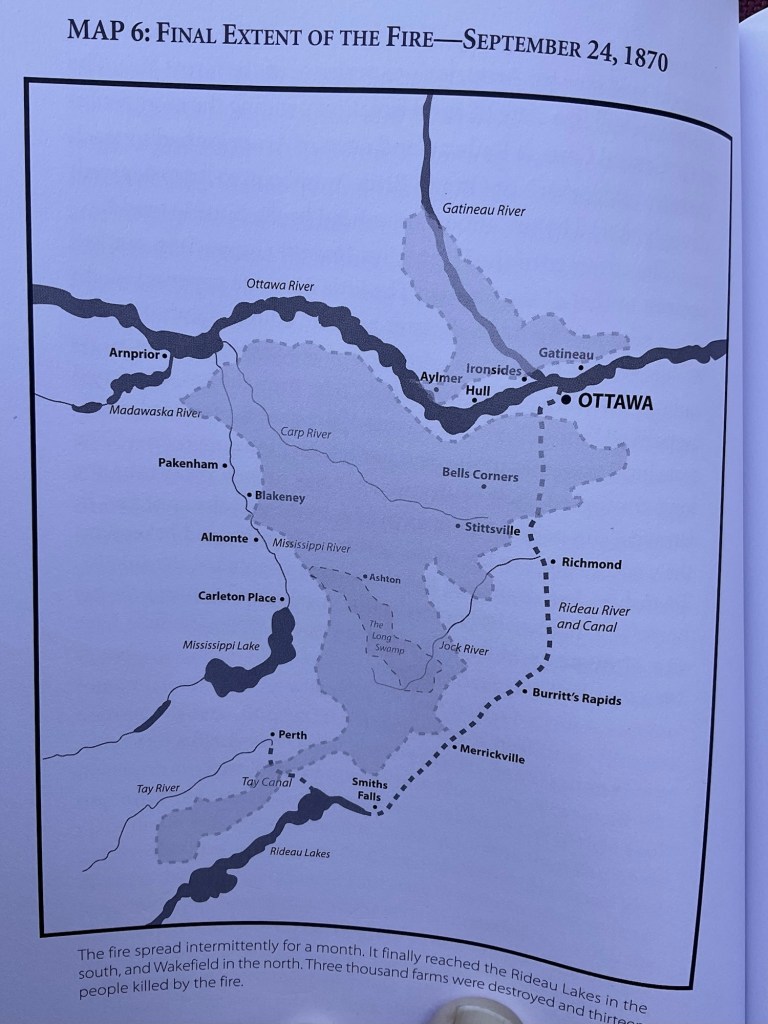
Can you imagine the terror – a wall of fire several kilometres wide – and nothing you can do! There were no rural fire departments in those days. The fire burned all day and night advancing as far as Arnprior and Fitzroy. On the 18th the wind changed to westerly with gusts as high as 140 km/hr. This carried the fire all the way to Dows Lake in Ottawa, south to Westport and into Quebec by jumping the Ottawa River at Britannia.
My home town Arnprior was saved by the Madawaska River and shifting winds. All told 3000 farms were completely destroyed and as many as 20 people were killed creating 8000 refugees. Ottawa was saved at the last minute by flooding Preston Street. Places like Bells Corners and Stittsville were completely wiped out. The fire continued to smoulder until the mid-September when heavy rains finally came.
In the aftermath, governments were very stingy in assisting people to rebuild. But gradually, farms and infrastructure were rebuilt until today, you would not know. There is an area south of Almonte called the burnt lands where the soil was burnt down to the limestone. Will have to check this out.
Thank you Terry for this interesting if tragic bit of local Valley history.


 mattersofthemoment