
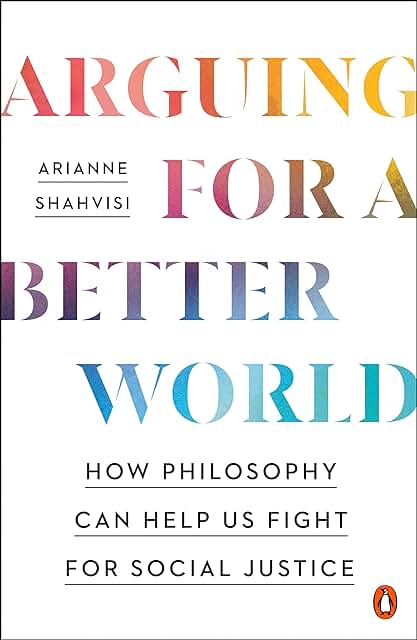
This book written by moral philosopher and professor Arianne Shavisi in 2023 deserves to be widely read. She provides fresh insight and understanding into many of today’s most controversial social and cultural issues like gender identity, racism, the cancel culture, Black Lives Matter, political correctness and structural injustice. She provides some concrete examples of how we can use philosophy in our personal decision making to make ethical and lifestyle choices that lead to a better outcome for all. She is an optimist believing that we can make the world a better place if we pull together. I learned so much from this book, I think I will read it again!
Arianne is a feminist who does not scream. Instead she quotes endless facts and numbers to illustrate what is going on in each area and the impact this has on those being disadvantaged by the status quo (and yes sometimes it’s men). Her education includes degrees in natural science and astrophysics. I learned so much about todays societal issues such as racism, gender issues and something called mansplaining (which is when a man (like me) jumps in unsolicited to explain a topic to a woman assuming she needs help understanding it simply because she is a woman). I had never heard of this term before but now that I have, I will try to refrain from doing it.
Here are a couple of examples of how to use philosophy to make the right decision that made real sense to me. A doctor in Africa faced with limited medical resources has to decide will she spend the last of those resources trying to save her patients or will she spend them on an inoculation program to potentially save numerous others who are not currently sick. Applying the principles of Utilitarianism which says to choose the action which brings about the greater good for society, she opts for the inoculation program.
Another powerful but everyday example quoting Kant’s categorical imperative which says choose the action which is the most universable that brings about the maximum good. A man had to decide if he would break a promise, an everyday event. One little promise no big deal right? But if everyone broke promises everyday what kind of society would we have? The correct ethical choice according to Kant – don’t break promises.
This book has very polarized reviews on Amazon. Some like myself (a slight majority) think it is one of the best books ever written on these subjects. Others say it is Marxist propaganda and were so disgusted and they threw it away.
Another example this time about how to combat racism. You are in conversation with someone when they say something like “Well you know what those people are like.” You sense where the conversation is going, are uncomfortable and do not wish to be complicit. So rather than saying nothing you say “No, I don’t know what those people are like, please explain.” And keep repeating this which forces the other person to go out on a limb displaying their racist views which they are less likely to do now that you have called them out about it. If everyone did this… Brilliant I thought.
We tend to live in silos where everyone looks like us, thinks like us, and believes like us. It’s a comfortable existence. Perhaps there is little self awareness of this and consequently, the chance we’ll continue to grow spiritually or intellectually is somewhat diminished. The feelings of differentness yet connectedness we experienced on a recent trip came not only from the travel but from interacting with people who were from 65 different countries!
We met and interacted with people from: Singapore, Indonesia, Philippines, Australia, New Zealand, Nepal, India, Albania, United States, Russia, Italy, Mexico, France, U.K., Greece, Hawaii, French Polynesia, Scotland, China, Japan, Sri Lanka, Brazil, Canada, Argentina, Germany, Thailand, Kenya and from other places we were not aware of. We manouvered around dozens of people on scooters or in a wheel chair due to mobility issues. There were people older than us, younger than us, LGBTQ couples, big people, small people, fit people, unfit people, couples, singles. We saw indigenous street people. It was a sea of diversity. Yet we all are family.
Adrianne is a different type of author for me. She is saying we can make it a better world with greater respect for differences and an open mind. I thoroughly enjoyed her book. I give it 9.5 out of 10. Should be available at your local library.












































 mattersofthemoment