Category Archives: History

d’Iberville 2

diberville1

colony 1

It was men like the Le Moyne brothers, especially Pierre d’Iberville, inspired by the endurance, techniques and cruelty of the Indians, who adopted similar guerilla warfare techniques by becoming even more ruthless in their lightning attacks on the English.  This integration with Indian culture, fierceness and technique prolonged the survival of New France until 1760 against much superior English odds.

In 1689 the population of New France numbered 14,000.  It’s territory consisted of Acadia on the Atlantic coast, Canada along the St Lawrence River and Great Lakes and Louisiana from the Great Lakes to the Gulf of Mexico along the Mississippi River.  It controlled such a vast territory by allying itself with dozens of Indian tribes, by having a centralized military command structure and strategically placed defensive forts. English settlers number 154,000 (a 12 to 1 advantage) in North America in 1689.  However, they are hemmed in by the French allied Indian tribes in multiple colonies along the East coast.  They rely on local militia for protection and are unable to cooperate with each other efficiently.  Their only major Indian allies are the Iroquois tribes of NY.

Lachine

Back home in Europe, to contain Louis IV’s ambitions, England joins with the Dutch, Austria and eventually Spain and Savoy in the Nine Years War against France, known as King William’s War in North America.  In August 1689, news of this having reached the English colonies first, 1500 Iroquois are emboldened to attack Lachine just outside Montreal.  Many French settlers are killed (reports range from 25 to 250) and the settlement is burnt to the ground.

Corlaer

In retaliation, Governor Frontenac sends a force of 210 led by Pierre’s brother Jacques, with Pierre 2nd in command and another brother Francois de Bienville, to attack Corlaer (Schenectady) outside of Albany, NY in Feb 1690.   They catch the town completely unawares, killing as many as 60 inhabitants, taking 25 prisoners and 50 horses back to Montreal after burning the settlement to the ground.

Pierre is rewarded with a Seigneury on Bai des Chaleurs in Gaspé but quickly disposes of the land.  He is neither interested nor temperamentally suited to the life of a seigneur.  Instead, that summer he returns to Hudson’s Bay with a small fleet of 3 ships, 30 guns and 80 men.  The English traders at York Fort are ready for a fight and chase Iberville away with a ship of 36 guns.  Pierre then attacks New Severn, an outpost, capturing it and thousands of rich pelts.  He winters in James Bay before returning to Quebec and thence to France in late 1691, to prepare for the next campaign.  The goal of the expulsion of the English from Hudson’s Bay was to elude him for several years to come.

(to be continued,  with gratitude for source material from the Dictionary of Canadian Biography, http://www.biographi.ca/en/index.php )


Leave a comment

Filed under History

Pierre Le Moyne d’Iberville

IMG_3170
Pierre Le Moyne Le Sieur d’Iberville (Valliants sculptures, Ottawa)

Of all the heroes of the French Regime in Canada, this guy – Pierre Le Moyne le Sieur d’Iberville (1661-1706) is the most intriguing to me.  Soldier, ship captain, explorer, trader, colonizer and adventurer – what a life he had!

The third son of Charles de Moyne, he was born in Ville-Marie (Montreal) in 1661.  He eventually had two sisters and eleven brothers.  His father Charles, arriving from Dieppe at the age of 15, started as an indentured servant to the Jesuit missionaries in Huronia.  He moved to Ville-Marie in 1646, helping to fight off the Iroquois. He also served as a peaceful emissary to the many Indian tribes allied with the French.  He eventually founds the Compagnie du Nord and becomes one of the wealthiest men in Montreal.

diberville1

Pierre had an upbringing punctuated with boating on the St. Lawrence and regular church services.  His military career begins in 1686 when he and two of his brothers join an expedition to route the English trader interlopers from Hudson’s Bay.  You may recall the story of Radisson and Groseilliers.  These two couriers du bois deserted to England after they are not allowed to keep their huge stock of high quality furs from the North because they had not been licensed for this trade.  The English then agree to establish several trading posts in Hudson’s Bay in order to divert the lucrative fur trade away from New France.

After an exhausting voyage up the Ottawa River to Lake Temiskaming, the French reach James Bay and quickly route 3 English forts.  D’Iberville distinguishes himself as the bravest of the brave with sword or onboard a ship.  He is made governor of the three new French Forts and spends the winter of 1687 with 40 compatriots in Moose Fort in James Bay.

Iberville_1686-1697_fr

With the English fur trade now disrupted, D’Iberville and his men await fresh foodstuffs and supplies.  When none are forthcoming by summer, he returns first to Quebec and then to France.  He seeks to promote the advantages of a sea approach to the fur trade in Hudson’s Bay and to garner trade goods and support to lure more Indians away from Port Nelson, the English trading site still going strong.

In this he was successful.  He takes command of the excellent escort vessel Le Soleil d’Afrique and sails her back to Quebec. Returning the James Bay, in September of 1688, two English vessels attempt to reestablish English control but are routed by D’Iberville.  During the winter of 1688-89, there is much misery and bad faith on both sides and the 85 English held in limbo are no match for the fierce wilderness hardened French.  25 English die of scurvy and exposure after D’Iberville refuses their request to hunt for fresh game.  His reputation as a swashbuckling privateer who gives no quarter is firmly established.  His goal to expel the English from Hudson’s Bay will elude him for a few more years.  Meanwhile he is recalled to Montreal for a new military campaign.  His career is just starting as is the huge fortune that he will acquire.

IMG_3172

(To be continued.)


Leave a comment

Filed under History

Missionary Epilogue

indigenous

The Jesuits failed to convert the Huron to Christianity before destruction of the latter by the powerful Iroquois tribes.  They did not see any good in the Huron culture or spirituality that needed saving.  Instead they saw it as an obstacle to Christian conversion that must be undermined, if not destroyed.  They failed to see that God was already at work in the Huron and that they too were God’s children.  They accepted the failure of their mission as the will of God.

Nowadays, the missionary approach is much different.  A missionary, e.g., of the Missionary Oblates of Mary Immaculate, still goes where the Church does not go.  But first, they seek to walk with the people, get to know them, their problems and needs and only then, adapt the Gospel message to their culture, belief system and circumstance.

Pope John Paul II wrote in his 1990 encyclical Redemptis missio:

“The universality of salvation means that it is granted not only to those who explicitly believe in Christ and have entered the Church. Since salvation is offered to all, it must be made concretely available to all. But it is clear that today, as in the past, many people do not have an opportunity to come to know or accept the gospel revelation or to enter the Church. The social and cultural conditions in which they live do not permit this, and frequently they have been brought up in other religious traditions. For such people salvation in Christ is accessible by virtue of a grace which, while having a mysterious relationship to the Church, does not make them formally part of the Church but enlightens them in a way which is accommodated to their spiritual and material situation. This grace comes from Christ; it is the result of his Sacrifice and is communicated by the Holy Spirit. It enables each person to attain salvation through his or her free cooperation.”

first nations

So did the Jesuits accomplish anything good in Huronia?  Yes, they were taking the gospel to the world which is what Christ told his apostles to do.  For the greater glory of God, souls are to be saved from the fires of Hell through conversion to Christian beliefs.  The cause of the Huron nation destruction was not the fault of the Jesuits, but of the warring Iroquois Confederacy who were bent on increasing commercial trade.

However Christ told his disciples (MT 10:14, MK 6:11, LK 9:5) that if any place does not welcome you or listen to you, leave that place and move on.  Clearly the Jesuits did not move on in the face of obvious resistance.  Instead, they sought to undermine the spiritual beliefs and practices of the Huron.  Christ did not give instructions to his apostles like this.  Indigenous people have human rights too.

It has been almost 30 years since George Erasmus, Chief of First Nations accused the Catholic Church of having destroyed native culture, language and traditions in Canada.  As Co-chair of the 1991 Royal Commission on Aboriginal Peoples, he erupted in an an emotional tirade after a presentation by the Catholic agency, Development and Peace.

canada

Since then we have seen many apologies from Catholic Bishops and Religious Congregations for this and other abuses that have taken place against indigenous peoples of Canada in the name of God and the Church.

Francis Jennings in The Founders of America, (1993) said that all such mission systems as the Jesuit in Huronia were intended and functioned in their various ways, to establish colonial domination over the Indians involved (p188).  David Treuer in The Heartbeat of Wounded Knee (2018), says the Jesuits were not as bad as the Franciscans and Dominicans.  Native American Trade Schools in the United States did a lot of good according to Treuer, an Ojibwe from Minnesota.  In addition to teaching trades and language skills, natives from historically warring tribes got to know each other for the first time, realized they had common interests and decided to bury the axe.

Hence much good has come out of Jesuit and subsequent missionary work and joint Christian initiatives in Canada.  Nevertheless we must not get complacent in our relationship with First Nations as the recent Truth and Reconciliation Commission and the Enquiry into Missing and Dead Indigenous Women reminds us.  Many of us harbour misconceptions, misunderstandings and mistrust of our First Nations brothers and sisters, who after all, are the original peoples of Canada.  Happy Canada Day!

reconcile


Leave a comment

Filed under Faith, History

Jesuits and the Huron Nation – Conclusion

As most know the story line I will paraphrase Proff. Eccles conclusion and also from Angus J. Macdougall, SJ’s excellent booklet on Brébeuf below.

Huron Wendat 2

Just as the fruits of the Jesuit mission to Huronia were bearing fruit, the menace of the Iroquois loomed larger again.  Recall that the Iroquois Confederacy, located in western NY and allied with the English colonists in Albany, sought to take over the Huron role of middlemen in the lucrative fur trade between western tribes and the colonial powers.

Huron-Wendat

In 1648 a 250 strong party of Huron paddled to Trois Rivieres and enroute, routed an attacking  Iroquois war party.  However while they were gone, an even stronger Iroquois war party attacked St Joseph mission and a neighbouring village in Huronia.  Of a total population of 3000, about 700 Huron were killed or captured, mostly women and children.  Fr. Antoine Daniel, SJ was killed too.

That winter was a cruel one.  Over 6000 persons took refuge in St. Marie as starvation stared them all in the face.  On March 15, 1649, a war party of some 1200 Iroquois attacked St-Ignace in complete surprise, breaching the palisade and over running the village.  After two unsuccessful attacks on nearby St-Louis, the same result occurred the next day.  Frs. Jean Brébeuf, SJ and Gabriel Lalemant, SJ who were visiting St. Louis at the time, baptised catachumens at the breach, urging the Huron to die bravely.  They themselves refusing to flee, were captured.  Both villages were burnt to the ground.

Huron Wendat 3

Not far away at the fortified St.-Marie mission, the French and Huron prepared for a last stand.  300 brave Huron from La Conception sortied out and inflicted severe losses on the Iroquois before being overwhelmed by much superior numbers.  Fearing the arrival of other large Huron relief forces, the Iroquois then withdrew.  This was on March 19 which was the Feast of St. Joseph.  The French attributed their deliverance to his special protection.  St Joseph is the patron saint of Canada

Jesuits of Huronia

Frs. Brébeuf and Lalement were martyred after being gruesomely tortured.  (In 1930, they along with six of their fellow Jesuit missionaries were canonized by Pope Pius XI.)  In the weeks that followed, 15 additional Huron villages were abandoned out of fear of further Iroquois attacks.  Two months later the missionaries would burn and abandon St.-Marie, their pride and joy.  The final withdrawl of the Jesuits occurred in 1650 as the Huron nation had been destroyed.  This they sadly believed was clearly part of God’s grand design.  The Jesuits then moved further west and established a new mission on the southern shore of Lake Superior.

The Iroquois themselves having suffered severe losses, negotiated a peace treaty with the French in 1653.  The Jesuits were then allowed to establish themselves in the villages of the Five Nations.  While free to trade in both Montreal and Albany, the role of middleman eluded them, as the Ottawa Nation centered around Michilimackinac took over this role from the Huron.  Remnants of the Huron survived, dispersing to the west and south

And so ends the story of the Jesuit and Huron Nation.  You can see all this amazing history by visiting the Canadian Martyrs Shrine and the neighbouring St.-Marie Among the Huron restored village in Midland, Ontario.  Here are a few pics from our visit there a few years back.  Thank you Proff. Eccles and Fr. Macdougall, SJ for your painstaking research and analysis.

Brebeuf


1 Comment

Filed under Books, Faith, History

Jesuits and the Huron Nation – Part 2

Jesuit mission to HuronWe learned last time from W. J. Eccles in the The Canadian Frontier 1534-1760, that the Jesuits established themselves in missions in Huronia during the period 1632-39.  Their goal was to convert the Huron Nation, some 30,000 strong, to Christianity.

Prof Eccles continues: “The Indians found little that appealed to them in the Christian way of life.  Moreover, the attempts by the Jesuits to make them change many of their established customs did not sit well.  The Indians lived without laws and with very few restraints; each man or woman was free to live as he/she thought best, and crimes were punished by the victim or his kin, not by the collectivity.  The only restraint on action was the normal desire to be held in esteem by his/her community.

Women were the masters of their own bodies and from puberty until pregnancy they gave themselves to any male that pleased them.  To the Jesuits this was a carnal sin.  Some others of the French, the men sent by the fur trade companies to establish good trade relations, found the Indian moral standards very acceptable and took full advantage of the Indian girls lack of sexual inhibitions.  Thus when the Jesuits tried to persuade the Huron to lead chaste lives, they met a cool reception.  If chastity was such a good thing, why did all the French Christians not practice it, they asked.  To this the missionaries were hard pressed to find an answer.


Beaver Wars

The Jesuits found that before they could hope to enjoy and real success, they had to undermine the old beliefs of the Huron, and in so doing, they helped to destroy their culture.  One approach was to demonstrate that the Indians reliance on dreams to govern their future actions was inefficacious.  Once a few Huron had been converted and openly rejected the belief in dreams, and if they had as much luck in the hunt as the pagans, the latter began to doubt their old beliefs.

If the Huron were occasionally impressed by the efficacy of the Jesuit prayers, they were quick to blame them when something went amiss.  And amiss it did.  It appears about 15,000 Huron, many of them children, died in the 1630s when a European disease for which they had no resistance, attacked their villages.  The missionaries saw this as the work of Satan but were quick to take advantage.  Previously, they feared baptizing an Indian unless they were reasonably certain that henceforth, she/he would lead a Christian life.   The missionaries were now able to baptize the dying by the hundreds.  Because the Jesuits were blamed for the disease, they encountered more resistance than ever but took satisfaction that thousands had gone to heaven that otherwise would have been barred to them.

Beaver

No sooner had the plague run its course and began to abate, than another, and even worse disaster stuck the Huron.  The Iroquois anxious to gain more control of the fur trade, negotiated a commercial alliance and peace treaty with the Huron and French in 1645.  However they gained nothing by this accord and soon embarked on a war of extermination against the Huron.

In 1647 their sudden assaults forced the Huron to abandon some of their outlying villages and withdraw to the more populous villages near St. Marie for protection.  At or near St. Marie Mission were some 13 Huron villages.  During that year, 3,000 persons had been given shelter and food.  Converts numbered in the thousands and over 2,000 in all had been baptized; however a large number of the last had been moribund.  Attempts were made to renew the peace treaty and to arrange a military alliance with the Andastes, a fierce Iroquois Nation in the Susquehanna Valley (in NY and PA) hostile to the Five Nations Confederacy.  The Jesuits remained confident that the Iroquois assaults could be curbed and they started to see some success to their missionary efforts at last.”

Huron Indians


(To be concluded next time…)


Leave a comment

Filed under Books, Faith, History

Jesuits and the Huron Nation – Part 1

Canadian Frontier

We celebrate National Indigenous History Month in Canada during June: https://www.rcaanc-cirnac.gc.ca/eng/1466616436543/1534874922512

I thought I would share a few excerpts from a history book I am reading.  It concerns the first interactions of the Jesuits with the Huron Nation in New France during the first half of the 17th century.

Prof. Eccles writes:

“It was in the west in Huronia, a vast area bounded by Georgian Bay, Lakes Huron, Erie, Ontario, and Simcoe that the Jesuits concentrated their major effort to convert the natives to Christianity. The Huron, estimated to number some 30 to 35 thousand, had obtained a more advanced culture than the Algonkin nations.  Living in semi-permanent villages, they depended on agriculture for their main food supplies and traded their surplus of corn with the northern and western tribes for furs.  Between 1634 and 1639, the Jesuits established 3 missions here, the largest of which was called Ste. Marie… As many as 65 French resided there at one time, priests, lay brothers, servants, a surgeon, an apothecary, and a number of artisans…These tiny outposts separated from the settlements on the St. Lawrence by hundreds of miles of wilderness, formed a unique frontier, a frontier of the intellect.  There the products of the highly sophisticated Baroque civilization confronted the Stone Age.

Huronia map


…The Huron had a religion of their own which sufficed for their needs, and which they showed a great reluctance to abandon.  Theirs was a cruel world in which sudden death could come at any time.  In seeking to explain chance events and the phenomena of nature that affected their lives at every turn, they had developed a deep-rooted set of mystic beliefs.  For them, the natural world, inanimate objects as well as animals, were inhabited by spirits; some were benevolent, some malevolent, all had to be placated, appeased or at least acknowledged.  They believed that in their dreams they were in communication with the spirit world; thus, to dream of success in the hunt ensured it; to dream of disaster caused plans to be abandoned.  Some among them were able to induce conditions of hysteria in themselves, and in this way communicate with spirits.  These were the shamans, the wisemen, who healed the sick with simple remedies of magic, and gave advice on what action to take to cope with major problems.  They were the priests of the Huron culture. Others possessed supernatural powers but used them malevolently; these were the sorcerers, and they had to be appeased.

…One great difficulty in any attempt to understand the Huron religious beliefs was that their beliefs were passed from one generation to the next orally.  The Indians had developed a large body of myths and legends to account for the inexplicable in nature, and although some Jesuits sought to understand these beliefs, the language barrier and the desire to impose their own alien beliefs made real understanding virtually impossible.  Yet this primitive religion was intricately interwoven into the whole of Indian life and society.  The early Recollets and then the Jesuits discovered that the Indians appeared to believe in a supreme being and in an after life, hence in the immortality of the soul.  The problem than became whether these beliefs could be accepted in essence and amended in accord with Christian beliefs, or whether they had to be destroyed, eradicated, then replaced by a pure Christian creed.  Initially the Jesuits, appalled at the strange mores and practices of the Huron, sought to eradicate and impose.  As they came to understand these Indians better, they discovered how impossible such a task is so they came to accept much and seek to build on it.

…Fr. Paul Le Jeune writes in Vol. IV of the Jesuit Relations : Our lives depend upon a single thread; and if, wherever we are in the world, we are to expect death every hour and to be prepared for it.  Your cabin is only chaff that might be burned down at any moment, despite all your care to prevent accidents, the malice of the Savages gives special cause for almost perpetual fear; a malcontent may burn you down, or cleave your head open in some lonely spot.  And then you are responsible for the sterility or fecundity of the earth, under penalty of your life; you are the cause of droughts; if you cannot make rain, they speak of nothing less than making away with you.”

Huronia picture
Huron Chief Nicolas Arendanki by Marianne S L’Heureux

Such was the nature of the first interactions between the Jesuit missionaries and the Huron in New France.  Proff. William J. Eccles has done a superb job in capturing this encounter.  William (1917-98) was a professor of history at the University of Toronto who wrote extensively on the French era in Canada.

To be continued.


Leave a comment

Filed under Books, Faith, History

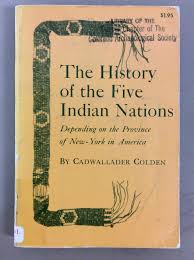
The Five Iroquois Nations

​This is a remarkable little book. It tells the very intimate story of the relationship between the Five Iroquois Nations of Western NY, the British and the French in 17th century colonial times. Written in 1727 and 1747 and often quoting first hand sources, makes it a very interesting  pre-confederation Canadian history read.

Covering the latter years of the Beaver Wars, 1663-1700, it starts and ends with interesting anecdotal facts:

–  the Iroquois or “longhouse people” were originally agricultural people raising corn, squash and beans, “the three sisters”.  Journeying north they were taught how to hunt and trap by the Algonquin peoples around Trois Riviere. On one of these early expeditions, the young Iroquois hunters faired very well outdoing their Algonquin hosts. In a fit of jealous rage the hosts murdered their visiting friends thus setting up a bitter war of retaliation that lasted almost 100 years.

– after peace was finally negotiated between the French and the Iroquois around 1700, there was an exchange of prisoners. Strangely enough most of the French and other native prisoners who were returned to Canada, freely chose to return to or remain with their Iroquois hosts for the rest of their days.

In between these bookends thousands of colonists, warring natives and indeed whole first nations were wiped out e.g., the Huron Nation in 1648, in an unrelenting series of attacks and brutal violence. The powerful Iroquois sought to become the middle men in the lucrative fur trade between the tribes near Lake Superior and the colonial powers in the east.  Although they greatly expanded their territory, they never quite succeeded as tribes further to the west took over once the Huron were gone..

The author spares no quarter in describing cannibalism and torture e.g., burning of prisoners alive that even the French succumbed to, to demoralize the other side. The British in Albany, always promising to come to the Iroquois aid in seeking to annihilate the French, never quite do setting the stage for the future abrogation of treaty rights that America became famous for. The Jesuits had a toe hold and counselled the Iroquois to break their relationship with the English in Albany. The Christian Mohawks in Caughnawaga near Montreal are called the “praying indians” and remained loyal to the French.

There are many detailed accounts of peace meetings between the Iroquois “sachems” or chiefs, the English and the French during which wampum belts and beaver pelts were laid down and gifted to signify honesty and commitment during negotiations. In the end. I was left with a sense of wonder and awe at the way the Five Nations conducted themselves with integrity throughout this violent period of our history.

I give it a 9 out of 10 rating and wished it were longer.


Leave a comment

Filed under Books, History

When the rivers meet in Spring

IMG_3106

Madawaska River flowing to join the Ottawa River

Arnprior has been our home since 2011.  We love the small town lifestyle because it is quiet and friendly and we can walk to almost everywhere in town.  There are many hiking trails and parks here, and the beautiful Galilee Centre for retreats and get togethers with friends and our Oblate community.   Arnprior has been in the news lately due to the record spring floods. Thought I would share a few photos from around town.

IMG_3100

Where these two rivers meet was flooded out

IMG_3113

Ottawa River at its first peak

IMG_3116

Sadly about a dozen houses where flooded

IMG_3112

Our house (right) on the Madawaska remained high and dry

The Ottawa has now subsided and things are getting back to normal as the massive cleanup proceeds.  People are searching for a reason why this happened (again) and what can be done to prevent it in future.  Certainly climate change is a plausible reason, but what is causing this change remains controversial.  I believe that we know implicitly that we are damaging the environment through our throw-away lifestyle and fossil fuel dependence and that we all must make changes to ensure our long term survival.

Arnprior has great recreational facilities e.g, hockey, swimming, library and lot’s of services for seniors.  On the short side for youth is a lack of local post secondary education facilities and not being able to find long term high paying employment opportunities.  Some complain that the shopping here is limited and statistics show there is a local shortage of nursing home beds.  We do have a great hospital and good medical care.  There are so many fundraisers it is hard to keep track.  There are many talented musicians, artists and trades people here and there are 4 local golf courses, a curling club, a bridge club, yoga studios, 10 churches, etc., etc.  It’s a great place to live, work, play and retire.

It is true that we are located on “unceded” Algonquin First Nation territory here (as is all Eastern Ontario).  However there is an agreement in principle with the Ontario Algonquin tribes to address this.  A treaty could be in place soon to address this historical shortcoming.  You can read more about this interesting development here.

IMG_3140

Samuel de Champlain canoed right by Arnprior in May 1613

IMG_3121

A morning dove is getting ready for summer in Arnprior

Cheers.  Have a great rest of Spring!


3 Comments

Filed under History

The Future Will Tell

Apart from the Jewish people, I know of no other race or nationality that have suffered more persecution, brutality, deceit and imposed immorality than the Polish people, yet have somehow they have overcome their indignities.  You might argue that black Africans, the Armenians or more recently the Rohinga, are being persecuted similarly, but the Poles have suffered for hundreds of years and they are still around!

Future

I found this gem of a book in my local library.  It is the memoir of an upper class Polish lady – Countess Maria Tarnovska.  It’s the story of her life in Europe during  WWI and in Poland during WWII.  She married a Polish diplomat, trained as a nurse and rose to be 2nd IC of the Red Cross in Warsaw during WW2.

The first part of the book is an enjoyable romp through the lives of diplomats living in the capitals of Europe just prior to WW1 – Madrid, Vienna, London, Oslo, Paris, Belgrade and Washington.  There are many delightful stories and anecdotes of what the people were like in each of these countries.  They had no sense of the impending darkness that was about to engulf them all.  Well connected, Maria even played bridge with England’s King Edward VII just before he died in 1910.  When WW1 broke out, she and her husband Adam returned to Poland where she served as a nurse in front line battlefields tending to injured soldiers.

She joined the Red Cross in between wars.  During WWII due to her many strengths and abilities, she became a key figure in the Polish Underground.  She recants in simple prose the overwhelming might of the German war machine that violated the treaty of non aggression and overran Poland in 3 days in August 1939.  Polish officers fled to Russia and were later secretly executed by the Bolsheviks because they were a political threat.

The Warsaw Uprising started 74 years ago today, and lasted for 63 glorious days until snuffed out by the soon to be defeated Germans.  The Russian army camped on the east bank of the Vistula  River failed to intervene on the side of the Polish fighters as they had promised.   Stalin had made a secret pact with Churchill and Roosevelt that Poland would be theirs as soon as the Germans were defeated.  15,000 resistanceFighters and as many as 200,000 civilians lost their life for nothing as it was never the intent of the Allies to allow Poland to become a free state again! What infamy!!!

So why did the Germans and the Russians hate the Poles so much?  They were hated for their strong (Catholic) faith and concept of freedom.  You could not convert a Pole or beat it out of them – the only way was extermination.  Maria makes a big distinction between the Wehrmacht – the unified armed forces of Nazi Germany and the Gestapo or SS police.  Wehrmacht Generals and soldiers were professionals who insisted on according the Polish people the rights that prisoners of war were due.  The Gestapo were hugs who delighted in the cruelest and vilest of indignities.  At one point the SS would round-up 100 people in the street and shoot them as surely a few of them were underground fighters.  It was the SS that ran the Concentration camps and implemented Hitler’s final solution for the Jews.

In all this Maria was never harmed herself.  She was imprisoned several times and after questioning, freed.  She must have had a commanding personality that enabled her to remain cool under pressure as she was connected with the Warsaw Underground at the highest of levels.  As a rep of the Red Cross, she took a direct part in negotiating the end of the Uprising and evacuation of Warsaw that followed.  She says no matter how vile the Germans were, the Communists were worse.  The Germans would inform the family when one of their members was imprisoned or executed.  The Communists after the war, would abduct dissenters in the middle of the night and the family would never know what happened.  A neighbour could snitch about something you said and you were gone.

The book is written in a gentle steadfast style without dwelling on death or violence.  She even forgave the Germans as the vast majority of them were good people who unfortunately fell under the spell of a madman when he told them that they were Gods. She is not as sympathetic to the Communists, many of who were Polish people with Russian names who fled to Russia and then returned to claim big government jobs in 1946.

Finally there is a Canadian connection to how this book came to life.  Written in the 50s in Brazil, the manuscript was held by the Tarnovska family for a generation until a relative living in Montreal undertook to get it published in 2016.  Wow, an amazingly fresh first hand story of what it was like to live in Warsaw with hope at a time when the darkest recesses of the human soul were on daily display. 9.5 out of 10 stars.

1 Comment

Filed under Books, History

Peter the Great

Peter the Great

I purchased this book in 1981 and finally got around to reading it.  Marie read it first and that motivated me. It is a great story of an amazing man and ruler.

Peter the Great was born in Moscow in 1672 and died in St. Petersburg in 1725.  He was almost 7 feet tall and had the life long curiosity of a young boy about all things, particularly boats and the sea.  He reigned for 42 years, first as Tsar and then as Emperor of All Russia.  Brutal in repressing dissent and with a temper, he was respected by his enemies and much-loved by his subjects.  He is seen today as being an enlightened despot – a precursor of rulers who came later such as Napoleon Bonaparte, Frederick the Great of Prussia and his own descendant, Catherine the Great.

Known as the Great Reformer, he modernized Russian society where all the land had been owned by the nobility and worked by serfs (unfree peasants) for centuries.  He did this by studying first hand (often incognito) in Holland, Germany and France, the technologies and techniques used to advance these nations e.g., boat design and building.  Then he would personally introduce these new ideas into Russia.  For example he:

  • adopted western dress in court society and required long beards to be shaven
  • modernized the army into a well-trained, lead and equipped fighting machine initially with imported foreign commanders
  • initiated Russian boat building, established the Russian Navy and opened up the Baltic and Black seas to maritime trade
  • defeating the mighty Sweden at Poltava in the Ukraine and delicately held the Ottoman empire at bay
  • built the magnificent city of Saint Petersburg – the Venice of the North on what had been vacant swamp land
  • modernized banking, currency, the justice system, foreign affairs, education and church administration
Peter rallying
Peter rallying Russia to victory over Sweden at the Battle of Poltava, 1709

This book reads like a novel and is a real page burner.  I particularly like how Robert Massie writes with complete command of the subject matter – his research is amazing.  He often branches down interesting side paths into the character and life of other key figures such as Charles XII of Sweden and George I of England.  There are a lot of details about the Great Northern War against Sweden but also much interesting  information about Peter’s relationship with his wife Catherine, his personality and the type of food and drink he liked (he was a prodigious drinker and eater).  The book is long at 850 pages and well illustrated with images and maps.

Russia Petertime
Russia in Peter’s Time

Prior to Peter’s time Russia was seen as a landlocked backwater and military laughing-stock of no import.  Thanks to Peter, Russia became a great power indeed as it is today.  However then as now, not many in the West fully understand Russia perhaps partially because of its geographic immenseness and location. Whenever Russia makes a move to protect her own interests, it is seen by many in the West as sinister and threatening to world peace.  I have more sympathy and respect for Russia and their history as a result of reading this fantastic biography.  I give it a 5 out of 5 rating.  It was a great way to prepare for an upcoming Baltic cruise!  Your comments are always welcome.

Peter 2


Leave a comment

Filed under Books, History