Having been raised Protestant and converting to Roman Catholicism some 22 years ago, I am still sometimes confused about certain terms and practices in my Catholic faith community. Take “vocations” for example.
As an Oblate Associate, one of the things I wonder sometimes is why I, a married person (happily to Marie) feel called to the Oblates, a consecrated religious community, as a lay associate. A good number of fellow lay associates are no longer or were never married it seems. Hence, it seems like it’s a non married group that I hang my hat with spiritually now. However, I likely overly generalize as their are indeed many married lay associates with the Oblates.
Roman Catholic monk and author Thomas Merton has something to say about this in his No Man is an Island. He says the “ordinary” way to holiness and the fullness of Christian life is marriage. Only a comparatively few are called to a consecrated life as a “special” way of sanctity. Most men and women he says will become saints through married life. Indeed, we are all called to love by God. Some live this love out through marriage. Some live this love out as religious or, as unmarried.
Many Christians often say “I have no vocation.” What a mistake says Merton! Married people have a wonderful vocation all the more wonderful because of the relative freedom and lack of of formality compared to a monastic or religious community call. Furthermore, navigating the marriage relationship and raising children in difficult circumstances often enables entering more deeply into the mystery of the divine, says Merton.
So I need not lament being married while attracted to the spirituality of a religious community. People who are single by choice or circumstance, can remember that Paul says he does not recommend marriage. Christ is coming back soon so no need. However if you must, get married, but it was not for him.
In the moment, it seems that God has provided us the gifts of a single life, a consecrated life (which may be single or married) and a married life. It is for us to choose as guided by the Holy Spirit how we want to live out God’s love. I am grateful for having had the choice and appreciative that the Holy Spirit has guided me to make what feels like the right “vocation” for me. What about you?
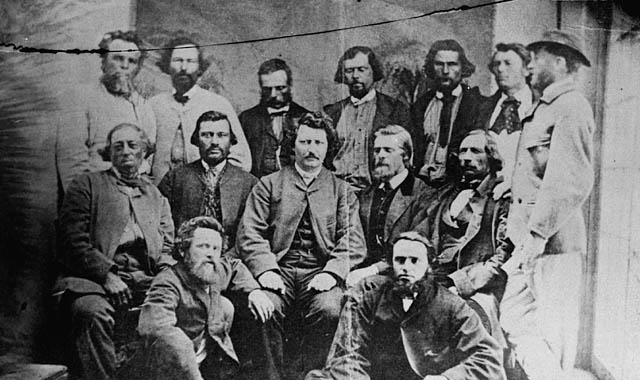
Louis Riel’s tomb in front of St. Boniface Cathedral
Métis leader Louis Riel is a controversial figure in Canadian history. Leader of the Red River and North-West Rebellions, he was executed for treason in 1885. We stumbled upon his grave site while walking from Winnipeg to St. Boniface over the Red River bridge. I wanted to learn more about him and his connection to the Oblates of Mary Immaculate.
First, a little about the Oblates in Manitoba. In June 1844, the Bishop of the North-West, Normand Provencher requested the help of the Oblates in evangelizing the Red River Colony (modern day St. Boniface). After 26 years of his trying, there was little to show. Most of the diocesan priests who came to the Red River mission soon returned to Quebec and the comforts of home. The Bishop wanted a religious order to establish itself locally to bring stability and progress to the mission of french Roman Catholics, Métis (French speaking mixed race of white European, Canadian and native descent) and the local Indian bands.
Initially somewhat hesitant, the Oblate Superior in Canada Fr. Guigues, was over ruled by St. Eugene de Mazenod the founder of the Order, who authorized sending Fr. Pierre Aubert and Brother Alexandre Taché to Red River in 1845. From 1845 to 1861, 20 Oblate priests, 8 brothers, and 2 secular priests who became Oblates were sent to the Red River missions. Brother Taché went on to be ordained and appointed the Bishop of St. Boniface in 1853. The Oblates in their missionary zeal went out to help found Manitoba, Saskatchewan and Alberta thanks to their tireless missionary efforts.
Louis Riel was born in 1844 in the Red River Settlement. His father, Louis Riel Sr., who was of Franco-Ojibwa Métis descent, had gained prominence in this community by organizing a group that challenged the Hudson Bay Company’s historical trade monopoly. Louis Sr. had enrolled briefly in an Oblate novitiate but withdrew. The Riels were noted for their devout Catholicism and strong family ties.
Young Louis was educated by the Oblates in St. Boniface. In 1858, Bishop Taché, OMI arranged for Louis to study in the Sulpician Order`s seminary in Montreal. Louis was known as a good student but one who suffered from unpredictable moodiness. Withdrawing from his religious studies in 1865, he spent time in Montreal, Chicago and St. Paul, MN before returning to St. Boniface in 1868. He soon became sympathetic to the Métis cause for independence. Both Canada and the U.S. were threatening annexation and there was no guarantee of language, cultural, property and political rights.
The Métis Provisional Government
After forming a group who used force to interrupt a Canadian land survey of their community, Louis was elected President of the Métis Provisional Government in 1869. After making good progress in negotiations with Ottawa, the execution by Riel of a local English speaking Fort Garry citizen, Thomas Scott for insubordination, drew the ire of Ottawa and the Protestant elite of Ontario.
The negotiated agreement enshrined the Métis demands and a list of rights which eventually formed the basis for the Manitoba Act of 12 May 1870 that formally admitted Manitoba into the Canadian confederation. However, the negotiators could not secure a general amnesty for the provisional government. A Canadian military expedition was dispatched to St. Boniface as an “errand of peace”. However, when Louis learned that they intended to lynch him, he fled to St. Joseph`s Mission in the Dakota territory of the U.S..
Louis returned to Canada after things cooled down and was elected as an Independent to Parliament in 1873. He was expelled and not permitted to take his seat until PM Alexandre MacKenzie secured an amnesty for him. While in exile, he spent his time with Oblate priests in Plattsburg, NY. It was then that he started suffering some megalomania, a narcissistic personailty disorder. He then spent time in an asylum in Quebec. He would pray for hours while standing, wrote many religious articles and started calling himself Louis “David” Riel, prophet of the new world.
After spending time in Montana and having a family he moved to Saskatchewan. A break with the church followed and he was barred from receiving the sacraments due to his increasing erratic behaviour. However, in 1884 he was to become the political and spiritual leader of the Métis Provisional Government of Saskatchewan. Known as the North-West Rebellion, the Métis and native forces led by Métis Gabriel Dumont were defeated at Batoche, SK in May 1885. A disheveled Riel also surrendered. He was tried and found guilty of treason in Regina. He was executed by hanging on November 16, 1885 after reconciling with the Catholic Church. He had rejected his lawyer`s advice to plead not guilty do to insanity. The jurors were all white protestants.
Riel is now regarded by some as a heroic freedom fighter who stood up for his people in the face of racist bigotry, and those who question his sanity still view him as an essentially honourable figure. His conviction was revoked by Parliament and he is regarded as a hero in Manitoba. Riel nevertheless presents an enigma. It is possible that Riel was both a murderer and a hero.
In the moment, I find Riel`s connection to the Oblates fascinating as they came to his spiritual rescue on several occasions in his life. I did not realize the extent of Riel`s religious activities and writings. He is indeed an enigma – a Canadian political figure who, greatly influenced by his Faith, stood up for the rights of the downtrodden Métis and native people against the prevailing racist and discriminatory attitudes of his times. That he mixed religion with politics and used force brought about his temporary downfall. I am glad he has been vindicated. The pattern of his life and later resurection is eerily Christ like. What about you?
I just finished reading Cross in the Wilderness by Kay Cronin. It is the story of the Missionary Oblates of Mary Immaculate opening up of the British Columbia wilderness in the 19th and 20th centuries. It was written in 1960 long before the term “cultural genocide” was applied to the way Canada treated its First Nations and related peoples with the residential school solution.
As an Oblate Associate, I wanted to learn more about what the Oblates actually did in yesteryear and today as missionaries to our First Nations, Deni and Inuit people. There is a lot of hand wringing and rewriting of history going on right now resulting from the imminent release of the Truth and Reconciliation Report June 2, 2015.
Well my conclusion is it was not all bad what the Oblates did. The Oblates starting around 1850 in Oregon and then moving north into B.C., founded “missions” to proclaim Christ’s kingdom and His good news. They baptized natives, taught them scripture and English or French, gave them the Eucharist, tended the sick, buried the dead and consoled the bereaved. Is this not what Christ did? The goal was to make responsible Christian citizens out of what were up until then the “children of the forest”.
In addition to chapels and churches, they built schools, hospitals and whole communities where none existed before in places like Mission, Williams Lake, Kamloops, Esquimalt and New Westminister. As well they ministered to the local white community which swelled after the gold rushes in the Cranbook and Chilcotin areas.
However in one section the book says that the Oblate priests and brothers brought the teachings of Christ and the elements of education to an ignorant, half-heathen and downtrodden race. Children sometimes were retained against their will to prevent them from leaving school. Often it was the European sense of cultural superiority at play more than the religious forces.
I was amazed at the number of buildings – schools, hospitals and churches were built by the Oblates. They even operated a successful ranch near Williams Lake for many years as well as farmed produce and meat in order to survive. They were known as “specialists in difficult missions” by the various Popes of the era involved.
It was only later that the Government in Canada got directly involved and tried to assimilate the natives by removing children from their families and forcing them to go to the residential boarding schools. They hired the various churches to run the schools. Abuses no doubt took place including the deaths of children due to disease and malnutrition. At one point there were 3000 active Oblates working across Canada in virtually every province. Today there are much fewer.
So what is one to believe. Some say this was “cultural genocide” – a human rights black mark against Canada based on what we consider now to be right. Others say not so fast, a lot of good work was done in teaching languages, manners, European dress, personal hygiene and the Christian faith. However separating kids from their families and expecting them to happily learn a new culture and reject their own cultural, and family roots seems at best, naive and at worst, a sinister experiment by today’s enlightened standards.
In the moment I say let’s not forget the good that these Oblates did in opening up the country and bringing civilization and humanitarian support to the natives for the first time. What do you say?
We met Fr Bernard Colgan, OMI for lunch today. He lives in Duque de Caxias a suburb in Rio. He is from Dublin and is helping to establish a new Parish in this bustling city. He has been in Brazil for 40 years and loves it.
He says there is a lot of violence like car jackings and drug related crime. However he has never been at risk. Brazilians are religious people and there is a long history. Religion was an integrating force since the Portuguese landed here in the 14th century.
The shortage here is in skilled professionals like accountants, engineers and dentists. Despite the corruption problems, Brazil has made progress in improving incomes, sanitary standards and transportation.
We gave Bernie some Canadian maple syrup. He has never been to Canada and did not know what it was. It was great meeting him and chatting about Brazil.
We are starting our 2nd cruise now. The clientele is a little younger. We got a free upgrade to a cabin with an extended balcony. Life is good. We are so reslaxed and thankful.